


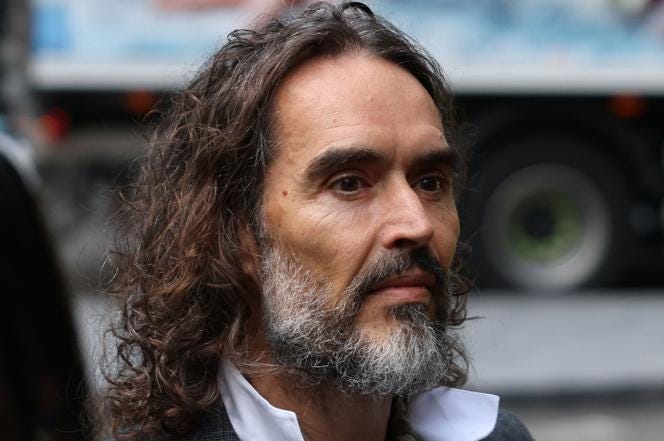
By now you’ve likely heard that actor and MAGA sycophant Russell Brand has been convicted of rape and sentenced to ten years in prison. Unsurprisingly, right wing pundits like Megyn Kelly are coming to his defense—literally whitewashing the abuse he committed. Every time I write a piece about how men systemically abuse women, my DMs explode with “Not All Men” complaints. I’ve written before on why this is a failed defense because it insists on centering men, rather than the women who face abuse and need men to stop committing and enabling abuse.
But a new study goes one step further, and demonstrates that empirically, statistically, and factually, it literally is all men. This is not hyperbole, but reality. Most men will stop reading at this point, knowing full well that the next few paragraphs will be deeply uncomfortable for them. For those men with the courage to admit men must do better and take responsibility, please read on. Let’s Address This.
“Not All Men”
I have addressed the “not all men” deflection before and I briefly address it again here: you do not get a cookie for not being a rapist. That is the floor of basic human decency, not an achievement worthy of recognition. The men who rush to announce their personal non-violence the moment this conversation begins are doing exactly what this culture has trained them to do—center themselves rather than confront the problem of male violence.
That makes you part of the problem, and that’s indefensible.
Because the data and facts show that unfortunately, horrifyingly, and tragically, it is all men. And the sooner we accept this harsh truth, the sooner we can address it.
Yes, It Is All Men
Lucia F. O’Sullivan and Scott T. Ronis of the Department of Psychology at the University of New Brunswick published a remarkably unique study on the male psychology as it relates to sex, coercion, and violence.
And while I link the full study above and encourage every man to read it, the abstract alone from this study is devastating. O’Sullivan and Ronis take an innovative approach to ensure men are honest about how they interact with women. Rather than asking men to confess openly about their intentions, they used anonymous surveys and a large sample size to account for potential variances. Men, therefore, opened up about their true intentions and interactions with women in ways they would not and do not when asked while identifying themselves. The abstract begins:
Few studies survey men who have remained undetected after engaging in acts of sexual aggression against women. Most survey women who were targets of sexual aggression or else survey men who consent to being identified.
Thus, O’Sullivan and Ronis aptly identify the problem with most surveys of men who target women, and the problem with surveys who ask women to share their experiences. Neither of those surveys truly get to the heart of what abusive men are thinking. Thus, the abstract explains how it solves this problem:
Using anonymous surveys of 2,689 U.S. and Canadian men (18–34 years), we aimed to assess rates of self-reported sexual aggression, reports of strategy effectiveness at forcing known reluctant women into sex, and men’s views of the circumstances, motivations, and positive and negative outcomes. Men reported occasions where they tried to get a woman to engage in sex that they knew she did not want and to which she had not consented.
Let me repeated this part: “Men reported occasions where they tried to get a woman to engage in sex that they knew she did not want and to which she had not consented.” And while marital rape is in fact rape, this survey specifically spoke to men who were not in a relationship with a woman prior to their attempts to sleep with her, adding:
The women were individuals with whom the men shared no prior romantic or sexual history.
Given this, the “not all men” crowd would have us believe that the number of men who tried to get a woman to engage in sex with them against her consent should be low—perhaps even in the single digits. They’ll have us believe that most men would never try to force a woman to engage in sex when they knew she had not consented. However, the O’Sullivan/Ronis study decimates this false hypothesis, reporting:
Overall, 95.1% reported having recently used at least one of the strategies to get a woman to have sex who they knew did not want sex and had not consented.
Let that sit for a minute. More than 95% of men, when asked anonymously, admitted to using a coercive strategy to force women to have sex when they knew she did not consent.
NINTY FIVE POINT ONE PERCENT!
Far from the “Not all men” mantra, the harsh reality that is virtually all men are guilty of predatory behavior. Now, you might wonder—what were those “strategies to get a woman to have sex” that the O’Sullivan/Ronis study cites? You can read all 36 questions at the link above, but I cite just the top 10 most common strategies here. Stop when you’ve engaged in any of these yourself, or know someone who has:
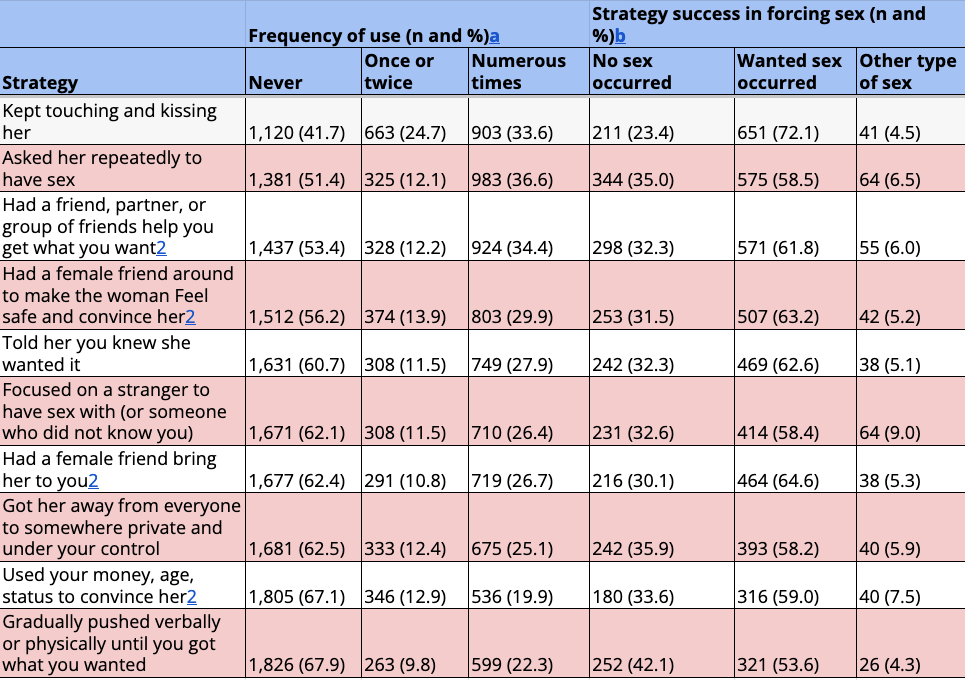
Towards the bottom of the 36 questions, at least 10% of men admit to moving beyond deception, and instead threatening or engaging in violence to coerce sex, i.e. commit rape. This study is especially powerful because it strips away the veneer of faux concern many men show to the systemic violence men impose upon women, and lays bare the harsh reality of what at least 95.1% of men think across the United States and Canada.
This study devastatingly puts to rest the “not all men” mantra—reasserting the question once more where it belongs—what are men going to do to stop this epidemic of male violence against women?
What This Means
Men: ask yourself the hard question—how many of those 36 coercive strategies are ones you’ve used? To how many did you say “yeah, I’ve done that before?” No one really knows but you. But deep down inside, you know. Now, what are you going to do about it?
Because for those wondering why women choose the bear—95.1% of men just showed why. According to the National Park Service, the chances of being killed by a bear are 1 in 2.1 million, and at most 1-2 people are killed annually by bears. Meanwhile, men kill at least 2400 women a year, every single year, that we know of. Meanwhile, up to 50 percent of women suffer rape and sexual assault at the hands of men, at some point in their lifetimes. Meanwhile, men arrogantly and cowardly defy all facts at hand and insist, “not all men.”
What Russell Brand exemplified with his rape and abuse of women is precisely what the aforementioned study confirms. Brand is not an aberration, but a manifestation of the systemic abuse men commit against women. Perhaps he engaged in more abuse than most men do, given his wealth, status, and fame. Irrespective of the reasons or of the extent, it is critical for men to understand what this study demonstrates. As I’ve written before—women are not safe around men, and indeed all men are responsible.
Yes, all men.
To the men who witness this violence, who know something is wrong, who have a friend or a brother or a colleague whose behavior they have excused or overlooked or rationalized away: it is your problem. It is absolutely, unequivocally, entirely your problem. Male violence does not survive without male silence. Every man who watches and says nothing is not a neutral bystander. He is a participant in a system that protects predators at the direct expense of survivors.
But I ask again—how many of you have used even one of the 36 coercive strategies documented in this horrifying O’Sullivan/Ronis study?
Get therapy. Do the internal work. Hold the men in your actual life accountable—not just the monsters in the headlines, but the ones at your dinner table, in your locker room, in your group chat, the one looking back in the mirror.
Refuse to be silent when you know something is wrong.
And if you somehow didn’t know before, now you know.
Conclusion
Half the world are women—all the world are her children.
A civilization in which 98% of rapists face no consequences, in which 95.1% of men force women to have sex with them, i.e. rape, and in which 90% of women murdered by men are killed by someone they knew—that civilization is not stable. It is not healthy. It is not just.
It is destroying itself.
The normalization of male violence against women is not a women’s problem that men can afford to ignore. It is a civilizational crisis created and enabled by men. Men, we built this. Which means men must dismantle it.
The solutions exist. The data is clear. The moral case is overwhelming. The only question remaining is whether enough men will choose accountability over ego, structural change over personal comfort, and the full humanity of women over the privilege of never having to think about this at all.
Choose correctly. The stakes for the future of human society could not be higher. And right now men, yes all men, are failing badly.
Qasim Rashid is a human rights attorney, author, and host of Let’s Address This, a platform dedicated to human rights, people-powered politics, and the accountability that corporate media refuses to deliver. Subscribe, share, and let’s remain relentless in our mission for a more perfect Union.
A reminder that this election week we are running a discounted subscription rate of $2.50/mo or $30/year. Your support makes our advocacy possible, so if in your budget, please do subscribe!
Rather than a monthly subscription, you can make a one-time contribution to support our human rights platform at any amount that fits your budget.
Saying "Not all men" and not confronting the rapey locker-room language and the culture that it spawns is no excuse.
Qasim, I think this is something men need to hear, even if it’s uncomfortable.
Too many are quick to get defensive instead of listening and acknowledging the problem.
Of course, not all men are perpetrators, but that doesn’t mean the rest of us can sit back and pretend we have no responsibility. We need to speak up, call out bad behavior, and stop making excuses for other men just because they’re our friends or colleagues. Just look at Junior’s defense of Brand.
The point isn’t to prove we’re one of the good guys. It’s to do our part to make things better. Women deserve to feel safe, and frankly, men need to be part of making that happen.
Thank you for taking the time to research this and bring attention to it.