


Consider this. What if I told you that the way our society tolerates dogs is simply unsustainable? For example, did you know:
Dogs violently attack 1 in 3 people at least once in a person’s life. Many people suffer multiple attacks.
Only ~2% of violent dogs face any reprimand whatsoever. Most roam freely to attack their next victim.
Annually, dogs kill ~2,400 people (that we know of).
And rather than hold dogs accountable, we constantly ask: what did you do to provoke the dog?
The data is clear: Dogs make people suffer a lifetime of trauma and death. How can we let this stand? We cannot. Now here’s the kicker. This article isn’t about dogs.
This is about men, rape, and women—and all of the above data about “dogs” is actually about men. And if you haven’t already seen what’s being revealed about Cornell University in real time, proceed with caution. Let’s Address This.

Women Are Not Safe Around Men
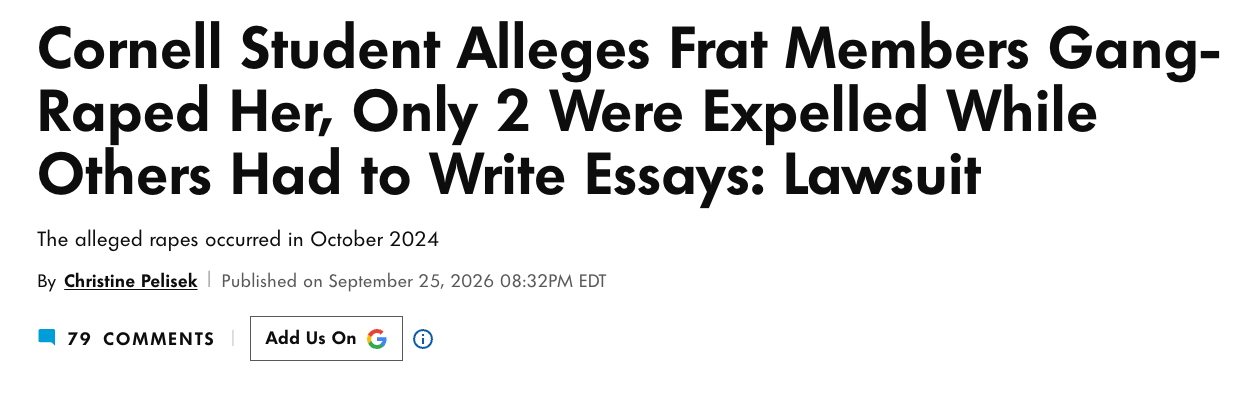
A few months ago I wrote an article titled “Women Are Not Safe Around Men.” I received hundreds of messages from angry men, screaming “Not all men!” Then a lawsuit dropped this week. A woman and former Cornell student reports that seven men at Cornell University fraternity drugged and gang-raped her for hours—then called their friends to come rape her too. Afterwards, she withdrew from Cornell.
The consequences for those seven men? Two were expelled. Five had to write a letter of apology. Zero faced criminal consequences.
The scariest part of all? This isn’t only a story about how seven men committed a horrific crime—but about how in addition to this revolting act, an entire social structure of men collaborated to absolve seven men of accountability.
What Happened at Cornell—And What Cornell Did About It
The facts are documented and damning.
Seven men allegedly drugged a woman, raped her for hours, and then sent a message boasting about “free pu**y” to their entire fraternity. And upon receiving that message, not a single man in that fraternity reported the crime to authorities. Not one called the police. Not one went to the administration. Not one chose to speak up for the woman being raped over loyalty to the fraternity he belonged to.
Seven men raped her. An entire fraternity received a message about it. Zero men reported it. The university did not pursue criminal charges. The District Attorney did not pursue criminal charges. Local law enforcement did not pursue criminal charges.
Men at every level of society failed her. They failed her that night. And they’ve failed her for the two years since.
And now, the victim is filing a lawsuit to defend her rights, because no one else will. I hope discovery pulls every email exchanged between the rapists, their parents, and university administration. I hope their apology essays are admitted into evidence. I hope every person who made the decision to let these men write letters instead of face consequences is named in the public record and held to account.
Speaking of, I looked up Cornell’s senior administration, and I was not surprised with what I found.
Who Made That Decision
Take a look at these 17 senior administration officials at Cornell University. Officials who undoubtedly played a decisive or leading role in determining the punishment for the seven men who are accused of committing rape. What do you notice?

Out of 17 senior administration officials at Cornell University, only 2 are women. This is not an accident. This is deliberate. This is what institutional power looks like when it is designed to protect itself.
And for those thinking that perhaps Cornell is slow to expel people, let me disabuse you of that notion? These are the same people who in 2024 suspended and removed four students from campus for peacefully protesting Israel’s genocide on Gaza.
Four students. Peaceful protest. Removed immediately.
In that same year, 2024, five students who repeatedly drugged and gang-raped a woman. Apology letters. Stayed on campus.
At Cornell University, it turns out that protesting genocide is a removable offense. But meanwhile, drugging, trafficking, and raping a woman is a writing assignment. Beyond reprehensible does not begin to cover it. FYI you can contact Cornell President Kotlikoff at (607) 255-5201 or via email at president@cornell.edu to express your opinions on his handling of this horrific event.
And here’s the truth—this problem is far worse than only Cornell University.
This Is Not Only a Cornell Problem. It Is a Systemic One.
Cornell is not an outlier. It is a mirror. And the breadth of stories are often buried. Consider that this victim suffered this horrific assault two years ago in 2024, and we’re only now hearing about it because she had the courage to speak up and file a lawsuit.
How many more cases are shrouded under layers of intimidation, bureaucracy, and lack of resources to hold rapists accountable?
According to the National Sexual Violence Resource Center, among college women, nine out of ten victims of sexual assault knew the person who sexually assaulted them. That is precisely what happened at Cornell. The woman who was raped was invited by a male friend—who then allegedly helped drug and rape her.
Whether his actions were premeditated or spontaneous is irrelevant to the abuse he enabled, and the protection he’s since enjoyed.
Universities are meant to build up young people and prepare them for the future. But in the United States, instead, the four to five years that women spend in university are some of the most dangerous years of their lives. In a nationally representative survey of adults, 34.4% of female rape victims were first raped between the ages of 18 and 24. These are the precise years most women spend on college campuses at institutions like Cornell—institutions that are demonstrating they will protect their male students over their female ones.
And this connects directly to the data I laid out in my previous piece. According to the Violence Policy Center’s landmark study When Men Murder Women, of the more than 2,400 females killed by males in 2023, 89.9% knew their killer. Nine out of ten. The threat is not the stranger. The threat is the man she trusted—the friend, the classmate, the fraternity brother who sent her an invitation.
Moreover, per RAINN, 98% of men who commit rape will never spend a single day in prison. The two Cornell men who only faced expulsion demonstrate this injustice. The five others who only had to write apology letters are likewise part of that statistic. All seven are walking free without a care in the world. The criminal justice system was not designed to protect women from men. It is not broken, but instead, it was designed by men, run by men, and it has functioned precisely as designed. And that’s the problem.
A Word on the Men Who Said “Not All Men”
Take note, whenever women point out all men need to do more to stop the abuse of women, inevitably some men respond “NOT ALL MEN!” Let me be clear—those men are confessing and should be treated accordingly. Men who center themselves over the women suffering abuse are telling on themselves. Believe them.
Because you do not get a cookie for not being a rapist. That is the floor of basic human decency—not an achievement, not a defense, and not a contribution to this conversation. The men who rush to announce their personal non-violence the moment that women cite the epidemic rate of violence men commit against women are doing exactly what this culture trained them to do: center themselves rather than confront the problem.
Here is the problem: not one man in that fraternity reported what was happening to a woman being drugged and raped down the hall. Not one. That is “not all men”—in practice. Male violence does not survive without male silence. Every man who watches and says nothing is not a neutral bystander. He is a participant in a system that protects predators at the direct expense of survivors.
Conclusion
I’ve said it before and it bears repeating. A civilization in which one in three women are sexually assaulted, in which 98% of rapists face no consequences, in which nine out of ten women murdered by men are killed by someone they trusted—that civilization is not stable. It is not healthy. It is not just. It is destroying itself.
Men of integrity should be humiliated by the fact that in our modern age, women are not safe around men. Period. Full stop. This is not my opinion. This is not a lazy generalization born of bias. It is a documented, data-driven, legally and empirically supported fact that our society has spent generations refusing to confront with the seriousness it demands.
Cornell is showing us—again and in real time—exactly what that refusal costs.
The question is whether men will let that humiliation consume us, or command us to act? Men, we built this. Which means men must dismantle it. The solutions exist. The data is clear. The moral case is overwhelming. The only question remaining is whether enough men will choose accountability over ego, structural change over comfort, and the full humanity of women over the privilege of never having to think about this at all.
It’s easy for men to separate ourselves from the men in that fraternity who received a text proclaiming “free pu**y.” We’d never stay silent if we got that text, right?
I need men to act with the urgency as if they got that text, because for all intents and purposes, the data shows that if you know at least three women in your life, at least one has suffered sexual assault. You’ve received that text, whether you want to admit it or not. The question is, what are you going to do about it?
Qasim Rashid is a human rights attorney, author, and host of Let’s Address This — a platform dedicated to human rights, accountability, and the justice our society demands. Subscribe, share, and let’s remain relentless in our mission for a more perfect Union.

Rather than a monthly subscription, you can make a one-time contribution to support our human rights platform at any amount that fits your budget.
I don't usually like men talking to women about rape. Few men understand what it is and what it does. Just like I don't explain men's issues to men. I really can't understand. This was handled very respectfully in this article and I appreciate that it may reach a man who hasn't been properly taught, or thinks it's not his issue.
What I think is the worst part of this (although there are several bad parts) is that this one instance is getting the attention it deserves while there are probably TONS of similar cases across tons of universities. As this article expresses, this is a much broader systemic issue. Cornell did not punish the seven men in proportion to the harm they committed.