


Throughout Zohran Mamdani’s historic run to become New York City’s Mayor, and thus New York City’s first Muslim American mayor, the right has constantly demonized him as wanting to “enforce Shariah Law.” Now that Mayor Elect Mamdani’s victory is certified, “Shariah Law” is apparently about to consume the Big Apple. That is, if the right wing pundits are to be believed. So, as a human rights lawyer and as an observant Muslim, let me set the record straight—there will be no Shariah Law taking over New York City…inshaAllah.
But in all seriousness, to combat the anti-Muslim and Islamophobic disinformation campaigns from the right (and unfortunately from the left) I launched an Islam Today newsletter right here on Substack. On Islam Today, I’ve previously written in detail explaining what Islamic Shariah is, and is not. Feel free to take a moment to read through here for yourself. (And subscribe if you fancy education on Islam).
But now that we have a historic first Muslim mayor of New York City, I figure it is an interesting thought exercise to consider what would “Shariah New York” actually look like? I don’t mean the draconian legislation we see in theocracies like Iran or Saudi Arabia. I mean the actual principles of Shariah as I explain in the article above? I feel it necessary to write this to arm you with the knowledge needed to rebuke the forthcoming onslaught of Islamophobic disinformation and hate. So, with that premise in mind, here are five things that would change if actual Islamic Shariah principles were applied in New York City. Let’s Address This.
1. Wealth Tax on Stagnant Resources
Zohran ran on a platform of affordability, and combatting wealth and income inequality. The Islamic economic system addresses these ills by taxing stagnant wealth, and condemning the hoarding of wealth. Accordingly, a standard 2.5% Zakat (tax) is applied to all wealth that sits unused. Wealthy people can avoid this tax if they spend money and keep it circulating in the economy. Doing so ignites small business growth, infrastructure build out, or increased wages—which in turn continue to ignite the economy and combat poverty. And to be sure, this is not a tax on income (like Mamdani’s proposed 2% tax on millionaires). This is a tax on the tens of trillions the super wealthy hoard while working people suffer and starve. The wealthy can avoid this tax altogether by simply spending their resources to drive forward the economy, rather than sitting on mountains of wealth that they grow through compound interest. Speaking of interest, let’s move to point two.
2. No More Interest
Islamic Shariah forbids interest because it exploits low income people and makes the wealthy even wealthier (without doing any actual work). Money itself has no utility. It isn’t food, or water, or housing. Thus, like the Old Testament, the Qur’an forbids usury and interest. Islamic Shariah instead encourages mutual partnerships for meaningful investments. This is critical because it forces the lender and the borrower to mutually collaborate on projects, rather than forcing the entire risk onto the borrower. Now, rather than interest, the lender earns money by investing and profiting off an innovative invention or business idea, just as does the borrower. If the idea fails, then both lender and borrower share that risk—as opposed to the current model where the entire risk rests on the borrower, who then suffers under compound interest debt.
3. Basic Necessities are Human Rights
Zohran wants city run grocery stores, free child care, and free busses. These are necessities in the modern day. Under Islamic Shariah, food, water, shelter, healthcare, education, and clothing are all guaranteed human rights, because they are all necessities for a person to live. Thus, Islamic Shariah mandates each of these as human rights that the government must provide to prevent exploitation and poverty. To be sure, Islamic Shariah encourages people to attain wealth and become wealthy through business, innovation, invention, and progress—and to be rewarded for the hard work they invest to build industry. However, Islamic Shariah forbids exploiting basic humanitarian needs as the vehicle by which one attains wealth. For example, in a city truly run under Islamic Shariah, insulin would be sold at cost or for a nominal profit, not at upwards of $12,000 a year as it is currently, as that is exploitation of medication people need to live. This principle to uphold access to human rights matches quite well with Mamdani’s message of affordability and human dignity.
4. Universal Basic Income
Under a New York Shariah City, Universal Basic Income would be enacted. Khalif Umar bin Khattab revolutionized the economic system of society by enacting UBI for all newborns. This elevated countless people out of poverty and ignited business and innovation. Contemporary studies have demonstrated how powerful this economic model truly is to combat wealth and income inequality, lift people out of poverty, decrease crime and depression, and increase life expectancy. In fact, the United States under President Nixon was mere votes away from enacting UBI—only to be foiled by conservatives who fabricated a study to claim that female economic independence would destroy households. Who knows, perhaps after achieving his campaign promises in his first term, Mayor Mamdani may run for reelection on the promise of enacting UBI.
5. Separation of religion and state.
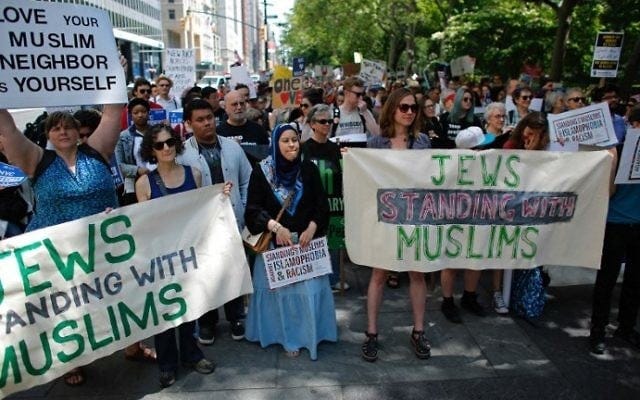
Yep, contrary to what we see in nations like Iran and Saudi Arabia, Islamic Shariah champions religion and state separation. In fact, when Prophet Muhammad (sa) established the Charter of Medina he exemplified the Qur’anic teaching of secular governance. The Charter of Medina condemned antisemitism, championed religious freedom, and forged a secular alliance between Muslims and Jews to stand united and protect the City-State of Medina against external attacks. I thought of this alliance as I saw Zohran Mamdani and Brad Lander stand united as a Muslim and Jew against injustice. Therefore, if Islamic Shariah were to be followed under a Mamdani administration, no theocratic zealots would be allowed to mix religion and state in New York City government. Truly a win-win for all New Yorkers.
Note the Hypocrisy
The hypocrisy in all this is, of course, the loudest voices fearmongering about “Shariah law taking over” are themselves mostly Christian nationalists who want Christian theocracy to take over. The lack of self awareness notwithstanding, and the projection from Christian nationalists notwithstanding—it’s critical to me that my readers understand what Islamic Shariah actually entails. While the above five examples are by no means comprehensive, I hope read this strengthened your understanding of Islamic Shariah. And I hope you see with even more clarity, the absurdity and vacuousness of the attacks on Zohran Mamdani for his faith.
Conclusion
This isn’t comprehensive, but it’s deeply instructive of two things.
First, our nation’s First Amendment remains one of humanity’s greatest achievements—protecting every person’s right to faith, expression, and conscience, and ensuring separation of religion and state. And second, at the heart of every true Islamic Shariah principle lies the same moral anchor that built democracy itself: absolute justice.
Justice in how we treat the poor, in how we govern, and in how we value human dignity above profit. The irony, of course, is that what extremists fear most about “Shariah law” are the very ethics all scriptures teach—compassion, equity, and accountability for power.
So, if “Shariah New York” means taxing stagnant wealth, banning exploitation, guaranteeing food and healthcare, and ensuring freedom of belief—then perhaps America could use a bit more of it. Because justice, after all, isn’t foreign. It’s the foundation of every great civilization—and it’s time we practiced it again.
Qasim, another point worth making is the respect for reading and writing throughout Islam. When a culture reveres reading and literacy it has usually acquired a tremendously useful knowledge base that it is trying to preserve and pass on to future generations so they don't have to reinvent the wheel.
ThankYou.
I’ve thought this from the beginning, but it seemed facile to say: it’s lovely to have a political figure with such a happy face.