


This is an actual email I received from what I can only assume is a real live human.
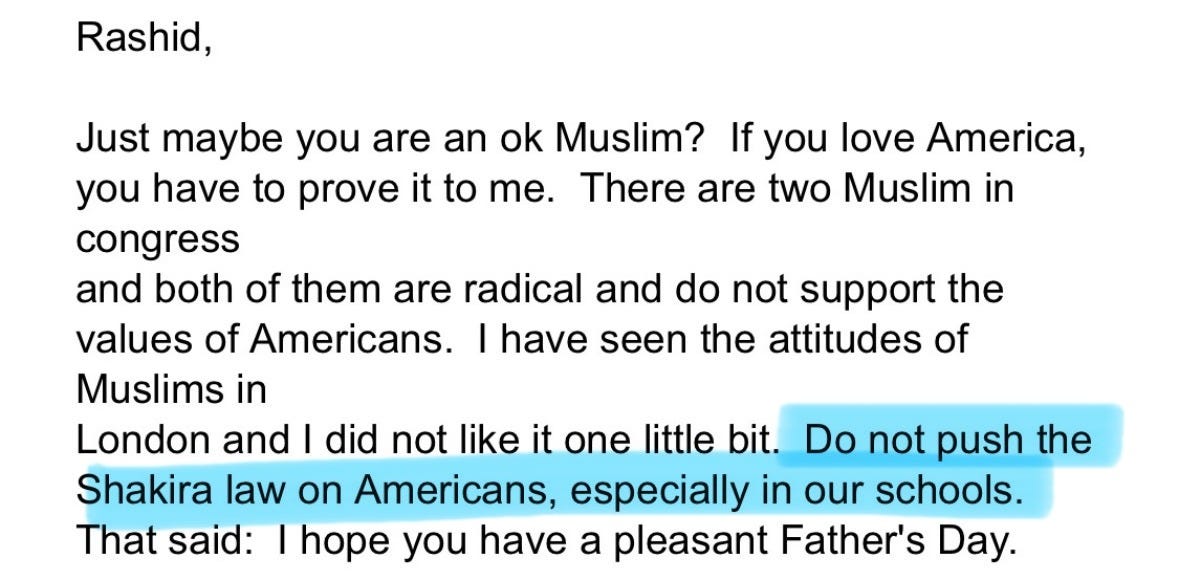
There’s a lot to unpack here, but I’m sharing it with you to warn about the impending threat of Shakira law on Americans. And while I can promise I personally will never push Shakira law on Americans, especially in our schools, the fact is, hips don’t lie.
Also, at least he wished me a pleasant Father’s Day.
In all seriousness, as I wrote last year, with the election win of Zohran Mamdani, anti-Muslim hate and Islamophobia is skyrocketing. If you’ve turned on your television or seen any political ads from the right, you have no doubt heard about the “dangers” of “Shariah Law.” Apparently, it is taking over, will enslave us all, and pretty soon we’ll be the United States of Islamerica. (Came up with that on my own, you’re welcome).
Except, this is all nonsense, peddled by political opportunists to divide, distract, demonize, and dehumanize. To arm you with the knowledge to wage an intellectual Jihad of the Pen against that fear mongering and disinformation, I’ve written this piece below on what Shariah is, and is not. I hope you use this information to combat the hate you’re seeing online, in your city council meetings, and when engaging with your elected officials. As always, I welcome your questions in the comments.
Let’s Address This.
1. What does Shariah mean?
First, let’s start with the basics. The general meaning of the word “shariah” is “law.” So when you hear people scream “Shariah Law” they’re screaming Law Law. It’s like chai tea or naan bread. And while naan is delicious, screaming “Shariah Law” is nonsense and speaks to the ignorance abounding.
The proper usage of the term is to say “Islamic Shariah.” You could just as easily say Christian Shariah or Jewish Shariah (more on that below).
Islamic Shariah is the law of the Qur’an and the word shariah literally means “A path to life giving water.” In fact, the word Yarrah (i.e. the root of the Hebrew word Torah) means precisely the same thing. Therefore, the concept of Shariah is actually ingrained in Abrahamic tradition. Now, Shariah is comprised of five main branches, and it’s the fifth branch that right wing provocateurs are up in arms about (though I doubt they even know that Islamic Shariah is comprised of five main branches). In any case, these branches are as follows:
adab (behavior, morals and manners)
ibadah (ritual worship)
i’tiqadat (beliefs)
mu’amalat (transactions and contracts), and
‘uqubat (punishments).
These branches combine to create a society based on justice, pluralism and equity for every member of that society. Does this mean Islamic theocracy? Categorically no. Islamic Shariah forbids that it be imposed on any person. Islam’s founder, Prophet Muhammad (sa), demonstrated that Shariah may only be applied if people willingly apply it to themselves—never through forced government implementation. Thus Islamic Shariah specifically rejects theocracy. In fact, when Prophet Muhammad (sa) migrated to Medina and built an alliance with the many Jewish tribes of Medina, he was unanimously decided as the Head of State of Medina. If Islam mandated, or even taught, theocratic rule, this was the moment when to implement an Islamic theocracy. Instead, he drafted the Charter of Medina, a secular governing constitution that established separation of religion and state, condemned antisemitism in clear terms, and recognized the equality in rights, humanity, and protections of Jews, Muslims, and all people residing in Medina.
Side Note: What does the “sa” after Muhammad (sa) mean? I explain here.
Thus, history records that in his very first opportunity to secure worldly power, the Prophet Muhammad (sa) instead held himself subservient to a secular constitution and rejected theocratic rule. A decade later Prophet Muhammad (sa) would again achieve even greater power in Mecca, and history attests to his just and magnanimous response then. (More on that shortly).
Additionally, the Qur’an does not promote any specific form of government, but requires that the form people choose must be based on adl or “absolute justice.” The Qur’an says, “Verily, Allah enjoins justice, and the doing of good to others; and giving like kindred; and forbids indecency and manifest evil and transgression. He admonishes you that you may take heed“ (16:91). Notice, religious preference is never mentioned. Likewise the Qur’an declares, “Verily, Allah commands you to make over the trusts to those entitled to them, and that, when you judge between men, you judge with justice.” (4:59). Again, while specifically citing entrusting people with power, i.e. leadership, and judging people on their actions—the standard provided is not a religious standard, but the secular standard of absolute justice. The Qur’an repeats this theme throughout the entire book, all while contrasting with the declaration, “There shall be no compulsion in religion.” (2:257). And, “‘For you your religion, and for me my religion.’” (109:7). And many more like this. The Qur’an could not be more clear that its religious teachings are a personal moral standard, and the public law of the land must be built on secular governance and absolute justice.
This principle transcends religion, time, and place. Therefore, for example, in ruling with absolute justice, the righteous Jewish King Solomon ruled as a just monarch based on this fundamental principle of Islamic Shariah—justice. The United States Constitution, written largely by deists, calls for equal justice under the law for all people in this country, regardless of faith, color, creed, or status—again based on this fundamental principle of Islamic Shariah—justice.
Finally, right wing provocateurs cite the ‘uqubat (punishments) branch of Islamic shariah to paint an often horrifying picture of what will happen “once shariah takes over.” Horrid descriptions of stoning for adultery, death for apostasy, and bans on speech. Notwithstanding that each of these injustices are categorically condemned in Islamic teaching, whatever the ‘uqubat (punishments) branch of Islamic shariah teaches—none of them would ever apply in the United States. Why? For two simple reasons that I will repeat again and again. One, Islam condemns theocracy and its teachings can never be imposed on any person. And two, the United States Constitution has the Supremacy Clause which ensures its laws on public discourse and accountability remain the supreme law of the land, forever and always.
Again, when Prophet Muhammad (sa) was the Head of State of Medina, he refused to enforce Islamic teachings on the residents of Medina, and instead established the Charter of Medina. This is history. This is fact. This is the separation of religion and state that Islam mandates.
For those interested in a 50-page academic peer reviewed publication on Islamic Shariah, your wish is granted. I published my law school thesis on the right wing attempts to “ban shariah law” way back in 2012. Yes, this contemporary fear mongering is regurgitation of the hate that spread around the 10 year anniversary of 9/11. You can read that academic publication for free here. And if you prefer the cliffs notes version, please keep reading below.
2. Do Muslims want Shariah to rule America?
The next claim we constantly hear is that Americans who are Muslim are running for office and getting elected to “enforce Shariah Law.”
This is patently false.
Americans who are Muslim are running as civically engaged citizens, taking a sworn oath to uphold the US Constitution, and delivering for the American people writ large.
Remember, the Qur’an teaches that religion must not be a matter of the state. Shariah is a person’s personal relationship with God. Prophet Muhammad (sa), even as the de facto ruler of Medina, ratified the Charter of Medina in which Muslims were held to Shariah, and Jews to the Law of the Torah. Not a single non-Muslim was held to Shariah because Shariah itself forbids compulsion. Again, the Qur’an clearly says, “There is no compulsion in religion“ (2:257).
Furthermore, Islamic Shariah obliges Muslims to be loyal to their nation of residence and specifically condemns creating disruption and discord or violating the laws of the land. Therefore, American Muslims must adhere to the U.S. Constitution as the supreme law of the land—exactly as the Supremacy Clause of the US Constitution requires.
3. If Muslims don’t want Shariah to rule the United States, then so what if it’s banned?
Because doing so would violate the US Constitution, and would furthermore put all Americans of faith at risk. In fact, banning any religion would hasten fascism in the United States, and that’s something every person in this country should find repulsive.
First, remember that Islamic Shariah is a personal relationship between a Muslim and God. The First Amendment forbids Congress from passing laws that restrict the free exercise of religion—particularly private exercise. Flat out banning Islam or banning Americans from the private practice of Islam would be a direct violation of our First Amendment
Second, if Shariah was banned, then what exactly are we banning? It would mean that Americans who are Muslim could not marry, inherit, write wills or choose to divorce per Islamic guidelines. Islamic Shariah teaches Muslims not to drink alcohol or eat pork. Would banning Islamic Shariah force us to now drink alcohol or eat pork? See how ridiculous this thought exercise becomes? And moreover, if similar restrictions were imposed for other faith groups, then no Minister could conduct a marriage ceremony, no Catholic Bishop could read the last rites, and no Rabbi could perform circumcision on an infant male Jewish child—because these are all Christian and Jewish religious laws, respectively.
Right now within our current legal system, American Jews regularly resolve civil matters through rabbinical courts known as beit din. American Muslims simply want to enjoy their same constitutionally guaranteed right. Our First Amendment exists to protect these rights to worship and practice for people of all faiths (and no faith). Ban one, you open the door to banning them all. That’s fascism, and I cannot think of anything more dangerous to the United States than that.
4. What does Shariah say about other religions?
Next, critics claim that Islam wants to “violently dominates the world through force.” If you’ve read this far, you’ve likely concluded such a claim is nonsense. But moreover, the Qur’an goes out of its way to emphatically protect all faiths and people from oppression of any kind.
Islamic Shariah specifically and repeatedly champions absolute freedom of conscience and freedom of religion. For example, the Qur’an goes as far as to oblige Muslims to fight on behalf of Jews, Christians and people of other faiths and to protect their churches, synagogues and temples from attack. (22:41). I’m not infusing my interpretation. The Qur’an specifically mentions churches, synagogues, and temples and commands Muslims to fight those extremists who attack them.
Furthermore, Shariah holds that to be a Muslim, a person must testify to the truth of all past prophets, including Jesus, Moses, Abraham, Krishna, and Buddha—and must respect their adherents. Anyone with common sense can see that it would make no sense for Muslims to celebrate and praise past prophets, and then seek to ban those who likewise celebrate and praise them. On the contrary, Muslims are called to champion religious pluralism. And under secular governance, such religious pluralism is not only possible but protected, as it ensures universal freedom of conscience for people of all faiths and no faith.
Finally, in 630 when Prophet Muhammad (sa) returned to Mecca and peacefully became the ruler of Arabia, his primary condition for non-Muslims (and Muslims) to reside in Arabia was that they allow all people of all faiths—be they Jews, Christians, Muslims or idol worshipers—to worship in peace and without oppression. And this is not theory, nor my opinion, but documented history.
For example, the highly respected 19th century British historian Stanley Lane Poole describes the situation upon Prophet Muhammad’s (sa) triumphant return to Mecca, after two decades of exile, as follows:
“But what is this? Is there no blood in the streets? Where are the bodies of the thousands that have been butchered? Facts are hard things; and it is a fact that the day of Muhammad’s greatest triumph over his enemies was also the day of his grandest victory over himself. He freely forgave the Kureysh all the years of sorrow and cruel scorn they had inflicted on him; he gave an amnesty to the whole population of Makkah. Four criminals whom justice condemned, made up Muhammad’s proscription list; no house was robbed, no woman insulted. It was thus that Muhammad entered again his native city. Through all the annals of conquest, there is no triumphant entry like unto this one.” (Lane Poole, quoted in introduction to Higgins’ Apology for Mohammad pp ixxi)
Likewise, another well known 19th century scholar Reginald Bosworth Smith writes in his his landmark book “Muhammad and Muhammadism”:
“Now would have been the moment to gratify his ambition, to satiate his lust, to get his revenge. Read the account of Muhammad’s entry into Makkah along with the account of Marius Sulla as he entered Rome, one would be in a position to recognize the magnanimity and moderation of the Prophet of Arabia. There were no proscription lists, no plunder, no wanton revenge. From a helpless orphan to the ruler of a big country was a great transition; yet the Holy Prophet retained the nobility of his character under all circumstances”.
I can cite scholar after scholar, but I’ll end with just one more for the sake of brevity. World renowned historian Sir William Muir writes on page 513 of his biography on Prophet Muhammad (sa), “Life of Mahomet” as follows:
“The long and obstinate struggle against his pretentions maintained by the inhabitants of Makkah might have induced its conqueror to mark his indignation in indelible traces of fire and blood. But Muhammad, excepting a few criminals, granted a universal pardon; and, nobly casting into oblivion the memory of the past, with all its mockery, its affronts and persecution, he treated even the foremost of his opponents with a gracious and even friendly consideration”.
This is how Prophet Muhammad (sa) treated those who exiled him, killed his companions, and killed his children and grandchildren. Beyond mere justice, this is a level of grace unmatched in world history. Think about how these historians—all of whom are non-Muslim might I add—are describing Prophet Muhammad (sa) when he attained power? And contrast that to the disinformation and demonization you see in the media today? These actual academics attest that no house was robbed, no plunder, no mass punishment—even that the integrity of women was protected and no woman was insulted. This is the man and religion that right wing provocateurs want you to fear. Documented history paints a very different picture—one of compassion, freedom of conscience, and absolute justice.
5. What about countries that oppress people and claim they follow Shariah?
So if all of what I have said above about Islam and Prophet Muhammad (sa) is true, why do we have theocracies in Iran, Saudi Arabia, and Afghanistan? This is a valid question.
Here’s the truth. Such countries exist as theocracies not by following Islamic teachings, but by opposing them. They have ignored the fundamental tenet of justice inherent in Islamic Shariah, and have instead used Shariah as an excuse to gain power and sanction religious extremism. It’s likewise important to understand that these nations don’t exist in a vacuum. The US Government continues to protect and uphold the dictatorship in Saudi Arabia. US interventionism funded the Mujahideen of Afghanistan, who now rule as the Taliban. That US and UK overthrowing the democratically elected President of Iran in 1953 set it on a collision course for what we now see today in the IRGC. This is not to absolve the leaderships of any of these nations for their injustices, but instead to demonstrate that these injustices did not come about because of Islam itself, but due to a myriad of forces that violated the fundamental tenet of justice and human rights. A combination of western interventionism, unlimited oil money, and propped up dictatorships have caused these current atrocities, and it would be foolish to ignore that. Consider that the world’s largest Muslim majority nation, Indonesia, while far from perfect, is nothing that anyone could describe as an oppressive dictatorship.
To be sure, not a single example of a “Shariah compliant” country exists. In fact, I would go as far as to argue that the most “Muslim country” in the world is likely the United States, because our US Constitution guarantees freedom of religion, freedom of speech, freedom of expression, freedom of thought, and secular governance—all built on absolute justice for all people. This commitment to absolute justice is the hallmark of Islamic Shariah. Those nations that oppress in the name of Islamic Shariah are as justified in their claims, as “Christian” enslavers who claimed their right to enslave Black people was based on the Bible, or the right to commit genocide of Indigenous Peoples was because God “ordained” it.
As for the “violent” verses from the Qur’an that are cited by extremists and critics alike—honest legal interpretation abhors quoting an excerpt as a means to understand the full law. For those interested in understanding the alleged “violent verses,” I have written a detailed article on my Islam Today platform—no paywall. You can read that article here, and it will make clear that the alleged “violent verses” are in fact a guidance on self defense and protecting universal freedom of conscience for people of all faiths and no faith against the onslaught of extremists.
In sum, Islamic Shariah guides a Muslim’s personal relationship with God, just as the Old and New Testaments respectively guide Jews and Christians in their personal relationships with God. These paths to life-giving water are nothing to fear.
Conclusion
Thank you for taking the time to read this essay. If nothing else, I hope it serves as a reminder that fear and ignorance are often louder than truth—but that doesn’t make them right. The truth is, Islamic Shariah—like Jewish Halacha and Catholic Canon law—is deeply personal. It is not a political agenda or a looming threat. It is a spiritual path rooted in our humanity, justice, compassion, and humility. And as history shows with the past systemic demonization of Catholics, Mormons, and Jews, weaponizing someone else’s faith for personal political gain is nothing new in the United States—but it’s always dangerous.
It is important we all understand that when bigots use disinformation tactics to smear Islamic Shariah and stoke fear, they’re not just attacking Muslims—they are in fact undermining religious freedom for everyone. That is why it is critical we all stand united against this religious discrimination. And that’s why I ask you to join me—not in fear, but in solidarity. Not because you’re Muslim, but because you see me and my fellow Muslims as your neighbors and equal humans. That unity against fascism is how we not only survive, but thrive as a nation.
In closing, I can promise everyone reading this that ‘Shariah Law’ will never ‘take over’ America—but I make no such promises about Shakira Law.
Share this with someone who may need it. And if you’re able, become a subscriber to support our work dismantling disinformation and building bridges of truth.
We’ve got work to do. Let’s get to it.
Qasim Rashid is a human rights attorney, author, and host of Let’s Address This—a platform dedicated to human rights, accountability, and the fight against the disinformation and hate that corporate media refuses to name. Subscribe, share, and let’s remain relentless in our mission for a more perfect Union.
REMINDER: You can make a one-time contribution to support our human rights platform at any amount that fits your budget.
It's all so weak isn't it? I keep coming across that same characteristic in so many strands of what the Trump administration is doing.
I mean all you have to do is a quick online search (preferably with a moderately clean search engine) and the facts are there, though not as nicely laid out as Qasim has provided them.
Germans in the 30s did not have access to the sum of almost all human knowledge available to them at the reach of a couple of clicks.
It's quite clear that those who believe the disinformation and misinformation do so as a choice. Because they're racists. That's what it all boils down to.
Shakira law on the other hand... that sounds a bit dodgy to me!
Thank you, Qasim, for this in-depth explanation that we can use when having to talk with ignorant family members who like to fear monger. I’m definitely saving this article.