


For many Americans, today is Thanksgiving Day. A time to reflect on family, friendships, and what we are grateful for. For many Indigenous Peoples, today is not a day of celebration, but a day of mourning. In fact, it is recognized as The National Day of Mourning, and it is critical we understand why. Let’s Address This.
What Is The National Day of Mourning?
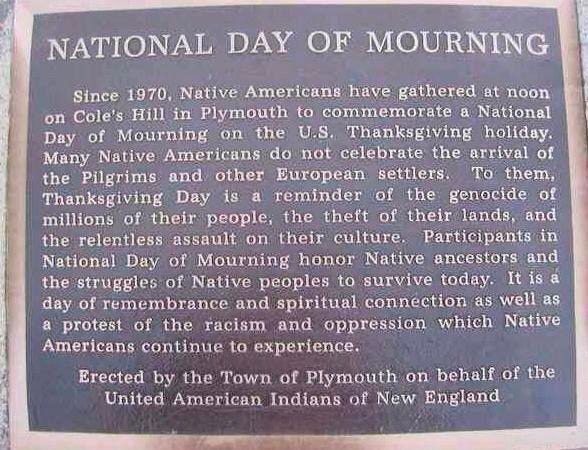
To get straight to the point, this plaque posted in the Town of Plymouth on behalf of the United American Indians of New England explains it with brevity and clarity.
European colonization ignited a mass genocide of Native Americans. A genocide so severe, that notwithstanding the inconceivable human impact, it literally changed the climate. While scholars differ and the precise number of Native Americans killed, leading scholarship estimates that European colonizers mass murdered at least 56 million Native Americans in North, Central, and South America:
When Europeans arrived in the Americas, they caused so much death and disease that it changed the global climate, a new study finds. European settlers killed 56 million indigenous people over about 100 years in South, Central and North America, causing large swaths of farmland to be abandoned and reforested, researchers at University College London, or UCL, estimate. The increase in trees and vegetation across an area the size of France resulted in a massive decrease in carbon dioxide (CO2) in the atmosphere, according to the study. Carbon levels changed enough to cool the Earth by 1610, researchers found. Columbus arrived in 1492.
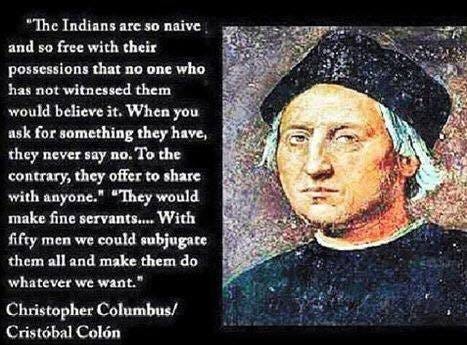
Columbus’s arrival, and certainly the subsequent mass European colonization and Trans-Atlantic Slave Trade that those colonizers enacted, was devastating to hundreds of millions of Native Americans. And while some defend Columbus to this day as some noble hero, his own writings show that his voyages were driven by a fascist desire to violently convert Indigenous people to Christianity by any means necessary. In his journal, he describes his mission to spread Christianity and praises the expulsion of Jews and Muslims from Spain, demonstrating a fervent commitment to conquest and subjugation. Columbus wrote in his journal to King Ferdinand and Queen Isabella:
Your Highnesses, as Catholic Christians and Princes who love the holy Christian faith, and the propagation of it, and who are enemies to the sect of Mahomet and to all idolatries and heresies, resolved to send me, Cristobal Colon, to the said parts of India to see the said princes...with a view that they might be converted to our holy faith...Thus, after having turned out all the Jews from all your kingdoms and lordships...your Highnesses gave orders to me that with a sufficient fleet I should go to the said parts of India...I shall forget sleep, and shall work at the business of navigation, so that the service is performed (Borne, 1906: 76).
And over the last 400 plus years, that genocide has perpetuated. As historian and scholar Alleta Cooper documents:
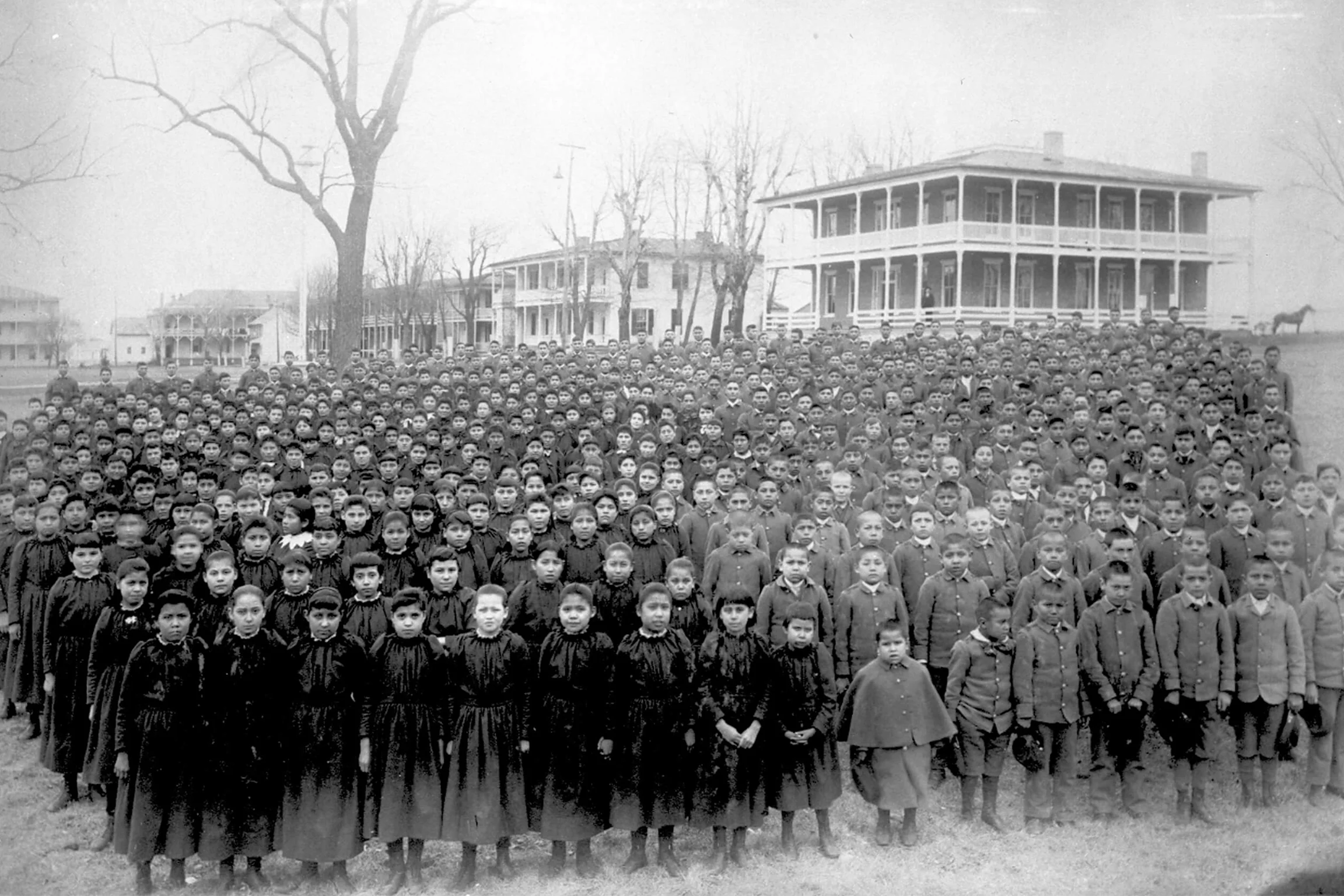
For 150 years, from 1819 to 1969, tens of thousands of Indigenous children were taken from their homes, often by force or coercion, to one of more than 400 schools funded by the federal government. In 1830, Native Americans were driven off their land by the Indian Removal Act, which was signed into law by President Andrew Jackson. Two decades later, the Indian Appropriation Act forced Indigenous people onto reservations, further stripping them of their land. Day schools were established to assimilate Native children, but policymakers did not think these schools went far enough to eradicate Indigenous culture. Thus, Federal Indian boarding school program policies were created.
Students were often required to adopt English names, forbidden from speaking their native languages, forced to convert to Christianity, and made to perform manual labor like brickmaking or farming. Resistance was met with violence. Sexual abuse was rampant.
The legacy of these genocidal policies perpetuates into the 21st Century. Today, Indigenous Americans suffer among the highest rates of infant mortality, maternal mortality, drug and alcohol abuse, and low life expectancy. The National Institute of Health reports:
More than one in five Native Americans (23 percent) reported experiencing discrimination in clinical encounters, while 15 percent avoided seeking health care for themselves or family members due to anticipated discrimination. A notable share of Native Americans also reported they or family members have experienced violence (38 percent) or have been threatened or harassed (34 percent). In adjusted models, Native Americans had higher odds than whites of reporting discrimination across several domains, including health care and interactions with the police/courts. In exploratory analyses, the association between geographic/neighborhood characteristics and discrimination among Native Americans was mixed.
This Thanksgiving Day, or National Day of Mourning, presents us an opportunity to recognize these perpetuating injustices and work to counter them.
What does that look like?
Take Action to Support Indigenous Communities
Indeed, we must take meaningful steps to support Indigenous Peoples. So, here are seven things you can do today. The linked list provides direct access to specific organizations, causes, and funds at which to contribute your time and resources. Take a moment to read through, and pick one action to take—and then publicize that action and ask others to match your effort.
Today should be a call to remember the rich histories and cultures of the Native Americans who lived in these lands long before European colonization ignited a arguably the largest genocide in modern world history. It should also be a call to action to invest meaningful resources, and for each of us to do our small part to help turn the tide of injustice.
Conclusion
It is long past time for the United States to properly honor Native Americans. President Biden’s formal apology for US Government run Indian boarding schools was one step. Yet, it is still woefully insufficient in providing meaningful economic, social, and practical resources to undo centuries of historical wrongs. And like Indigenous Peoples' Day, which takes place earlier in the year, the National Day of Mourning is not just about correcting historical wrongs. It is also about recognizing the resilience and contributions of Native Americans and creating space for a more truthful understanding of American history.
This day serves as an opportunity for reflection, learning, and respect for the people who were the original stewards of this land. As we give thanks this day, let us also spend the day learning about the cultures, histories, and ongoing struggles of Indigenous peoples, and what we can do to help restore even an iota of justice denied.

Qasim, I am SO grateful for you to be bringing this subject up. Even the black races don't see this as "thanksgiving." Only the white race tries so effing hard to convince themselves that because they got everything they wanted that, of course so did the natives and the brown and the the black population of the "their" country. It was stolen! The slaves helped build it under duress but hey why bring that up when your white families are determined over generations of lying to each other that it isn't so. Kudo's to you for at least broaching the subject. To all other races remember you are not forgotten regardless of the erroneous history written.
I am mourning the genocide of my ancestors. Thank you for your advocacy.