


I am an immigrant.
In 1977, my father arrived in the United States with $30 in his pocket. That was it. No guarantees. No powerful family name. Just $30, a belief in hard work, and a belief in America. It sounds cliche, but it’s the quintessential American story.
Like so many immigrants before him, he came here because this country promised something extraordinary: that your worth would not be determined by where you were born or your immigration status, but by what you built, how you served your community, and whether you lived up to the principles this nation claims to stand for. A decade later his family (my mother and my siblings) joined him. Together my parents built a life here. They raised four children. And they did so with dignity, discipline, and an unwavering belief that the Constitution of the United States was not just a document—it was a promise.
My mother passed in 2023 and my father passed just last year. I don’t think they could have imagined the life their children built when they arrived in this country nearly half a century ago. Today my wife and I are raising three incredible American-Pakistani children of our own. They are living the American dream our parents brought us here seeking. They are growing up in a country that—at its best—rewards hard work, protects liberty, and recognizes that every person born here belongs here.
That dream is now under attack. And if that dream ends, the American experiment risks ending as well. Let’s Address This.
Trump v. Barbara
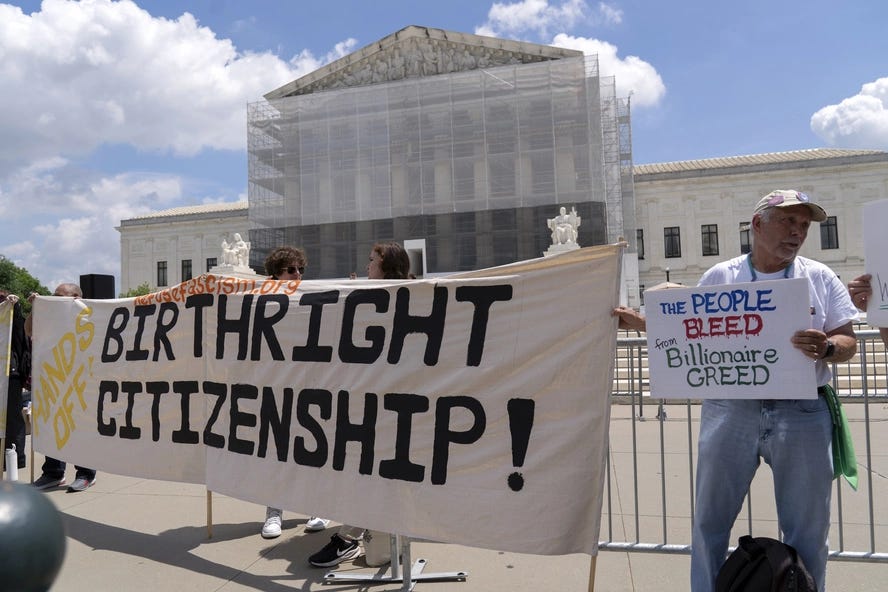
On April 1, the Supreme Court will hear oral arguments in Trump v. Barbara, a case challenging President Donald Trump’s attempt to end birthright citizenship in the United States by executive order. The ACLU and its partners brought this case as a nationwide class action to defend the constitutional rights of babies who would be affected by the order. Several federal courts have already blocked the policy as unconstitutional, but the Supreme Court will now decide whether more than a century of settled constitutional law will remain intact.
At stake is one of the clearest promises contained within the Constitution: the Citizenship Clause of the Fourteenth Amendment. Legal scholars agree that the 1857 Dred Scott decision–which denigrated enslaved Black people as less than human and therefore not privy to the rights afforded by the Constitutional promise of equality–ultimately led to the Civil War.
Ratified in the aftermath of the Civil War, the Fourteenth Amendment was written explicitly, not just to overturn Dred Scott, but also to ensure that citizenship could never again be manipulated to exclude people based on ancestry, race, or political convenience. The text is unambiguous. It declares that all persons born or naturalized in the United States, and subject to the jurisdiction thereof, are citizens of the United States.
That language was not accidental. It was a deliberate constitutional safeguard designed to prevent political leaders from deciding, arbitrarily or opportunistically, who belongs in this country and who does not.
The 14th Amendment
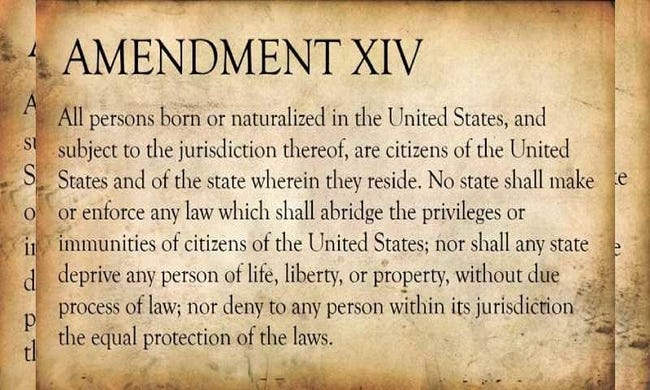
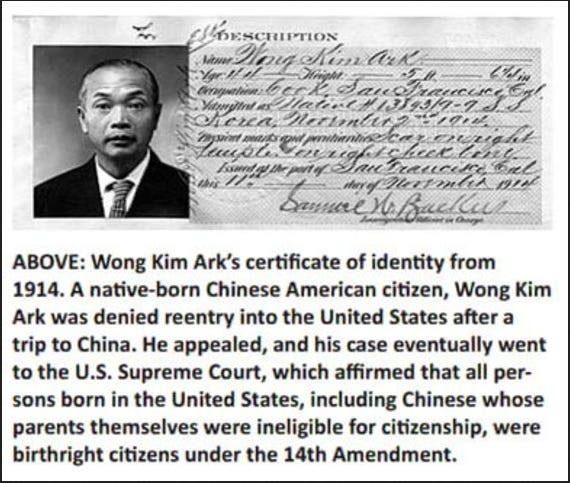
The 14th Amendment was written not only to ensure the horrific ruling in Dred Scott, and the dehumanization of any person in this country, could never happen again, but also to ensure that this country would apply a broad rule of birthright citizenship—not one that depends on parents’ immigration status or the President’s preferences. For more than a century, the Supreme Court has affirmed this principle, including in the landmark 1898 decision United States v. Wong Kim Ark, which confirmed that children born in the United States are citizens regardless of their parents’ immigration status.
President Trump’s executive order attempts to override that settled law by executive decree. His administration claims that the Fourteenth Amendment does not extend to children born to parents who are not citizens or permanent residents. This argument is not supported by the constitutional text, by Supreme Court precedent, or by more than a century of consistent legal interpretation. It is, quite simply, an attempt to rewrite the Constitution through executive power.
The consequences of such a move would be profound and destabilizing. Birthright citizenship has long provided a clear and administrable rule: if you are born on American soil, you are American (with very few exceptions, such as the children of ambassadors). Removing that guarantee would throw countless families into legal uncertainty. Babies born in American hospitals would no longer automatically be recognized as citizens. Hospitals, schools, and government agencies would suddenly be forced to inquire into parents’ immigration status in order to determine whether a child is entitled to citizenship. The result would not be clarity or order, but bureaucratic chaos, widespread discrimination, and inevitable errors that would harm innocent families.
Even more troubling, ending birthright citizenship would create a permanent subclass of people born in the United States but denied full membership in the nation where they live. Such a system would undermine the very democratic principles the Fourteenth Amendment was designed to protect.
The Broader Sinister Strategy
The attack on birthright citizenship does not stand alone. It is part of a broader effort by the Trump administration to redefine who counts as American. Since returning to office, the administration has expanded immigration detention, gutted congressionally mandated asylum protections, deployed armed federal agents into immigrant communities, and is now spending billions of dollars building what is accurately described as concentration camps. The Trump administration has additionally attempted to use wartime authorities to disappear people to foreign prisons without due process. It has punished non-citizen students for engaging in First Amendment-protected speech. It has even placed U.S. citizen children on deportation flights, including children receiving cancer treatment. The administration’s own immigration chief has spoken openly about creating a deportation system that operates like “Amazon Prime for human beings,” a chilling description of a government apparatus designed to remove people as quickly and efficiently as possible regardless of human cost.
None of this makes any of us safer. All of it violates our human rights and our Constitution.
Taken together, these actions reveal a consistent objective: to reshape the boundaries of belonging in the United States by disregarding the constitutional safeguards that prevent such abuses of power,
But the Constitution does not bend to the preferences of a president.
The Constitution Must Matter
We are a secular nation that mandates separation of religion and state. And in our constitutional system, no president—regardless of party, ideology, or popularity—possesses the authority to unilaterally redefine citizenship. That authority rests with the Constitution itself, interpreted through the courts and constrained by the rule of law. The Fourteenth Amendment is not advisory language that a president may reinterpret through executive order. It is binding constitutional text that has governed this country for more than 150 years.
For families like mine, this principle is not theoretical.
My father came to this country with almost nothing but the conviction that the United States was a place governed by law rather than by the whims of whoever is in the White House. That conviction allowed him to build a life, raise a family, and watch his children and grandchildren flourish in a nation that promised equal citizenship to all who are born here.
If that promise can be revoked by executive decree, then the very foundation of that dream begins to erode.
This is why the case now before the Supreme Court matters so profoundly. It is not merely a legal dispute about immigration policy. It is a constitutional test of whether the principles embedded in the Fourteenth Amendment remain durable in the face of political pressure.
Conclusion
Here’s how you can get involved. I am collaborating with the ACLU to call on Americans to stand up for those principles by supporting their effort to defend birthright citizenship before the Court. Ahead of oral arguments on April 1, the ACLU is gathering signatures to demonstrate that Americans understand what is at stake. That we are prepared to defend the constitutional guarantee that every child born in this country is entitled to full membership in it.
I support the ACLU’s effort not simply as a lawyer, but as an immigrant, as the son of immigrants, and as the father of three American children whose futures depend on the continued vitality of the Constitution.
My father believed that America’s greatness rests not in its wealth or its military power, but in its fidelity to the rule of law. And it is now our responsibility to ensure that the constitutional promise he believed in remains intact for the next generation.

First of all, how soon will Melania, Ted Cruz, Elon Musk & George Santos be leaving? (To name a few) We can open the gates for every anti-American republican to leave, then slam the door shut! 😁
Your story is my family’s story just a few decades later. With the exception of First Nations, it is every family’s story. We can only hope that this court upholds the constitution and not the cult.