


The Taliban is committing yet another atrocity upon Afghan girls. A human rights catastrophe and a violation of international law. And it has absolutely no basis in Islamic teaching—despite the Taliban’s cynical and dishonest invocation of religion.
But this story is bigger than Afghanistan. It is a story about the global failure to protect girls from child marriage—including right here in the United States. And it is a story about the consequences of twenty years of American imperial warfare that left women and girls in Afghanistan worse off than before a single bomb was dropped.
In this article I analyze the horrors that the Taliban is inflicting upon women and girls, the United States’ complicity in this atrocity, and what meaningful legal levers we have to fight back and protect women and girls in Afghanistan and globally.
Let’s Address This.
What the Taliban Just Did—And Why It Is So Dangerous
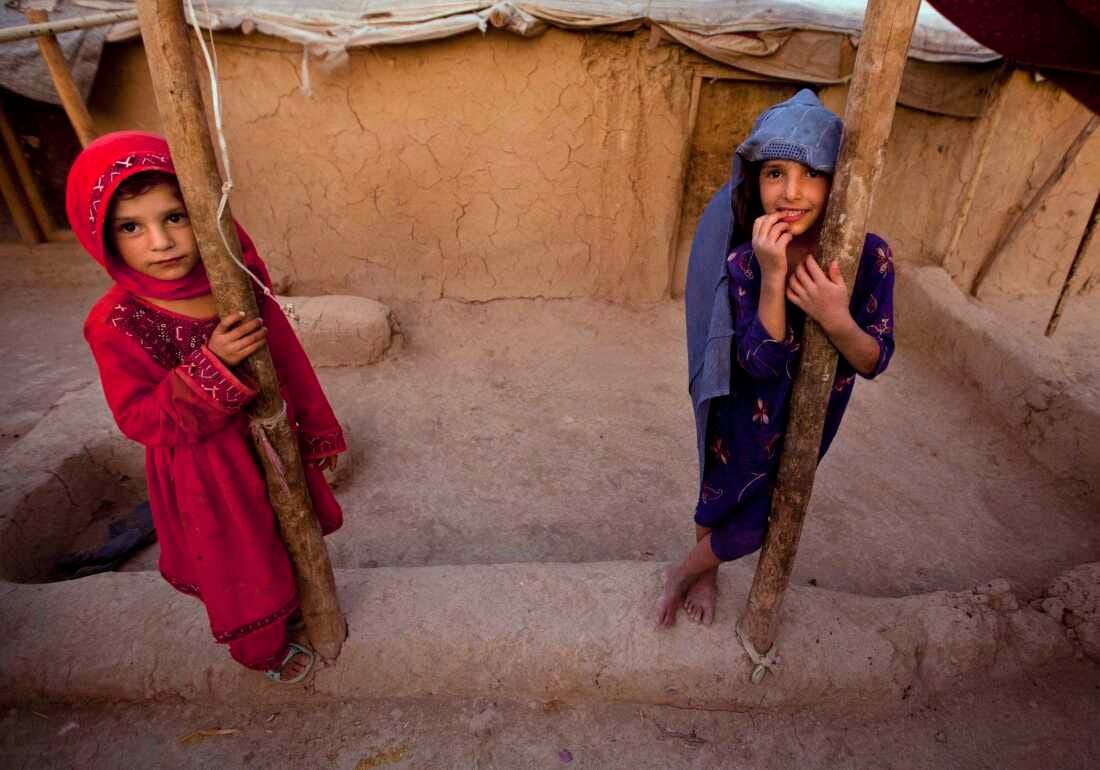
This month Afghanistan’s Taliban government published Decree No. 18—a new law on judicial separation in marriage. The United Nations expressed “grave concern” about the decree, saying the code further entrenches discrimination against women and girls. The law’s most devastating provisions target girls directly. Among its most controversial provisions, it says that the silence of a girl reaching puberty can be interpreted as consent to marriage. It also includes a section on the separation of girls who reach puberty and are married, which “implies that child marriage is permitted,” the United Nations Assistance Mission in Afghanistan said in a statement.
And escape from that trap has been made nearly impossible. If a girl asks her husband for a divorce and he denies it, “then in this case, there are no witnesses with the girl, the husband’s word is valid,” the new law says. As Human Rights Watch Afghanistan researcher Fereshta Abbasi asked devastatingly: “How could a girl who has been married to an abusive husband for four, five years dare to go to court?”
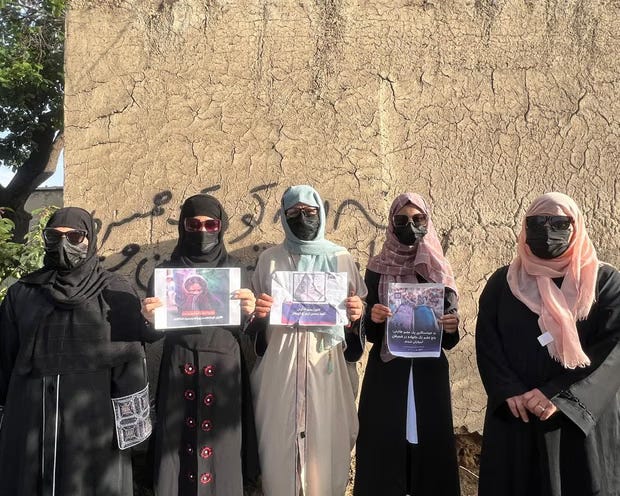
Additionally, a husband’s absence or failure to provide financial support is no longer considered sufficient grounds for divorce. The legislation has triggered protests in the capital, Kabul. Women’s rights organizations have described the law as “institutionalized violence” against women and children. The Taliban already commits gender apartheid in their restrictions on women’s right to work and movement—and now further financial apartheid by absolving the men controlling every aspect of their lives from providing financial support.
The scale of the crisis this law will deepen is staggering. According to the Guardian’s reporting, there are no official statistics on forced and underage marriages in Afghanistan, but activists say the rate has risen at an alarming pace in recent years, driven by the Taliban’s ban on girls receiving education after the age of 11. One informal estimate cited by The Guardian suggests that since that ban, approximately 70% of girls have been pushed into early or forced marriage—and that 66% of those marriages involved girls under the age of 18.
“Decree No. 18 is part of a broader and deeply concerning trajectory in which the rights of Afghan women and girls are being eroded,” said Georgette Gagnon, the UN official overseeing the mission in Afghanistan.
The Taliban’s response? They claimed the decree follows Islamic law. That claim is not just wrong. It is an insult to Islam itself.
This Is Not Islam—It Is a Perversion of It
Violent and insecure men have long used religion as an excuse to abuse women when in reality they mean patriarchy and their own egos. The Taliban invokes Islam to justify virtually every atrocity it commits against women and girls. This must be named and refuted directly—because the conflation of Taliban ideology with Islamic teaching is false and devastating to the women and girls harmed by their twisted logic.
The Quran is explicit. Surah An-Nisa, verse 20 condemns any force or coercion in matters relating to women, declaring in explicit terms:
O ye who believe. It is not lawful for you to inherit women against their will; nor should you detain them wrongfully… and consort with women in kindness…
No deep interpretation needed. In simple terms. It is unlawful to deny women their free will and autonomy. The Prophet Muhammad (peace be upon him) established—fourteen centuries ago—that no woman can be married without her express and free consent, and that a woman may seek divorce unilaterally, on the basis of her own desire alone, without requiring her husband’s agreement. This right—known as khula’—predates Western legal frameworks for divorce by over a millennium.
Moreover, when marrying or divorcing, Islam mandates a wali, i.e. a legal representative, to keep a degree of separation between a woman and the man who may eventually become her husband, or her ex-husband, with the mandate to exclusively protect her interests. Islam was the first major world religion to mandate and codify women’s right to consent to marriage and to exit it, while prioritizing her safety throughout.
On financial rights, Islam provides another clear guidance. A woman has equal rights over her husband’s income, he has no rights over her income. Accordingly, in no circumstance should a woman not have financial access and autonomy. When Prophet Muhammad (sa) married Khadija, she was a wealthy CEO. He was her employee. At no point did he usurp or demand her rights or property. Islam forbade it.
Returning to the topic of marriage, Prophet Muhammad (sa) also made clear that girls are not to be married before the age of maturity—defined in Islamic jurisprudence as adulthood, with full legal and moral capacity to consent. Forcing a child into marriage—and then legally stripping her of the ability to leave—is not Islamic governance. It is the abuse of religious authority to perpetuate misogynistic control.
The Taliban has no Islamic justification for this law. None. What they have is power—and a willingness to use it brutally against the most vulnerable. And while the Taliban’s atrocities have brought this injustice into the spotlight, the reality is sadly far worse. This injustice is a global crisis and merits a global response.
This Is a Global Crisis—Including in the United States
It would be convenient if we could frame this purely as an Afghan problem or a Taliban problem. It is not.
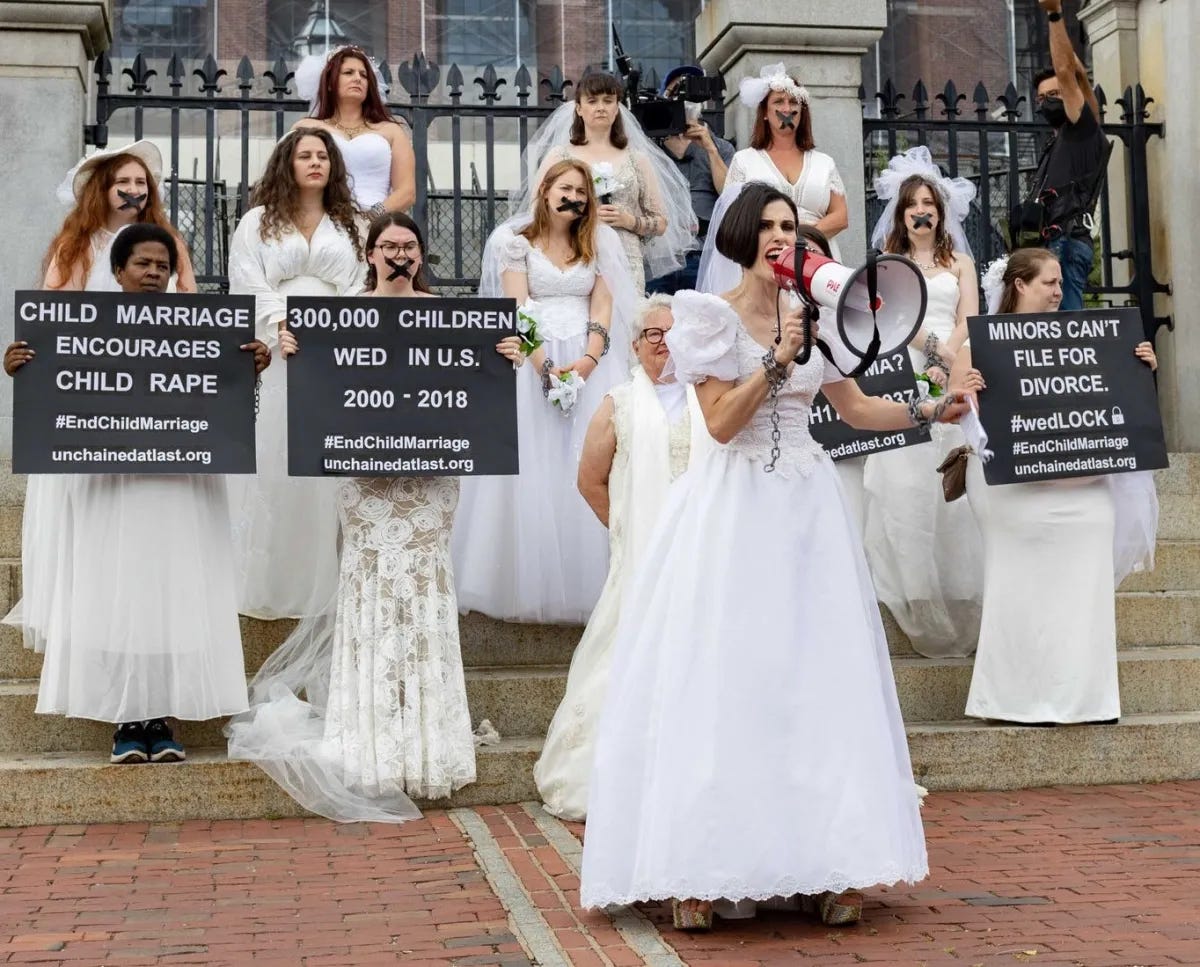
Child marriage is a global crisis. And the United States—which will inevitably be among the loudest voices condemning this Taliban decree—has its own catastrophic reckoning to face. Just last month in Oklahoma, 36 Republicans voted to block a ban on child marriage. What should have been an easy unanimous vote passed only 51-36. As of this article, more than 30 states nationwide have no ban on child marriage. And it is not an anomaly.
According to the non-profit Unchained At Last, since the year 2000, the United States has documented 315,000 cases of child marriage within its own borders—largely sanctioned by the Church and courts. No federal law bans child marriage in America. Not one. Individual states have varying and inconsistently enforced protections, but there is no national floor that prohibits the marriage of minors under any circumstances.
This brings us to the critical question of international law—and here the news is both good and deeply troubling.
The Convention on the Elimination of All Forms of Discrimination Against Women (CEDAW)—the most comprehensive international human rights treaty specifically protecting women and girls—calls explicitly for action to specify a minimum marriage age of 18. Under CEDAW, any law that permits or enables child marriage is a violation of the treaty’s binding obligations. Article 16, paragraph 2 states plainly:
The betrothal and the marriage of a child shall have no legal effect, and all necessary action, including legislation, shall be taken to specify a minimum age for marriage and to make the registration of marriages in an official registry compulsory.
CEDAW was adopted by the United Nations General Assembly on December 18, 1979. Afghanistan has ratified this treaty. The United States has not.
The self-proclaimed leader of the free world has refused to ratify the world’s primary treaty protecting women and girls from discrimination, child marriage, and forced union—placing itself in the company of nations it routinely condemns for their human rights records. Women and girls in America remain unprotected by the very international standard we are now invoking to condemn the Taliban.
This hypocrisy does not excuse the Taliban. Nothing excuses the Taliban. But it does mean the United States must put its own house in order—immediately—if it wants to lead with moral authority on this issue.
The United States must ratify CEDAW. Now.
Afghanistan Has Ratified CEDAW—And That Is Our Legal Lever
Here is the crucial legal fact that must drive the international response: Afghanistan has ratified CEDAW.
Afghanistan is a signatory to the Convention on the Elimination of All Forms of Discrimination Against Women, as documented by the United Nations Treaty Collection. That means the binding obligations of CEDAW—including Article 16’s explicit prohibition on child marriage and its mandate that “the betrothal and the marriage of a child shall have no legal effect”—apply to Afghanistan under international law.
Decree No. 18 is not merely morally reprehensible. It is a direct violation of Afghanistan’s binding international legal obligations under a treaty it has ratified.
This matters because it gives the United Nations and the international community concrete, treaty-based grounds to demand accountability. Not as cultural imperialism, not as Western interference, but as the enforcement of a legal commitment Afghanistan made to the world and to its own people.
The UN must not limit itself to expressions of “grave concern.” Grave concern is not accountability. The UN Security Council, the Human Rights Council, and UNAMA must use every mechanism available under international law to hold the Taliban to Afghanistan’s existing treaty obligations—including targeted sanctions on Taliban officials responsible for implementing laws that violate those obligations. The sustained, coordinated pressure must not relent until Afghan girls are protected.
Regional nations—particularly Pakistan, which itself banned child marriage in 2025—have both the geographic proximity and the cultural and religious relationship with Afghanistan to bring the Taliban to the table. Pakistan’s leadership must use that leverage. The silence of regional Muslim-majority nations on the Taliban’s systematic abuse of Islamic principles to oppress women is itself a form of complicity. It must end.
The Consequence of Forever War and Imperial Failure
Finally, we cannot conclude this conversation honestly without confronting the role American foreign policy played in creating the conditions we now condemn.
Twenty years of American military intervention in Afghanistan—at a cost of over $2 trillion and tens of thousands of lives—ended with the Taliban returning to power in 2021 in a collapse so swift it further rendered the entire enterprise a catastrophic failure. Women and girls in Afghanistan are, by virtually every measurable standard, worse off today than they were before the first American bomb fell.
And let us not forget who negotiated the terms of that collapse. Donald Trump’s administration negotiated the Doha Agreement—releasing 5,000 Taliban prisoners, including senior commanders and hardened extremists, in exchange for commitments the Taliban promptly ignored. That agreement did not include a single binding protection for Afghan women. Not one. The Trump administration traded Taliban prisoners for nothing—and Afghan women are paying the price.
This is the inevitable consequence of wars fought not for human rights but for geopolitical positioning, natural resources, and imperial projection. When the empire packs up and leaves, it is always the women and girls who are left to bear the weight of everything that was promised and never delivered.
Global Solidarity Is Not Optional—It Is Obligatory
In conclusion, the path forward is clear—we must center the protection of women and girls in Afghanistan and globally. It will not be easy. But it is obligatory.
The United States must ratify CEDAW internationally and ban child marriage domestically. Today, the spectacle of America condemning child marriage abroad while refusing to adopt the international treaty that prohibits it—while 315,000 documented cases of child marriage have occurred on American soil since 2000—is a moral and legal incoherence that undermines every word we say.
Afghan girls did not ask for twenty years of war. They did not ask for a Taliban that imprisons them in childhood marriages before they have had the chance to become the doctors, lawyers, scientists, teachers, and leaders they were born to be. They did not ask for a world that watches their subjugation, issues statements of grave concern, and moves on.
They deserve more than our concern. They deserve our action.
The future is not unwritten for Afghan girls—it is being written right now, by men with power and without conscience. The question is whether the rest of the world will let that stand. We cannot. We must not. And we will not—if we are serious about the human rights we claim to defend.
Qasim Rashid is a human rights attorney, author, and host of Let’s Address This—a platform dedicated to human rights, international law, and the accountability that corporate media refuses to deliver. Subscribe, share, and let’s remain relentless in our mission for universal human rights
.
Since the US has a pedophile president, & many of his cohorts subscribe to this, it is fair to say that these men hate women & girls. Mormons did the same thing taking multiple underage girls as wives. This clearly subjugates the girls to a hellish life. It would seem that the Taliban have taken a page from America's disgusting legacy.
Thank you for speaking out on this issue, Qasim. This is probably one of the most important issues of our day: protecting children, our most precious gifts!
Thank you for the critical expose' of this disturbing issue. It is heartbreaking to think of the innumerable women and girls around the world impacted by this deeply disturbing problem. Another element at play is the role of pedophilia in undergirding support for underage marriages. I value that you highlight how this contradicts the Quran and how the Taliban's false conflation of this with Islamic practice is inherently damaging, as well as a misrepresentation of how women are to be regarded according to a true understanding of Islamic text and history.
There is such hypocrisy in how the US seeks to position itself as the champion of civil rights and claims women and children have differential protections here, in contrast to various other countries, but a mere review of the age of marriage for many US states directly contradicts this perspective.
I believe the way you challenged Pakistan and other predominantly Muslim countries to speak up and stop simply averting their gaze is critical to generating pressure on the Taliban to reevaluate their position on this heinous practice.
Thank you for being the vital voice you are in giving voice to vulnerable girls and women, both under Taliban rule and here in this country, too.