


This is a guest post by Brian Derrick, Founder and CEO of Oath. Brian founded Oath with one brilliant idea — how do we ensure the money donated to candidates goes to those with the best chances of winning? Brian and his team built Oath to do just that, and to date have raised more than $75 million to help flip red seats blue. I’ve worked with Brian for years and am excited to share his research and findings with you, especially as we face a seismic moment in our politics during these primary and midterm elections. If you’ve ever wondered where your donation will do the most good to save our democracy, follow Brian’s work. Let’s Address This.
The ‘Split’ In The Democratic Party Is Not Where You Think It Is
by Brian Derrick, Founder and CEO of Oath

The national media loves a “Dems in Disarray” story. Is Zohran Mamdani and the progressive wing pulling the party to the left and out of contention in key races? Or are more moderate centrists dampening enthusiasm and alienating the party’s liberal base? Does the DNC have its act together? Who will take the party mantle in 2028?
It’s true that there is conflict within the Democratic party, but its most dramatic split is not ideological.
In dozens of districts around the county, there is a generational surge of younger candidates mounting serious and well-funded challenges to aging incumbents as part of an anti-establishment energy sweeping the party from center to left. From Connecticut to California, some of the oldest and longest-serving House incumbents are facing unprecedented primary challenges. It is one of the biggest and most underdiscussed stories in the 2026 midterm cycle, and it will have serious repercussions for the next Congress.
What the data on campaign fundraising tells us
A few years ago I co-founded Oath, a strategic giving platform that helps Democrats find races and causes where their dollars can make the greatest difference, without the spam and spin of other giving platforms. As part of our work, we analyze FEC filings in hundreds of races around the country to see where candidates stand in terms of fundraising relative to their opponents (both in primaries and in the general election).
This year, one of the most meaningful storylines we’re seeing in the data is an intra-party, generational revolt against aging, incumbent Democrats. Oath just released our findings in a new report, which was covered in NPR.
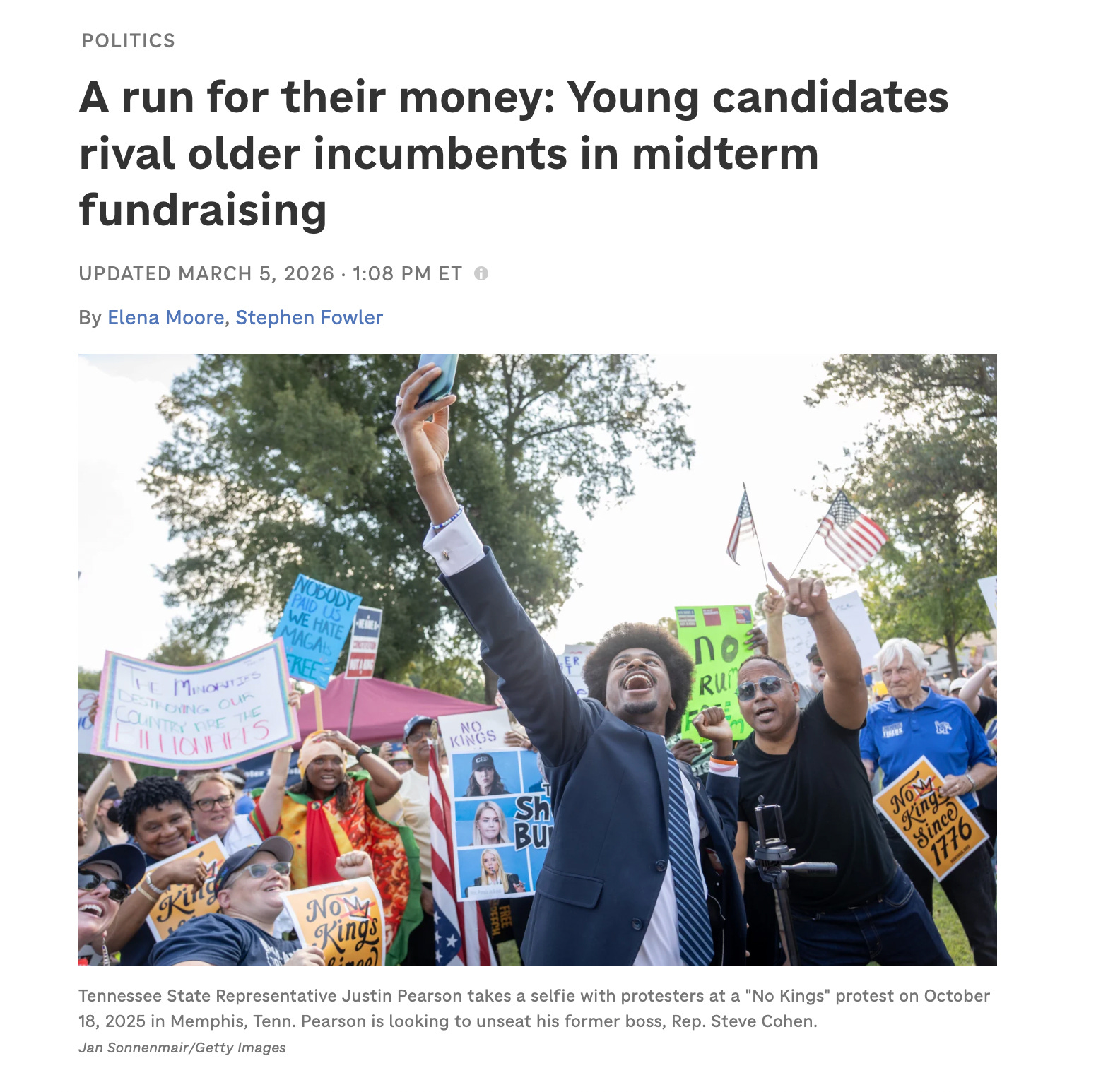
In 2026, more than 210 challengers have entered primaries against incumbents over the age of 65. More than 80 of those challengers are millennial or Gen Z. That is almost a 4x increase over 2024. And they’re doing well. Collectively, they have raised more than $20 million — a hugely significant amount, particularly in normally-sleepy primary races where campaign dollars can have a major impact on outcomes.
To give you a sense of the spike, here are just a few of the standout races where primary opponents are challenging older incumbents who have not been challenged recently:
CA-04: Eric Jones has raised $2.5M, outraising Rep. Thompson (74), who had no Dem challenger in 2024.
CT-01: Luke Bronin has raised $1.7M, outraising Rep. Larson (76), who had no Dem challenger in 2024.
MD-05: Quincy Bareebe raised $1.2M, up sharply from the $270K he raised in 2024 in his bid against Rep. Hoyer (86).
MI-13: Donavan McKinney has raised $850K, outraising Rep. Thanedar (70).
MA-08: Patrick Roath has raised $600K, outraising Rep. Lynch (70), who had no Dem challenger in 2024.
TN-09: Justin Pearson has raised $700K, outraising Rep. Cohen (76).
CA-32: Jake Levine has raised $1M against Rep. Sherman (70).
The message being sent is clear - if incumbents do not choose to retire, the next generation is no longer going to “wait their turn”. This is part of the reason that Democrats have thus far directed an unprecedented sum into competitive primary races this cycle – a fact at odds with many incumbents’ stated aim to keep the focus on winning back the House.
The shift is not just about age. Younger candidates are presenting more combative and populist messages that distinguish them from the institutionalist ranks of incumbents — and donors are rewarding them for it.
Why this matters
Part of the reason this story remains undercovered is structural: the FEC doesn’t make it easy to track candidates’ ages. Plus, many of these races are in safe Democratic seats, which means they have less relevance to the media’s horse race coverage of who will win control of the House in 2026.
But safe seats are exactly where party identity is built. What we’re seeing in these fundraising numbers and competitive primaries is the new Democratic bench: future committee chairs, future statewide contenders, future national leaders. These types of districts produce the politicians who define what Democrats prioritize, how they communicate, and what voters think “a Democrat” looks like — and they are on the verge of being controlled by a new, much younger generation.
If you want the Democratic Party to feel different (and based on some polling on the party’s approval, we should all want that), primaries are an important mechanism to actually make that happen.
The brand of the Democratic Party cannot change unless we change who we think of as typical Democrats. In these fundraising numbers, we’re starting to see the potential beginnings of that change.
What we can do from here
The generational momentum that we’re seeing in these primary races is exciting, but it will only be sustained if these challengers not only win their primary but also outcompete their Republican opponents in November. And if that’s going to happen, they’ll need continued financial support.
Republican House candidates are outraising Democrats across the board, despite widespread disapproval of the Trump administration and an electorate that seems poised to deliver a strong blue wave in 2026.
At Oath, our entire focus is on making it easier for everyday supporters of progressive values to understand where their money is most needed. To do that, we assign all participating candidates an Impact Score from 1-10, based on a proprietary algorithm that takes into account polling data, fundraising performance, and a bundle of other metrics. That score helps users understand where their dollar will go the furthest.
In 2024, more than two-thirds of campaign dollars given through our platform went to candidates in races that were decided by five percentage points or less. In comparison, less than one-third of party money across the board went to those races.
With smarter, more strategic campaign giving across the country, Democrats can compete more effectively in more districts — and younger, newer candidates can remain competitive even if they don’t have decades of big-money fundraising networks to rely on.
The two strengths of the outgoing generation of Democratic incumbents are money and inertia. In 2026, there is a real path to countering both of those strengths and bringing a new crop of exciting, smart, progressive candidates into power.
If you’re interested in contributing through Oath, you can visit out website at app.oath.vote. We keep all donor data private, so you can control how often you hear from us, and you won’t be getting any spam texts.
Boomer here. If folks don't know when to retire the constituents need to tell them it's time!
When Mamdani ran in NY, there was a rule about how much money can be spent during an election. We need this, it will help those not backed by the rich. It’s the only way we can get good people in.