


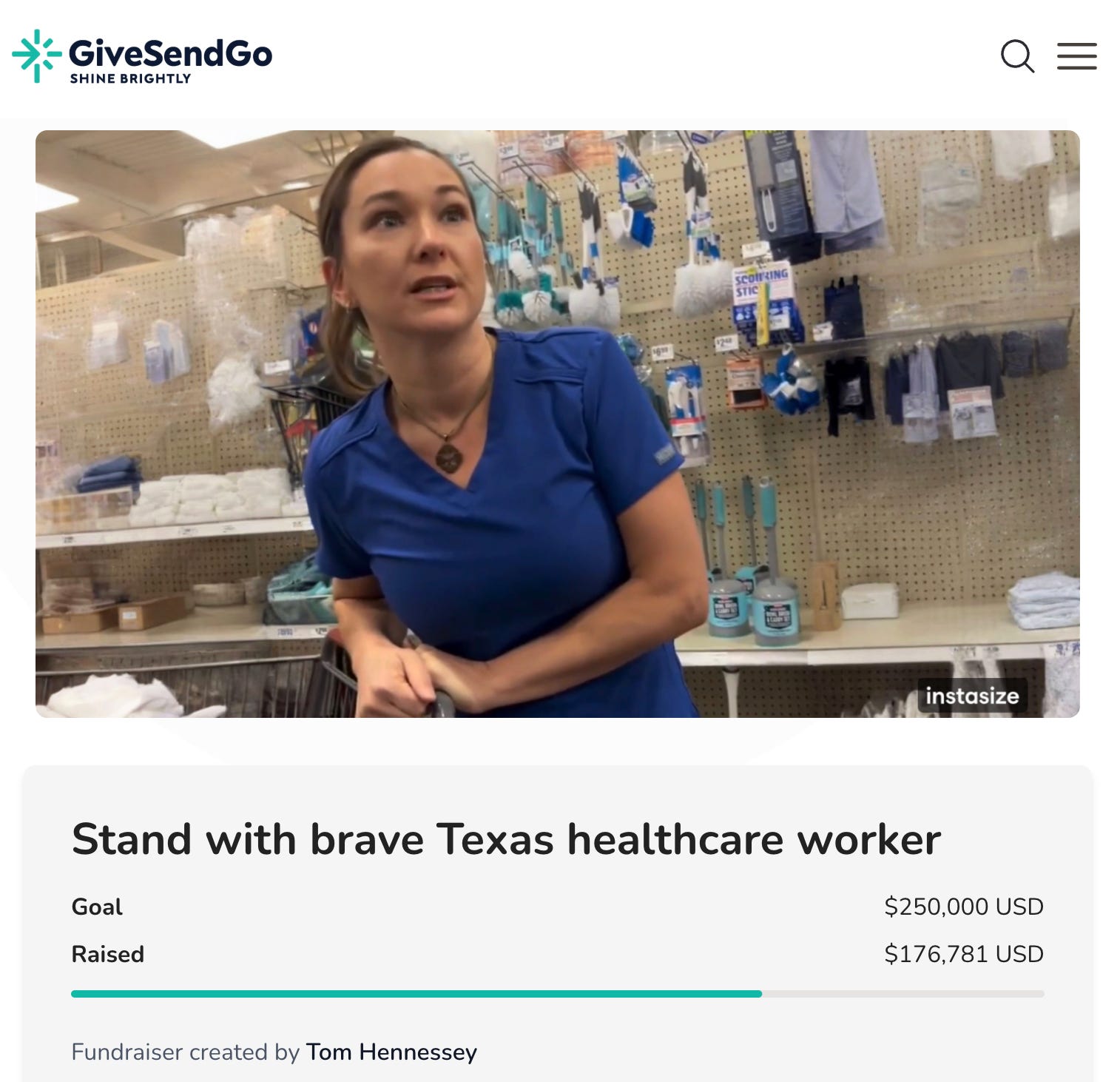
A woman walks into a public store, tells two Muslim customers they are not welcome in “a Christian country,” gets fired, goes viral—and within 24 hours raises over $100,000 in online donations.
No legal fees. No medical bills. No emergency. Just the financial reward for telling two Muslim women they do not belong.
If you needed a single image to illustrate how white supremacy functions as an economic system in America—not just a moral failure, not just a social pathology, but a monetized, crowd-funded, algorithmically amplified revenue stream—this is it. Because sadly this is not a random exception or anecdote. It is a sustained rule that has integrated itself through American history, thrives today, and places all of us—yes including white people—in immense danger. Let’s Address This.
The Incident—And the Pattern It Belongs To
On June 20th, Dasha Kilpatrick, a massage therapist and former employee of Massage Forest in Conroe, Texas, was recorded telling two Muslim women: “You’re not welcome here. This is not a Muslim country. This is a Christian country.”
She was fired. The video went viral. And within 24 hours, far-right online communities had raised her more than $100,000. Here’s her video and my response to her.
This is not an isolated incident. It is the latest entry in a well-documented, financially traceable pattern—one that writer Malynda Hale has captured with devastating precision. Hale writes:
This is what white women’s tears actually means. It’s not a claim that white women never feel real fear or real distress. It’s the name for a very specific and well documented pattern, where a white woman’s emotional state, whether genuine or performed, gets protected and believed and mobilized in ways that immediately erase accountability and shift the harm onto someone else.
That pattern—accountability erased, harm shifted, emotion monetized—is not a bug in our system. It is a feature. And the financial architecture that rewards it is more robust than most people realize.
The Receipts
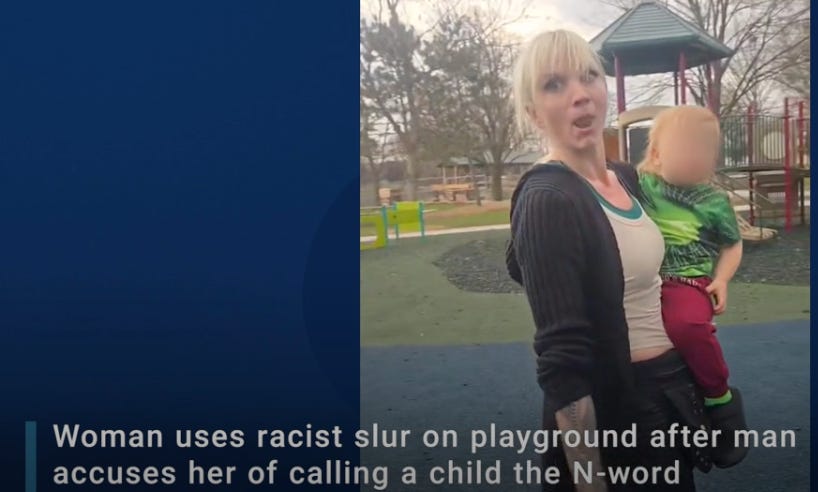
In May 2025, Sharmake Omar captured video of a white woman named Shiloh Hendrix accosting a five-year-old Black child at a park in Minnesota—repeatedly calling him the n-word. Not a teenager. Not an adult. A five-year-old child.
An online fundraiser purportedly for Hendrix raised more than $750,000—with countless donation comments espousing explicit white supremacist views. Three quarters of a million dollars. For calling a kindergartner the n-word.
Let us continue.
After Kyle Rittenhouse crossed state lines with an AR-15 to counter-protest a Black Lives Matter rally and killed two people, an online fundraiser—billed as a legal defense fund and boosted by Donald Trump—raised more than $2 million.
Among the donors were several individuals whose contributions could be traced to email addresses linked to law enforcement officials. One $25 donation, made anonymously but linked to the official email address of Sergeant William Kelly—then serving as Executive Officer of Internal Affairs in the Norfolk Police Department in Virginia—came with the comment: “God bless. Thank you for your courage. Keep your head up. You’ve done nothing wrong.”

Internal affairs. Of a police department. Donating to a man who killed two people at a protest. Telling him he did nothing wrong.
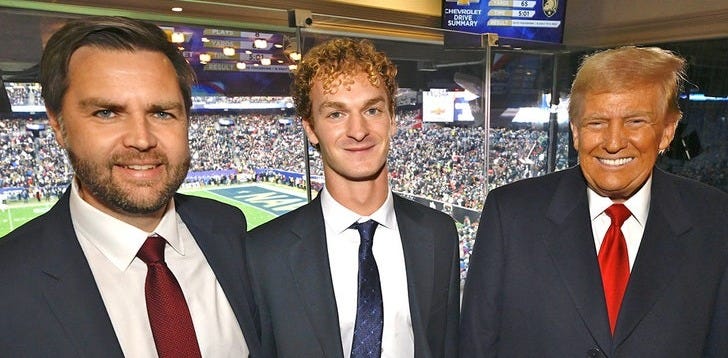
In May 2023 in New York, Daniel Penny choked and killed Jordan Neely—a Black man—on the subway. Racists raised nearly $3 million for Penny’s legal defense. He was subsequently personally invited by JD Vance to attend the Army/Navy football game. Not held at a distance. Celebrated. Platformed. Rewarded.
These are not anecdotes. They are a dataset. And what that dataset reveals is a system—consistent, predictable, and financially lucrative—in which the performance of white grievance generates wealth, while the victims of that grievance are left to absorb the harm.
From Crowdfunding to Policy: The Same System, Larger Scale
The connection between these viral fundraisers and the structure of American public policy is not metaphorical. It is direct.
White Americans receive 20% shorter prison sentences than Black and brown Americans convicted of the same crimes. The same ideology that raised $750,000 for a woman who called a five-year-old the n-word has shaped the criminal justice system that delivers those sentences.
$20 billion more in annual funding flows to white-majority schools than to Black-majority schools. The same ideology that rewards racism with crowdfunding campaigns has built the educational funding architecture that produces that gap.
Black and Latino Americans are charged and arrested at up to 6-10x higher rates than are white people, despite similar crime rates. The donors who gave to Rittenhouse’s fund included police officers. Those police officers go to work every day making decisions about who to stop, who to charge, who to shoot, and who to let walk. The ideology does not stay online. It governs. Do you see the connection?
The Logical End Point: The World’s First Trillionaire
And then there is the man who has become—on paper, at least—the world’s first trillionaire.
Born to openly racist parents in apartheid South Africa. Having publicly espoused the white supremacist “great replacement” theory. Whose companies have been sued repeatedly and extensively for racial discrimination. Whose ex-partner Ashley St. Clair has stated openly that he is a racist. Who performed a Hitler salute—twice—on national television, and faced no meaningful consequence for it.
He is the natural, logical, inevitable result of a society that has spent centuries building a financial rewards system for whiteness. Not an aberration. Not an outlier. The manifestation. The man at the top of a pyramid that was built, brick by brick, on the economic machinery of racial hierarchy—from slavery to redlining to discriminatory lending to underfunded schools to disparate sentencing to crowdfunded racism—all converging at the pinnacle of a single man’s net worth.
That is not a coincidence. It is a conclusion.
And why does this also hurt white people? Because throughout American history, wealthy white elites have always used poor whites as their excuse—particularly via the Southern Strategy. As long as they can convince poor white people that “at least” they’re better than Black or brown people, the elites can continue to push policies that harm low income communities. It’s no wonder that to this day, white Americans are the largest demographic of people on welfare, life expectancy is lowest in red states, and poverty, maternal mortality, and infant mortality is highest in red states.
The policies of white supremacy actively harm Black and brown people, and actively sacrifice low income white people to perpetuate. The only way through is by standing united across racial lines against the economic scourge of white supremacy. Otherwise, the cycle continues, advances, and creates that much more devastation.
The Failure of Legacy Media—And Why Diverse Voices Matter
Here is what corporate media will not tell you: these stories are connected.
Dasha Kilpatrick, Shiloh Hendrix, Kyle Rittenhouse, Daniel Penny, and the world’s first trillionaire are not separate stories about individual bad actors. They are chapters in the same book—a book about how white supremacy functions as an economic system, how it is crowd-funded at the micro level and structurally enforced at the macro level, and how accountability is erased at every stage of that process.
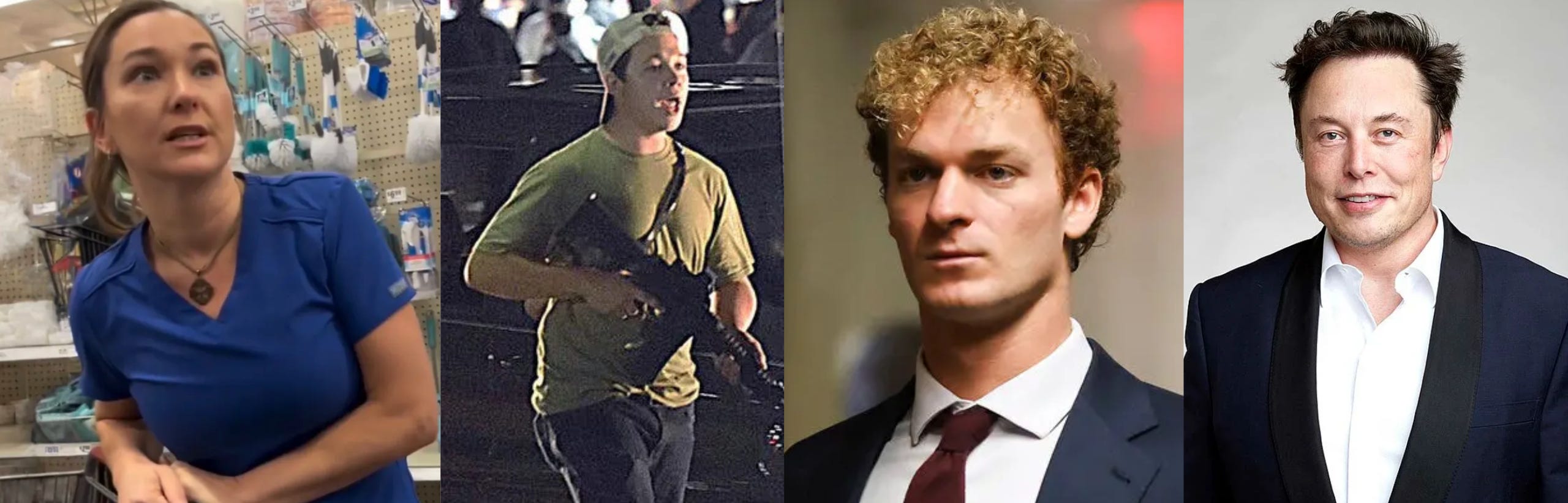
Corporate media covers each of these stories in isolation—if it covers them at all. It treats them as viral moments rather than systemic evidence. It platforms the perpetrators and minimizes the victims. It performs neutrality in the face of documented racial hierarchy and calls that journalism.
This is why diverse and representative voices in media are not a nicety. They are a necessity.
When the people writing the stories look like the people writing the crowdfunding checks, the connections go undrawn. The pattern goes unnamed. The system goes unchallenged. And the receipts—$100,000, $750,000, $2 million, $3 million, $1 trillion—keep accumulating.
Journalists and commentators of color do not cover these stories because of identity politics. We cover them because we have the lived experience and the analytical framework to see what others are trained—or incentivized—not to see. Because we know, from the inside of these communities, what is at stake when the pattern goes unnamed. Because we understand that calling something what it is—a financial reward system for racism—is not inflammatory. It is accurate.
Let’s Address This exists because that accuracy has to live somewhere. Because the stories that connect Dasha Kilpatrick to Shiloh Hendrix to Kyle Rittenhouse to the world’s first trillionaire deserve to be told—not as isolated outrages, but as a coherent, documented, damning indictment of a system that has chosen, again and again, to reward the performance of white supremacy with cold, hard cash.
The receipts are in. The pattern is clear. The question is whether we have the collective courage to name it, resist it, and build something different.
I believe we do. And I believe the growing community of people-funded, independent, diverse media voices—telling the stories that corporate media buries—is how we do it.
Subscribe. Share. And refuse to let the pattern go unnamed.
Qasim Rashid is a human rights attorney, author, and host of Let’s Address This—a platform dedicated to human rights, accountability, and the diverse voices that corporate media refuses to amplify. Subscribe, share, and let’s remain relentless in our mission for a more perfect Union.
The truth is America is not a Christian country or a Jewish country or a Muslim country. America is a secular society. That woman just didn’t like anyone who was different from what she is.
Thank you for opening my eyes to this. When Rittenhouse pulled his killing "stunt," I thought sure he should be charged with murder. This "pattern" is sad...and unAmerican.