


Today we publish a critical guest piece by Co-Founders of the non-profit Stop AAPI Hate, Cynthia Choi and Manjusha Kulkarni. These leaders and this org have been at the forefront of documenting, analyzing, and providing meaningful counters to the rise of anti-Asian hate. I encourage you to read below to help expand your understanding of the ground reality that directly impacts the tens of millions of Asian Americans in the United States today. Let’s Address This.
The Dangerous Myth That Anti-Asian Hate Has Faded
by Cynthia Choi and Manjusha Kulkarni, Co-Founders of Stop AAPI Hate
When COVID-19 first swept across the United States, it forced a long-overdue national reckoning: anti-Asian hate was real, widespread, and escalating.
We saw the headlines. We saw the violence. Communities mobilized. Funding flowed. For a brief moment, the country paid attention at an unprecedented scale.
Then the attention faded. Today, it can be easy to assume anti-Asian hate was only a temporary surge tied to the pandemic – but that assumption is not just wrong. It’s dangerous.
Anti-Asian hate has not disappeared. It remains disturbingly widespread and is being increasingly normalized.
What The Data Tells Us
New survey data from Stop AAPI Hate reveals that a staggering half (49%) of Asian American and Pacific Islander (AA/PI) adults experienced a hate act in 2025 because of their race, ethnicity, or nationality – a level that has remained consistent across all three years since we began our national survey (2023-2025).
It may be tempting to downplay the issue when levels of hate remain steady – but we should be clear that a reality in which half of AA/PI adults experience hate is neither normal nor acceptable.
The data is clear: anti-Asian hate has not returned to pre-pandemic levels. Stop AAPI Hate’s reporting center data plus years of research done by us and others show there was an initial surge of anti-Asian hate that began at the onset of the pandemic – and hate has remained alarmingly high ever since.
And yet public urgency has largely disappeared. Funding for nonprofits serving Asian communities has dried up, and media coverage has dwindled. But the absence of attention does not reflect the reality on the ground.
What Is Causing Elevated Levels of Hate?
To understand why anti-Asian hate remains elevated, we need to look beyond pandemic-era interpersonal acts of violence and examine the broader system that sustains them.
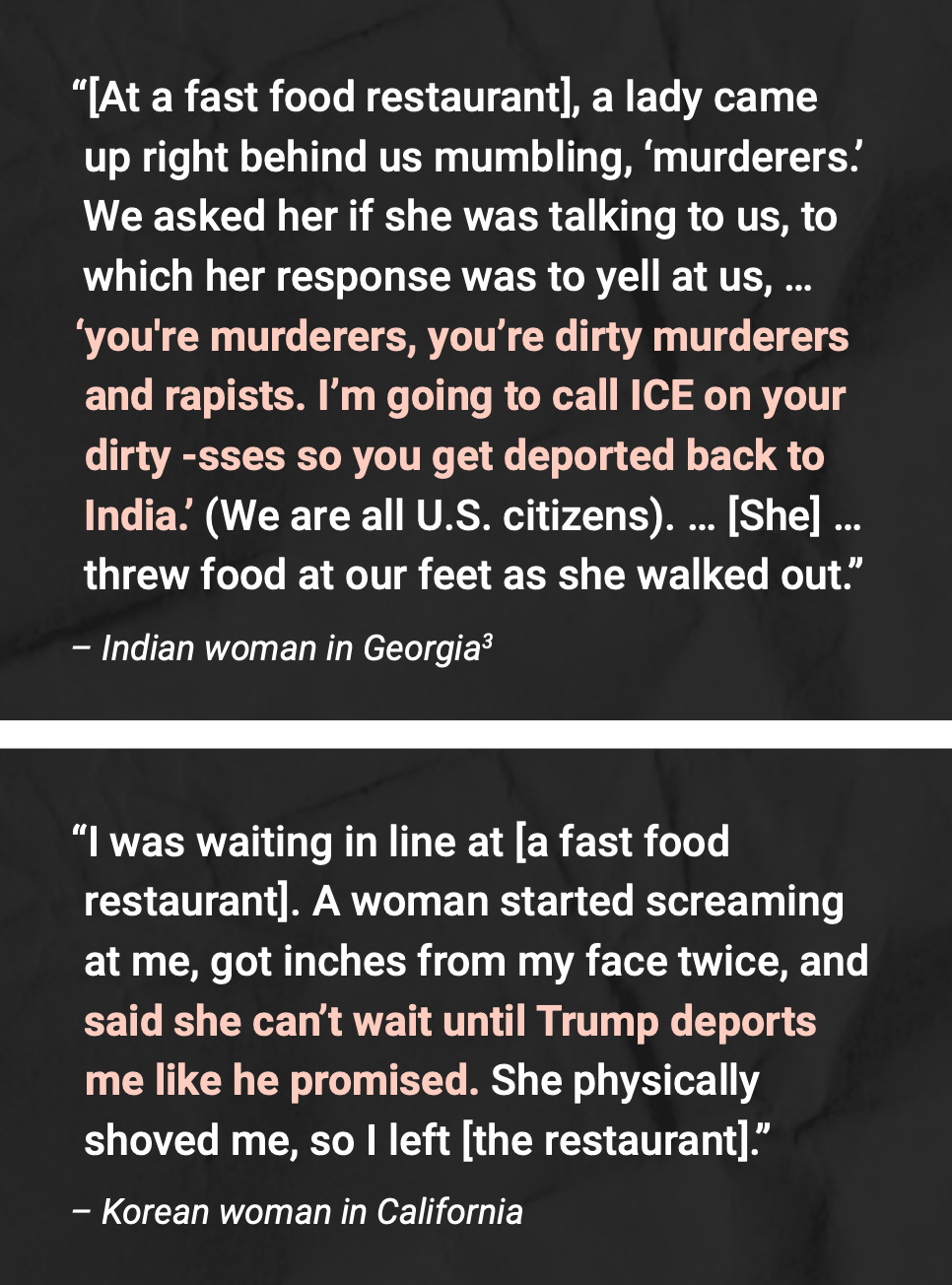
This is where the “trifecta of hate” comes in: 1) harmful rhetoric, 2) discriminatory policies, and 3) the acts of interpersonal hate they enable. Harmful ideologies like racism and xenophobia manifest in racist rhetoric. This rhetoric justifies exclusionary and discriminatory policies. And both create the conditions for state actors and private citizens to commit acts of hate – whether it’s an individual hurling a slur in public, a student facing discrimination at school, or the government enabling racial profiling in ICE raids.
The trifecta of hate has only intensified since 2020, driven year after year by a relentless stream of xenophobic political rhetoric and racist policies. And across these years, there is a common denominator powering the trifecta: Donald Trump and his allies.
Early on in the pandemic, anti-Asian hate surged alongside bigoted rhetoric from Trump – including his repeated use of the racist phrase “kung flu” – which fueled the scapegoating of Asian people. He then launched his 2024 campaign marked by xenophobic rhetoric and policy proposals. Now, his administration is advancing a sweeping anti-immigrant agenda that is inspiring acts of interpersonal hate.
Deliberate Political Weaponization
To make matters worse, Trump and other elected officials have long weaponized geopolitical conflict to justify anti-Asian hate. We have repeatedly seen politicians use flashpoints of tension between the U.S. and China to foment racialized suspicion and hostility toward people perceived as Chinese.
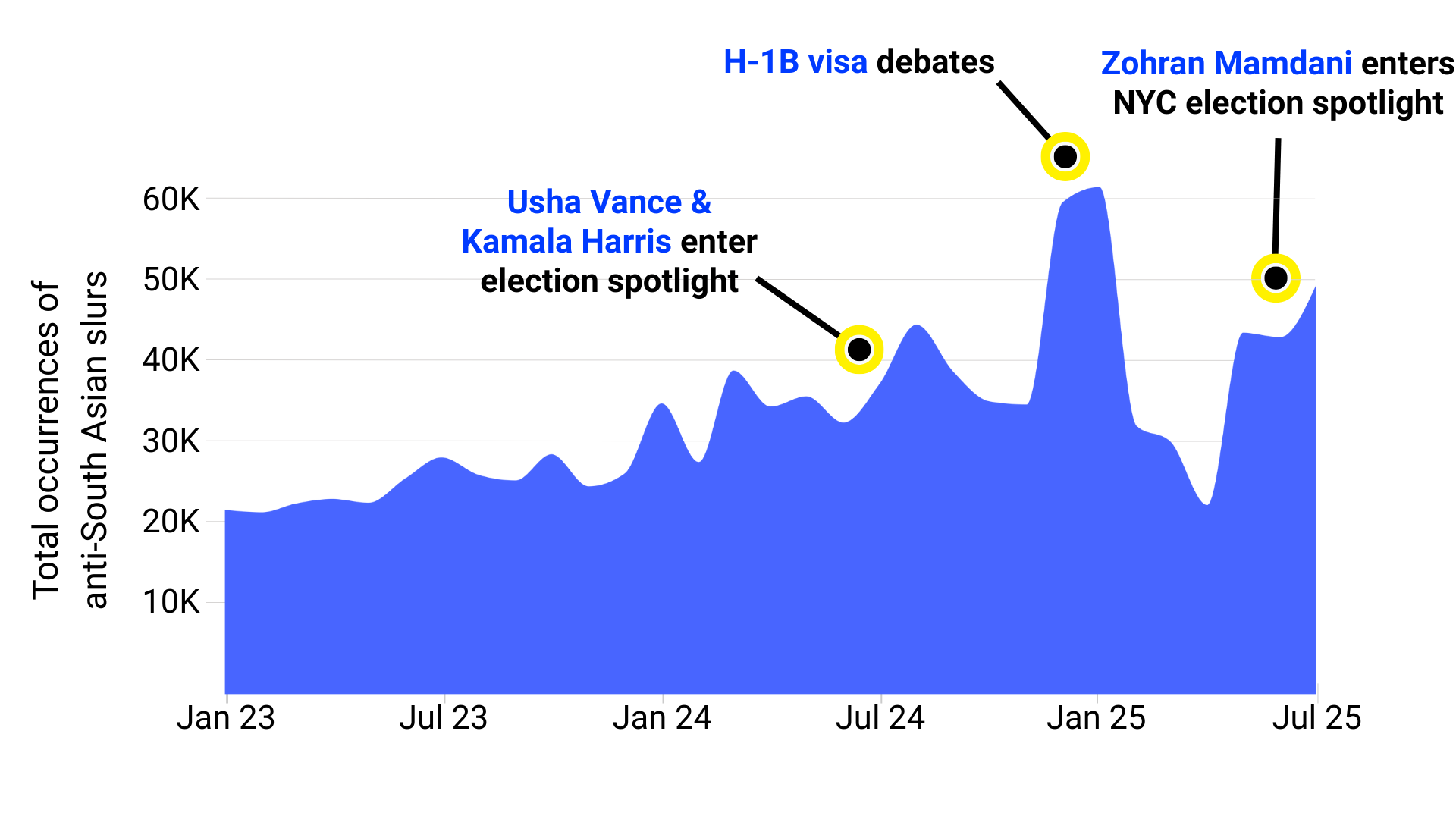
South Asian communities have also faced targeted attacks, as politicians – including Trump and J.D. Vance – continue to normalize anti-Indian hate, amplify racist rhetoric, and support policies that unfairly punish South Asian immigrants. This has brought devastating consequences. For example, Stop AAPI Hate found that spikes in Islamophobic and anti-South Asian posts online coincided with the recent debates over H-1B visas as well as moments when prominent Indian American political figures such as Kamala Harris, Usha Vance, and Zohran Mamdani were thrust into the national spotlight.
Anti-South Asian Slurs in Online Spaces Associated with Targeted Violence (January 2023-July 2025)
Source: Moonshot, Chart: Stop AAPI Hate
This intensely xenophobic political climate has created a hostile environment in which waves of racism can be easily sparked, causing frequent and deep harm. In fact, our latest survey found that 53% of AA/PI adults say either they or another AA/PI individual they personally know has felt the harms of anti-immigrant policies and sentiment under Trump – a finding that applies to both those with and without U.S. citizenship.
Our years of research paint a clear pattern: when racist political rhetoric and policies persist, so do acts of anti-Asian hate.
Political leaders do not just reflect public sentiment – they shape it. Their words define who is seen as American and who is cast as “other.” Their policies signal who is protected and who is targeted. When leaders use racist rhetoric or advance xenophobic policies, they create the conditions in which hate thrives. Right now, those conditions persist.
The danger is not only that anti-Asian hate remains high – it’s that we have also stopped paying attention. Because when attention fades, so does accountability. And when accountability fades, harm continues unchecked.
How We Effectively Counter The Hate
If we are serious about confronting hate, we cannot treat it as a temporary crisis that flares up and disappears. We must recognize it as a systemic issue that requires sustained actions such as investing in organizations that support survivors and prevent violence, holding political leaders accountable, and openly rejecting the myth that anti-Asian hate is no longer an urgent issue.
Many are already taking action. In recent years, advocates have secured major new investments – such as California’s historic $140 investment in the Stop the Hate program that has benefitted millions by providing legal assistance for victims, mental health services for seniors, workshops for youth to address hate in their schools, and more.
At the same time, Asian American communities have also been building political power, increasing visibility, and advancing strategies that prioritize preventing hate rather than only responding to it.
Without this ongoing advocacy, it’s very well possible that we could have seen even sharper increases in anti-Asian hate rather than the persistently high levels we see today. All of the gains matter – not because they signal the problem is solved, but because they show what sustained resistance can achieve even in the face of escalating attacks.
And that is precisely why we must continue to act.
Cynthia Choi is a Co-Founder of Stop AAPI Hate and the Co-Executive Director of Chinese for Affirmative Action. With over 30 years of experience in the nonprofit sector, she has led local, state, and national community-based organizations and initiatives on a range of issues from racial and gender justice to violence prevention.
Manjusha Kulkarni is a Co-Founder of Stop AAPI Hate and the Executive Director of AAPI Equity Alliance. A prominent civil rights advocate and lawyer recognized for her work in addressing anti-Asian hate, she was appointed to California Commission on Asian and Pacific Islander American Affairs (CAPIAA) in January 2026.

Qasim Rashid is a human rights attorney, author, and host of Let’s Address This. Share, and let’s remain relentless in our mission for a more perfect Union.
Equality will not be realized until we physically remove the criminal scum from the White House, from totally controlling the media, from the bench of SCOTUS and by taxing the multi billionaires out of existence!
Thank you for this piece. I also saw this piece from ACLU Wisconsin earlier today.
https://www.aclu-wi.org/news/racial-profiling-rampant-after-supreme-court-ruling/