


There is a coordinated campaign underway in America today, operating simultaneously at the federal and state level, targeting one of the country’s most fundamental guarantees: the right of every American to freely practice their faith. And the same war hawks who, this week alone, militarily threatened Pope Leo, bombed the Rafi Nai Synagogue in Iran, and murdered more than 300 Christians and Muslims in Lebanon, are also behind this dangerous domestic campaign.
Its architects have dressed it up in the language of national security, constitutional order, and Western values. But strip away the buzzwords, and what remains is something far older and far uglier—the deliberate use of fear, ignorance, and disinformation to scapegoat a religious minority for political gain.
The weapon of choice? Two words: Shariah law.
Before we examine what is happening and who is doing it, let’s start with what those two words actually mean. Because if you are going to wage a campaign against something, the least you can do is understand what it is.
In honor of two years of Let's Address This, you can now become a paid subscriber to our human rights platform dedicated to social justice and the facts that corporate media ignores at 50% off until April 23. For a limited time, it is $25 for an annual subscription to support this work.
What Shariah Actually Is
The word “Shariah” comes from the Arabic word for a path to life-giving water. Remarkably, the root of the Hebrew word Torah means precisely the same thing. Shariah, in other words, is not some alien concept hostile to the West. No, it is, at its linguistic and theological root, an expression of the same Abrahamic impulse toward divine guidance that gave the world the Torah and the Gospel.
Shariah is comprised of five main branches: adab (behavior, morals and manners), ibadah (ritual worship), i’tiqadat (beliefs), mu’amalat (transactions and contracts), and ‘uqubat (punishments). Together, these branches form a framework for a life rooted in justice, compassion, and personal accountability before God.
Critically—and this is the fact most frequently buried under the political noise — Shariah forbids that it be imposed on any unwilling person. This is not a footnote. It is a foundational principle. The Qur’an states plainly: “There is no compulsion in religion.” (2:257) Prophet Muhammad himself, even as the de facto ruler of Arabia, codified this in the Charter of Medina, under which Muslims were held to Shariah and Jews to the Law of the Torah. Not a single non-Muslim was held to Islamic law, because Islamic law itself prohibits such coercion.
In other words, Islamic Shariah specifically and explicitly rejects theocracy.
Do Muslims want Shariah to impose itself on American law? No. Shariah is a personal relationship between a believer and God. American Muslims are, in fact, obliged by Shariah itself to be loyal to their nation of residence and to uphold its laws. The U.S. Constitution is the supreme law of the land—and Shariah does not conflict with that. It demands that.
What does Shariah say about other religions? It champions absolute freedom of conscience. The Qur’an goes so far as to oblige Muslims to fight on behalf of Jews, Christians, and people of other faiths and to protect their churches, synagogues, and temples from attack (22:41). To be Muslim, a person must testify to the truth of all past prophets—including Jesus, Moses, Abraham, Krishna, and Buddha—and must respect their adherents.
And what about the countries that oppress people in the name of Shariah? They have ignored the fundamental requirement of justice that sits at the heart of Islamic law, using religious language to sanctify what is, at its core, a power grab. As I have written previously, not a single genuinely “Shariah-compliant” country exists today. Ironically, the country that most closely reflects Shariah’s core values—freedom of religion, freedom of speech, freedom of conscience, freedom of thought—is America itself. Or, at least it is supposed to be. Those who oppress in the name of Shariah are no more justified than the “Christian” enslavers who claimed the Bible gave them the right to hold Black people in bondage.
That is Shariah. A spiritual path. A personal framework. A call to justice. Nothing more, nothing less.
Now Look at What Is Actually Happening
With that foundation established, look at what a group of sitting members of the United States Congress have been saying in recent weeks.
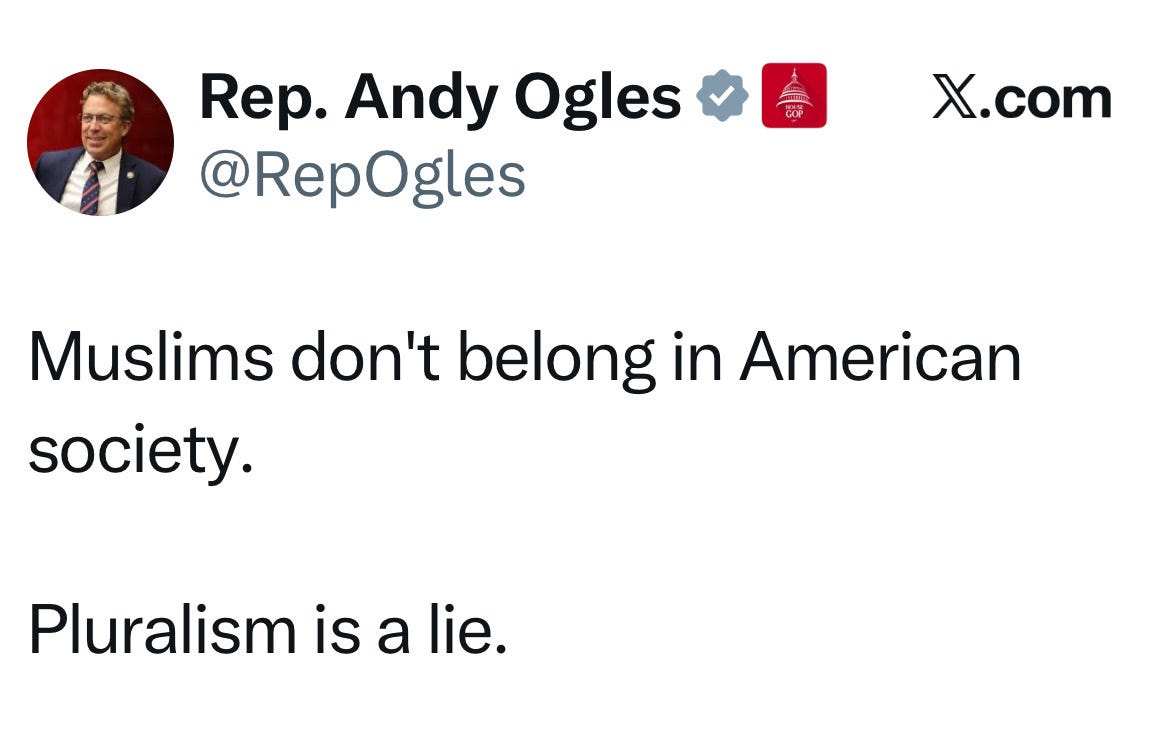
Rep. Andy Ogles of Tennessee declared that “Muslims don’t belong in American society” and that “pluralism is a lie.”
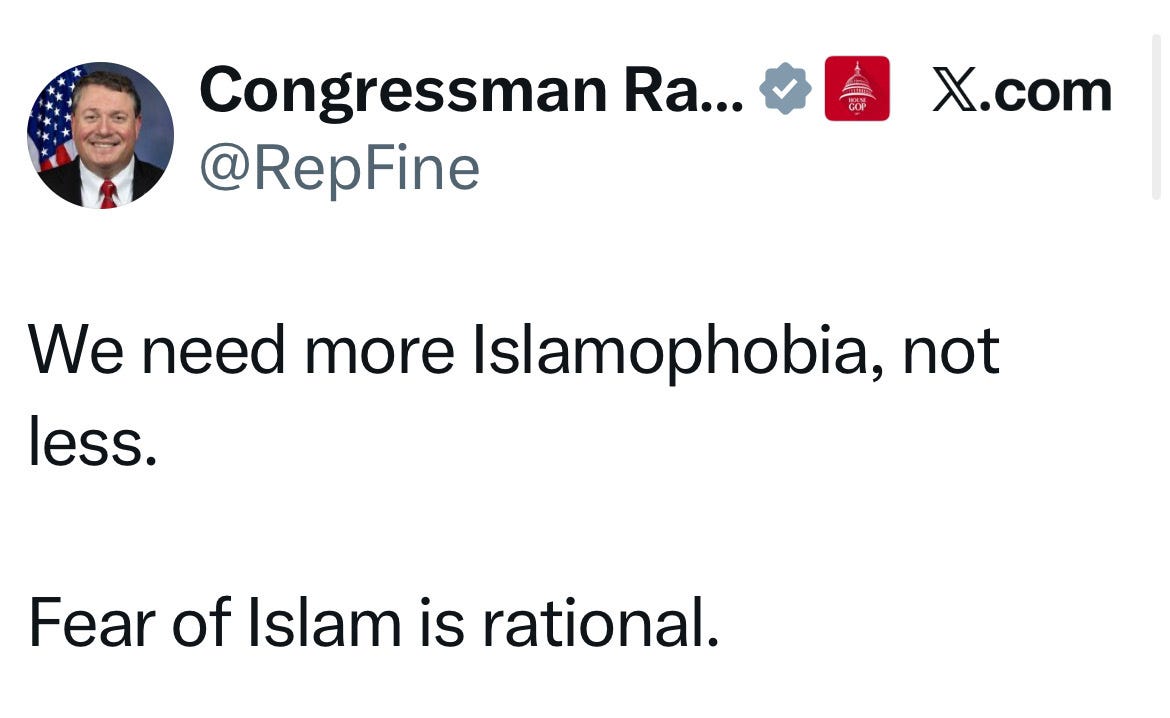
Rep. Randy Fine of Florida posted that “we need more Islamophobia, not less” and that the choice between dogs and Muslims “is not a difficult one” — a statement so extreme that it drew condemnation from Jewish leaders, CNN anchors, and Israeli-born former officials who called it reminiscent of the language used against Jews in Nazi Germany.
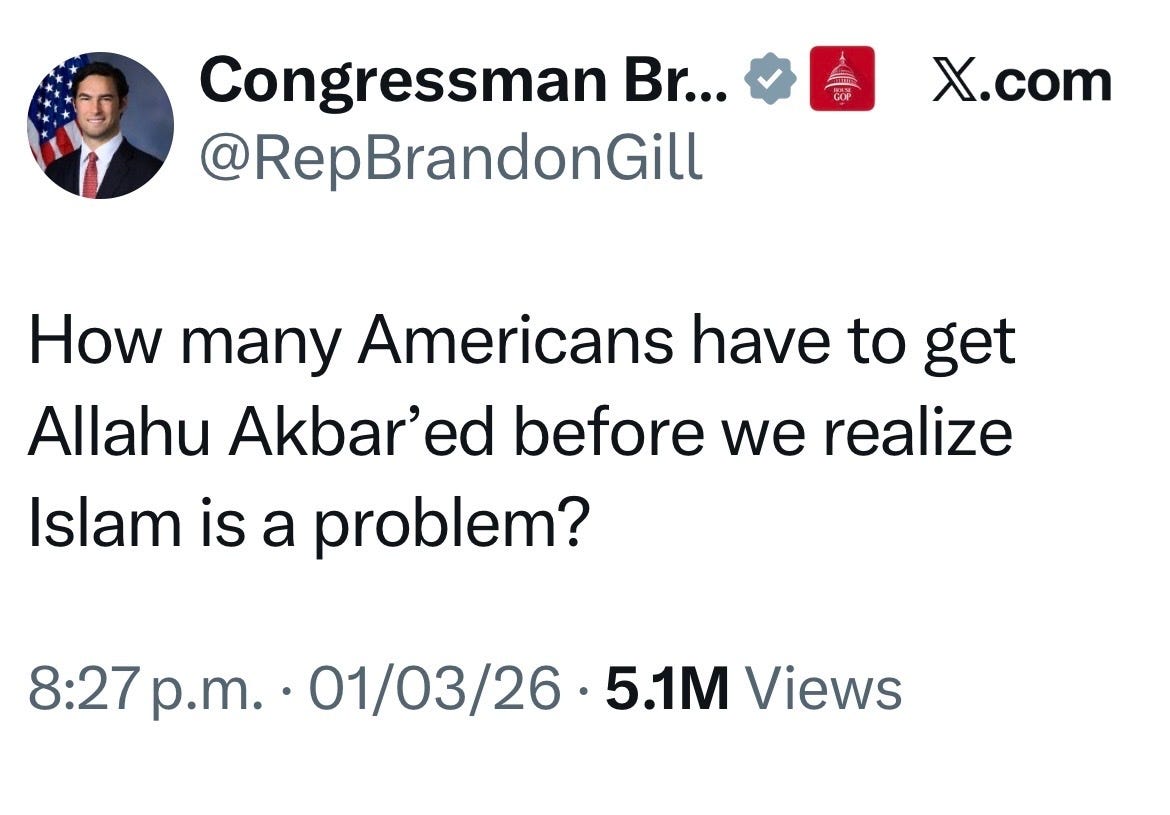
Rep. Brandon Gill of Texas called Islam itself “a problem.”
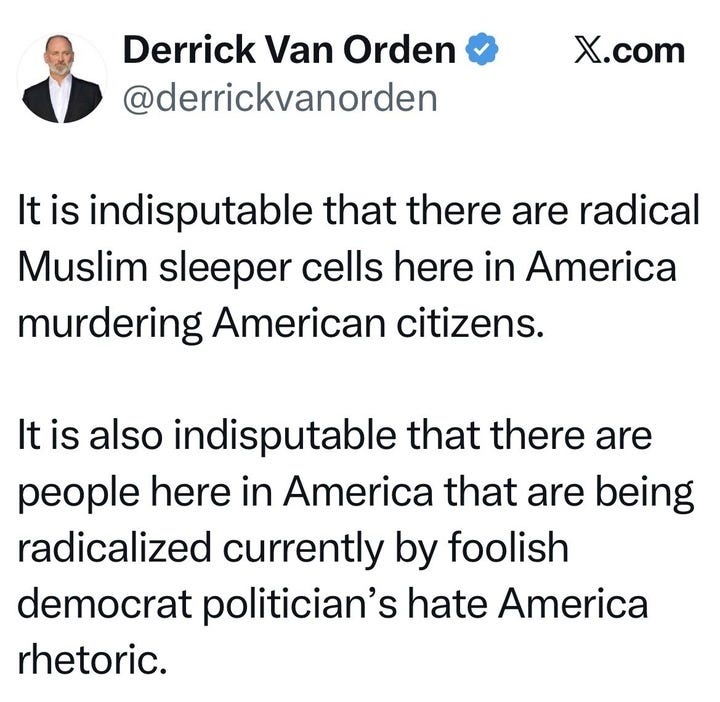
Rep. Derrick Van Orden of Wisconsin invoked the specter of Muslim sleeper cells.
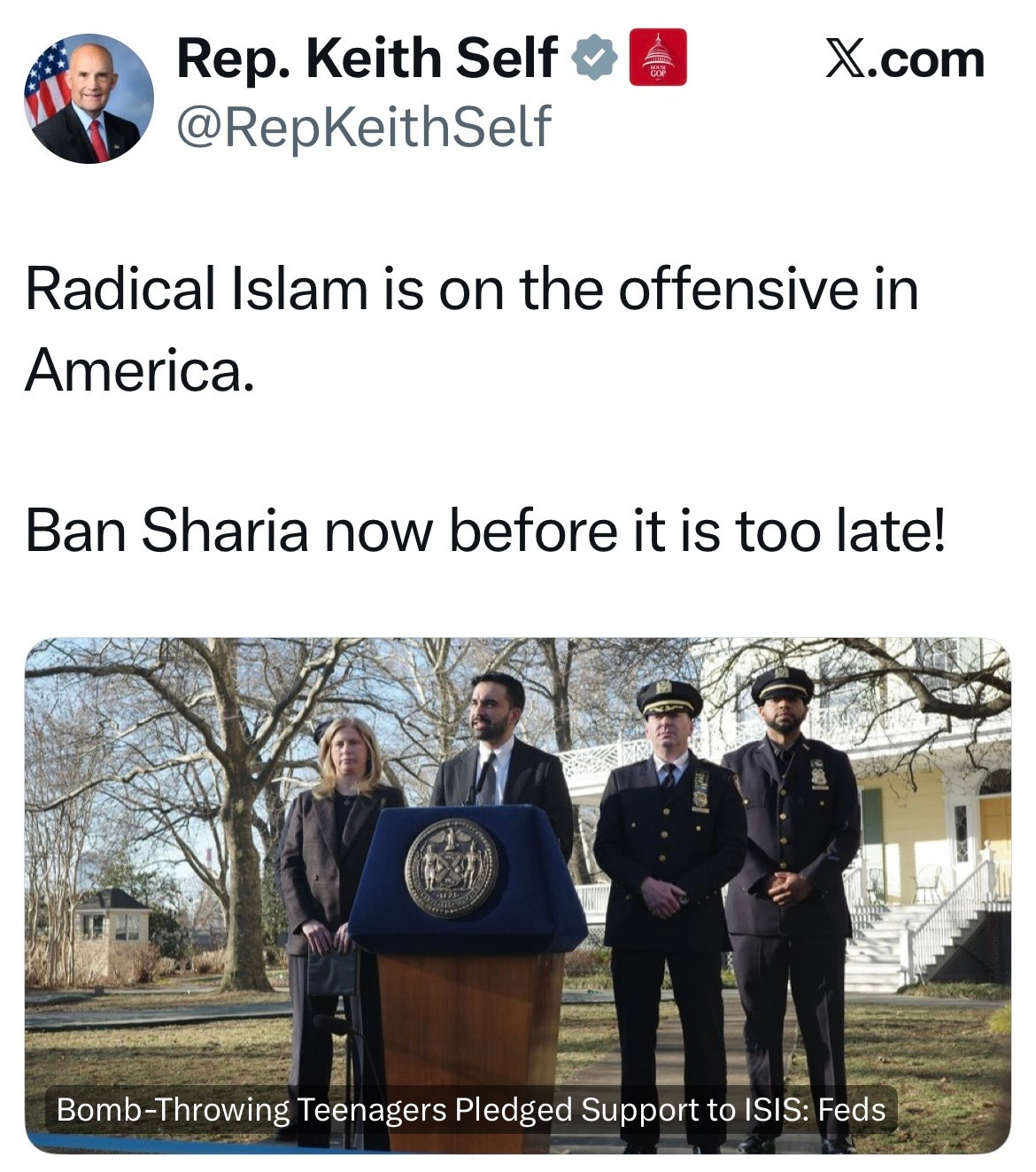
Likewise, Rep. Keith Self of Texas co-chairs what he has branded the “Sharia-Free America Caucus,” a congressional body now boasting 59 members across 24 states whose stated mission is to “save Western Civilization.”
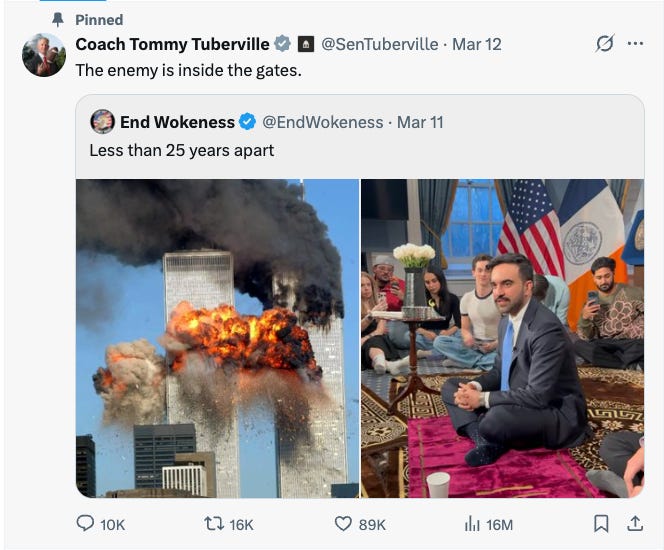
Senator Tommy Tuberville referred to Muslims as the “enemy inside the gate.” As of the writing of this article it is literally his pinned tweet on Twitter.
This is not fringe. This is not a handful of isolated bad actors mouthing off on social media. This is coordinated, escalating, and increasingly normalized rhetoric from elected officials who hold real power over real laws that affect real people.
The Coordination Is the Story
And this is why it is so critical we recognize the connection between domestic and foreign policy. The same war hawks funding Netanyahu and bombing Iran also seek to strip rights and protections from Americans who are Muslim here at home. Moreover, that’s only part of what makes this moment particularly alarming. Beyond the rhetoric—the fact is that this domestic anti-Shariah campaign is operating simultaneously at the federal and state level, with unmistakable signs of coordination. When members of Congress, state governors, and state-level candidates are all using the same language, pushing the same legislation, and amplifying the same disinformation, that is not coincidence. That is strategy.
At the federal level, the “Sharia-Free America Caucus” has introduced two separate bills aimed at banning Shariah. In Oklahoma, Republican state lawmakers have introduced a state bill to the same effect.
In Texas—which has become perhaps the most aggressive battleground in this campaign—“banning Shariah” has become a genuine electoral platform. The state has ten members of the congressional Sharia-Free America Caucus alone.
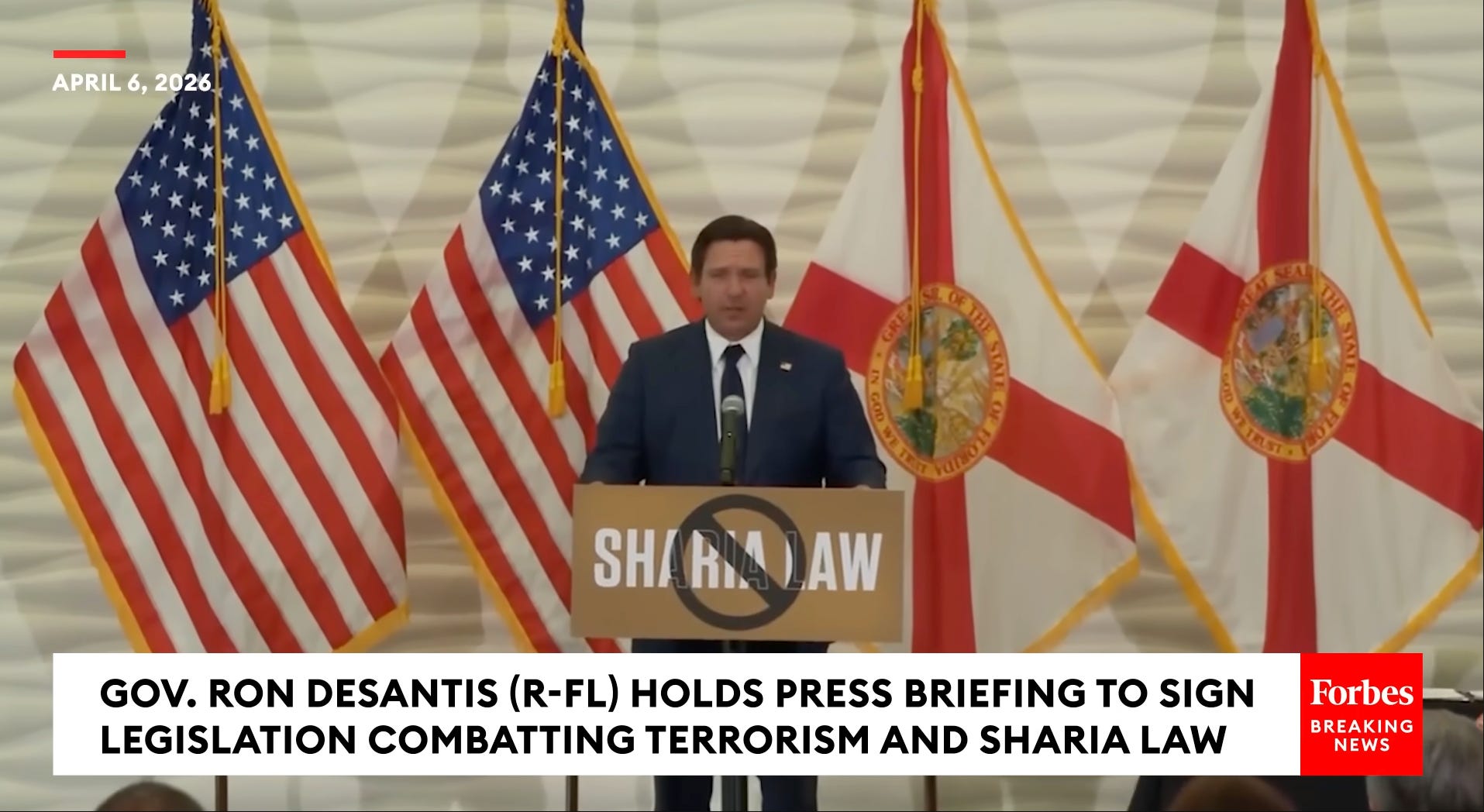
And just this week, Florida Governor Ron DeSantis signed HB 1471 into law—a sweeping piece of legislation that bars Florida courts from applying what it characterizes as foreign or religious law, with Shariah explicitly in its sights. DeSantis called it the “strongest action” any state has taken against what he termed “stealth jihad.” The Council on American-Islamic Relations immediately called the law “draconian” and warned it threatens free speech, religious freedom, and due process for Muslim Floridians. Legal challenges are already anticipated.
In Georgia, State Senator Greg Dolezal is running for Lieutenant Governor on a platform centered on—not education, not infrastructure, not healthcare—but on banning Shariah law. Yes, a candidate for the second-highest office in the state of Georgia has made the suppression of a religious minority’s personal faith practices his central campaign promise. (Fortunately he faces a Democratic challenger who, as fate would have it, is former Georgia State Senator Nabilah Islam-Parkes—an American Muslim woman of color. More on her in a future article, I promise).
Nobody wins when a government decides that one faith group’s private religious practice is a threat to civilization. When the government is empowered to determine which religious laws are acceptable and which are not, every faith community is at risk. The Minister who performs a wedding ceremony, the Catholic Bishop who administers last rites, the Rabbi who performs a circumcision—all of them operate under religious law. If Islamic Shariah can be banned, so can theirs. If the First Amendment doesn’t apply to one faith group, it will be stripped of every faith group. Rights that are not universal are not rights at all. They are privileges, revocable at the whims of whoever holds power.
The Real Target Is Religious Freedom Itself
Here is the part that these politicians count on you not knowing: banning Shariah does not just affect how Muslims worship. It directly undermines their ability to marry, inherit, write wills, and pursue divorce according to their faith. American Jews have long resolved civil matters through rabbinical courts known as beit din—a constitutionally protected exercise of religious freedom. American Muslims seek nothing more and nothing less than the same right. The First Amendment guarantees it. These bills threaten to strip it away.
And the campaign does not stop at legislation. It operates through dehumanization. When a sitting congressman says the choice between dogs and Muslims is easy, he is not making a policy argument. He is doing something far more dangerous—he is removing the humanity of six million American citizens in a single sentence. History teaches us, with brutal consistency, where that road leads.
As NPR has reported, what makes this moment uniquely dangerous is that, unlike in previous eras when such rhetoric drew rebuke from Republican leadership, today’s anti-Muslim statements are met largely with silence—or worse, encouragement—from the top of the party. That normalization is not incidental. It is the point.
Unfortunately, we see little comparative pushback from the Democratic Party. Some leaders like Ro Khanna have loudly spoken up against this hate, but we see no meaningful coordinated response to this highly coordinated hate campaign. That matters, because silence in the face of injustice risks complicity, dangerous complicity.
Why This Matters — And What We Do Next
This is exactly why I built Let’s Address This. Not to echo what you already know or soften the truth. But to confront the narratives that powerful people rely on going unchallenged—and to do so with clarity, facts, and accountability. Because when disinformation spreads this freely, silence is not neutral. It is complicity.
Every piece I publish on this platform is free to read and free to share, because access to truth should never depend on your ability to pay. But this work is only possible because of readers like you.
If you believe in independent, human rights–focused media that holds power accountable, I invite you to support this platform. Right now, in honor of our two-year anniversary, annual subscriptions are 50% off.
Thank you for being part of this movement—and for helping ensure the truth reaches those who need it most.
Qasim Rashid is a human rights attorney, author, and host of Let’s Address This, a platform dedicated to human rights, social justice, and the facts that corporate media ignores. Subscribe for more.
A version of this article was published on my platform Islam Today, launched to combat the systemic rise of anti-Muslim hate and Islamophobia. If interested in reading more researched scholarship, support our mission of education as a free or paid subscriber.
Thank you for reporting on this. The ignorance and hatefulness of these elected representatives is astonishing. And for the general citizenry not to understand that attacks on one group's religious freedom is an attack on everyone's religious freedoms -- it's simply prejudice pretending to be patriotism.
Thank you for writing this!