


This weekend I watched the new Superman movie, direct by James Gunn, and it is a strong contender for the best Superman movie yet. The Superman franchise is not paying me to write this review, nor do I have any contact with anyone associated with the film. I’m writing this because I feel compelled to share a powerful work of art that speaks to the human rights issues I care so deeply about. Walking into the theatre I’d seen murmurings from MAGA pundits that the movie was “woke” (used as a pejorative of course) and even “anti-Israel.” Not only are these claims unfounded, in reality, the film demonstrates the power of storytelling, the need for justice, and makes us wonder—who are the real superheroes in our world today?
Let’s Address This.
NOTE: Spoilers below. If you have not yet seen Superman, you can stop here and avoid spoilers. Otherwise, please proceed!
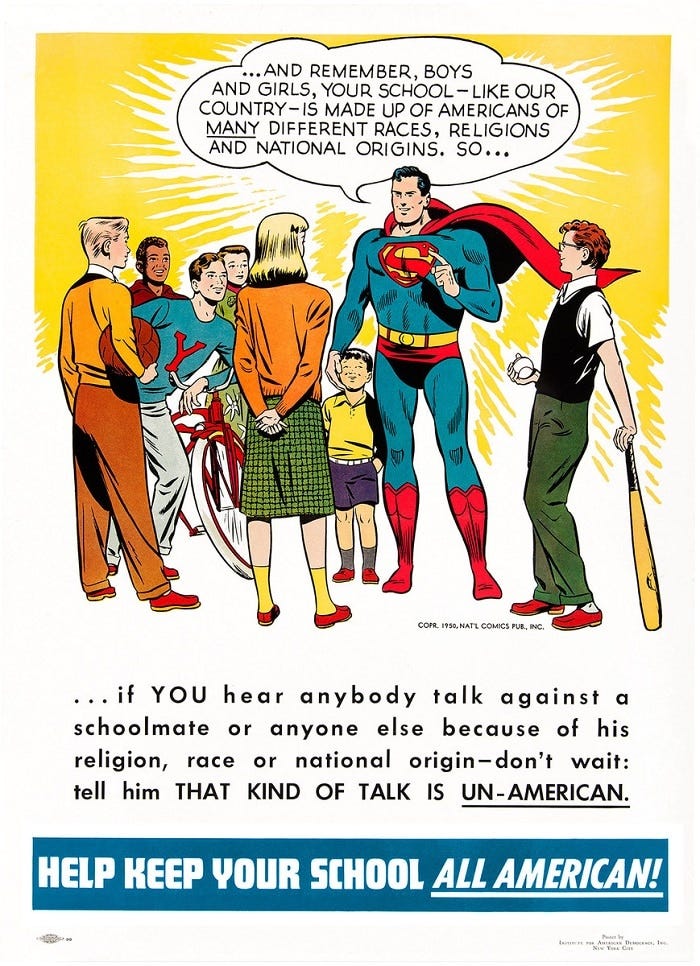
Is Superman ‘Woke?’
The above 1950s era comic answers this question. Not only is being Woke a good thing in terms of respecting human dignity and diversity, it is who Superman always was. This was Superman in Jim Crow America—an immigrant alien orphan raised by a childless couple and taught to accept all religions, races, and nationalities. Superman was the de facto anti-establishment anti-corruption anti-nationalist superhero. Those offended by that notion of inclusivity either never understood why Superman was created, or want to transform him into a right wing zealot to appease their own egos. Either way, with this bizarre alleged criticism of ‘woke,’ they reveal much about themselves. Now let’s dive into the film.
A Timely Commentary on Earth 2025
I assure you Let’s Address This is not transforming into a movie review platform. Yet I feel compelled to write about Superman because its parallels with politics and human rights today cannot be ignored. Movies have often served as water carriers to glorify war and nationalism, e.g. American Sniper, Top Gun 1 and 2, and Air Force One, among many others. Superman does the opposite, and appeals to our inner and innate humanity to care for one another, to place public good above personal greed, and to recognize the need of heroes to speak up and step up for marginalized communities today. With that, let’s dive into the plot.
The Plot
Superman focuses on a conflict between two fictional neighboring nations, Boravia and Jarhanpur. Boravia is an American ally for decades, a nation who has received $80 billion in military aid from the United States through defense contractor Lex Luthor. A nation with a history of grotesque human rights violations, ruled by the imperialist President Ghurkos (more on him later), yet gets away with it because it is, after all, an American ally. And a nation who wants to conquer Jarhanpur to ‘free it from its tyranically dictator,’—an excuse we soon learn is largely western propaganda. Jarhanpur, by comparison, is a poorer and underdeveloped nation with no real army. It’s residents prepare to fight Boravia’s massive military with sticks, stones, and pitchforks. And as they face destruction, Superman intervenes and forces back the Boravian military.
We quickly realize Boravia and Jarhanpur are metaphors for both Israel and Palestine as well as Russia and Ukraine. This is also why I find it fascinating that some claim the movie is “anti-Israel.” In fact, the movie is anti-imperialism. And given the noted distinction that the Jarhanpurians are brown skinned and not physically dissimilar to Palestinians, the movie’s resemblance to Israel’s aggression against Palestine largely also applies to Russia’s aggression against Ukraine. However, I’ve yet to hear anyone from the right claim the movie is “anti-Russia.” Why? Because they recognize Russian aggression against Ukraine as unjust and illegal, yet refuse to apply the same rules to Israel’s occupation of Palestinian lands and current invasion and occupation of Gaza. As the film progresses, the forces of evil seek to advance Boravia’s war of aggression against Jarhanpur, all with US backing and support. Because, after all, horrific human rights violations notwithstanding, the United States stands by it’s ally Israel Boravia.
The Players
Each of the main characters play a role that well corresponds with contemporary society. It isn’t subtle, either. And that’s what makes the film such an impactful experience. It doesn’t offer whitewashed aspirations of right and wrong, but speaks truth to power unequivocally.
Superman: Played by David Corenswet, the film makes no secret of the fact that Clark Kent is an undocumented illegal alien orphan, raised by an anonymous childless couple. Despite facing torture to reveal the identity of his adopted parents, Superman resists, knowing full well Luthor will kill them if he finds out. In fact, the one martyr is an apparently Muslim food truck owner named Malik Mali Ali, who had earlier attempted to help Superman. This act of solidarity enraged Lex Luthor, who kidnaps Ali to use him as leverage against Superman. Luthor tortures Superman to reveal his parents’ identity, and when he does not, Luthor executes Ali with a bullet to his head. Right now, anti-Muslim hate crimes are at record highs—most of which corporate media ignores. Right now, by some estimates the genocide in Gaza has killed more than 300,000 Palestinians—all of whom the United States and the Israeli government deems expendable. Thus, the symbolism of a portraying a Muslim American martyr as an expendable casualty did not go unnoticed to this Muslim American writer.
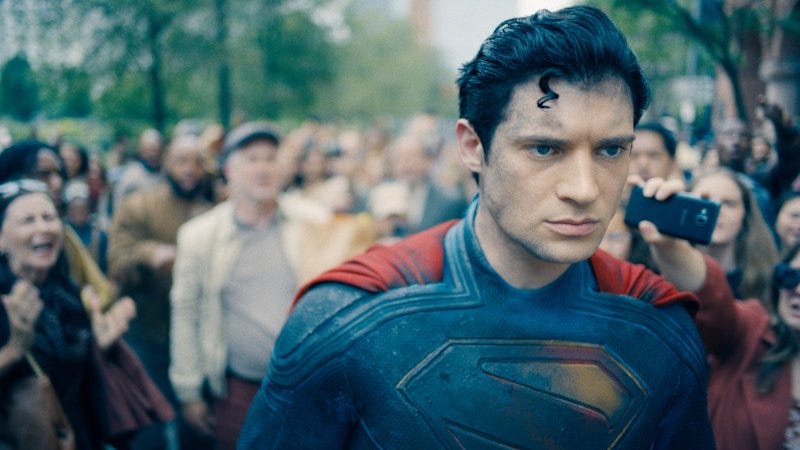
As another stark similarity, a Department of Defense official makes clear to Superman that because he has no documented status, he therefore has no rights and due process of law in the United States. While in reality the United States Constitution affords due process to all people, documented or not, the film’s commentary speaks to the fact that this due process is being unjustly denied. And thus, to further emphasize the point, just as the US Government is outsourcing immigrants to private contractors to lock into torture camps and gulags on foreign soil, in the movie the US Government outsources Superman’s detention and torture to billionaire sociopath Lex Luthor, who traps Superman in a tiny torture chamber in a pocket universe and in a different dimension.
Lex Luthor: Played by Nicholas Hoult, the film leans in to the modern tech bro billionaire brand of a man who is allegedly a genius, hopelessly corrupt, and openly envious of everything he doesn’t have. Luthor is the lead villain, with several villains under his direction. He is a man who demands total control and compliance, has every tech gizmo imaginable at his disposal, virtually unlimited wealth (yet somehow wants more), and commands a team of insecure minions who hang on his every word (DOGE employees, anyone?). There’s even a moment where we see Luthor’s army of online social media influencers—literally monkeys locked in cages trained to sh*t post rage bait against the film’s hero, Superman. An astute commentary on how mindless bots drive online outrage.

Luthor is a combination of Elon Musk and his reliance on government contracts and shady dealings with foreign governments, Peter Thiel and his eugenicist style obsession with using technology to ‘perfect’ humanity and make himself immortal, and Donald Trump and his obsession with power and wanting to be a king. It is revealed that Luthor is helping Boravian President Ghurkos invade Jahanpur in exchange for sovereign kingship over half of Jahanpur—again—a not so subtle jab to Jared Kushner boasting about “beachfront property” in Gaza or Trump’s AI generated propaganda video of a Trump Gaza hotel.
Lois Lane: Played by Rachel Brosnahan, Lois Lane’s story arc represents the hope of what journalism is supposed to be. She begins by grilling Superman for his uninvited intervention that stopped Boravia from invading Jahanpur, focused on whether he had the proper approvals to stop a war, rather than on the principle that Superman saved the lives of innocent people who would have otherwise been murdered. She admits that her and Superman are opposites, because she inherently questions everything and everyone, and Superman inherently trusts everyone and sees the good in them. It is only when she sees the injustices imposed on Superman that she decides to take meaningful action to stop billionaires and the US Government from colluding to deny basic humanity. Lane partners with fellow journalists to uncover Luthor’s conspiracy with Boravian President Ghurkos, and turns the public opinion back in favor of Superman. She likewise partners with Mr. Terrific to risk her life to save Superman.

The overall media ethos in the movie is that of demonstrating how, just like in real life, billionaire influenced and billionaire run media is devastating our society with misinformation, disinformation, and flat out propaganda. In that backdrop, Lane ultimately emerges as a principled journalist—not without her flaws—but with a bent towards social justice for working people.
Bovarian President Vasil Ghurkos: Played by Zlatko Burić, President of Boravia, Vasil Ghurkos appears as a brilliant fusion of Vladamir Putin and Benjamin Netanyahu. A man who is deeply corrupt while claiming to stand for democracy and rule of law, bent on imperialism while claiming to oppose tyranny and war, and full of bravado while sending a powerful military to massacre children from the comfort of his bunker.

And as he sends young people to massacre innocent civilians, he hides behind a camera and makes secret deals with billionaires. Ghurkos effortlessly weaves together everything detestable about politicians into one soulless person, and reminds viewers why Putin and Netanyahu are both wanted by the ICC for war crimes.
The Justice Gang: Featuring Mr. Terrific, the Green Lantern, and Hawk Girl, the Justice Gang’s story arc directly rebukes the cowardice of bystanders. Early in the film they refuse to help save Superman for fear of being viewed as “political.” Mr. Terrific, notably a Black superhero, is the first to break from this apathy and decides to help Lois Lane find and save Superman from his prison in the pocket universe.
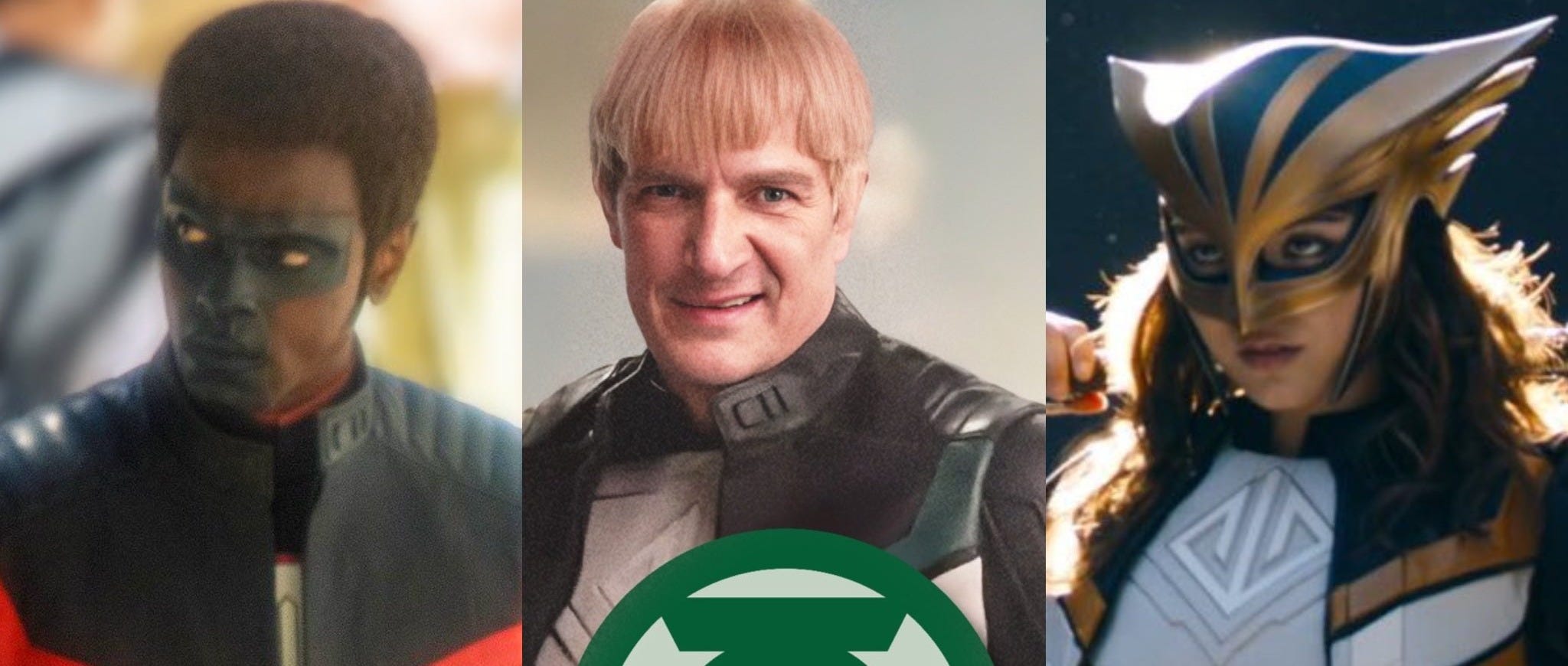
Towards the end of the film, the rest of the Justice Gang shows up to protect the Johanpurians from the impending annihilation they were about to face from the powerful U.S. backed Boravian military. The lesson is clear—when it comes to basic human rights and dignity, remaining silent is choosing to be complicit in genocide. That it is incumbent upon all of us to step up and support the marginalized, as that is how ultimately protect our humanity.
Political Detainees: The film depicted hundreds, if not thousands, of innocent people detained in cages inside Luthor’s pocket universe, all for the ‘crime’ of criticizing Lex Luthor, posting unflattering commentary about him, or for opposing war and genocide. This was clearly a direct jab at the United States government denying due process of law and arbitrarily and cruelly detaining in cages innocent people like Kilmar Abrego Garcia, Mahmoud Khalil, Rumeyza Ozturk, and more. Indeed, experts estimate that of the 204,000 people that ICE has detained without due process of law, 93% have no criminal record or record of violence whatsoever.
The meta human who tortures Superman with kryptonite does so because Luthor holds his son hostage. It is only after Luthor executes Ali, that he realizes that Ali’s life was no less valuable than his son’s life, and chooses to help Superman. To me, this was a message that none of us are free until all of us are free, and we cannot trade lives for human dignity. This is also a call out to a beautiful teaching both in Judaism and Islam, where we are taught that to kill one life is to kill all humanity, and to save one life is to save all humanity.
Additional Character Similarities: Superman fights an army of fascists called The Raptors, who hide their faces and conceal their identities—a knock on anonymous ICE agents. A newspaper headline briefly asks if a billionaire is funding the next Metropolis mayoral candidate—perhaps a knock on what we’re seeing in NYC with billionaires getting behind Cuomo and Adams to oppose Mamdani. But certainly a knock on unlimited money in politics corrupting our Republic. Superman’s Earth parents are a childless couple that he has to keep anonymous, because their safety is in danger for harboring an ‘illegal alien immigrant,’—a knock on the Trump regime raiding homes, schools, and hospitals to intimidate anyone who would give immigrants sanctuary. We see corporate media platform Lex Luthor to demonize Superman, without any fact checking or verifying of Luthor’s claims. Perhaps the one unrealistic part was their retraction of supporting Luthor towards the end of the film, because I do not recall corporate media like the New York Times or Washington Post ever actually admitting they were wrong to platform and enable Trump and genocide.
The Movie Heroes vs Real Life Heroes
Finally, as I walked out of the film I began to ask myself—who are the real life superheroes of today? None of us can fly, or shoot laser beams out of our eyes, or exert super human strength. But the film answers this question too. In the penultimate moment of the film Superman implores to Lex Luthor that his strength is not because he is physically strong or because he can fly—but because he is ultimately as human as anyone on Earth, and persists on with courage and heart despite his many mistakes and flaws. His strength, Superman insists, is not in his muscle, but in his courage to continue putting one foot in front of the other and fight for what is right against all odds. Thus, we see clearly who are today’s superheroes.
It’s leader like Ms. Rachel, who speak up for Palestinian babies suffering genocide, despite vicious attacks against her character and safety. Film director Ava DuVernay, who continues to use her massive platform to call out the injustices in American foreign policy in Palestine. It’s Senator Chris Van Hollen who uses his position of power and privilege as an elected official to oppose war, oppose concentration camps, and oppose denial of due process—even traveling to El Salvador to meet with Kilmar Abrego Garcia. It’s US Veterans standing with Afghan refugees at their immigration hearings, to protect them from ICE fascists. It’s Barbara Stone, a 71-year-old grandmother arrested by ICE for protecting immigrants at a San Diego immigration center. It’s Mahmoud Khalil, Rumeysa Ozturk, and Mohsen Mahdawi for fearlessly speaking up for justice despite government tyranny targeting them to destroy their lives.
It’s the people of Palestine and the people of Ukraine, standing up to tyrannical invasion and destruction from an imperialist corrupt politician who cares nought for human rights and international law. It is every person who refuses to sit silent as we watch an ongoing genocide broadcast in real time, on our phones, laptops, ipads, and television screens. It is the working class teacher leaning into the importance of diversity, despite Federal crackdowns. It is the business owner declaring that their business is open to all people, despite right wing targeting of inclusion. It is the person turning off corporate media funded by billionaires, and investing in independent scholarly voices and non-profit media to invest their dollars in a future committed to factual accuracy and human rights. It is every person for whom human rights are not a weather pattern to bear in some conditions but not others—but the ever shining brightness of Earth’s yellow sun, one that gives power to Superman, yes, but also to all life on Earth to continue to put one step ahead of the other in the ongoing and unrelenting march towards justice.
Conclusion
The brilliance of this Superman film isn’t just in its visual spectacle or storytelling—it’s in its insistence that heroism isn’t defined by powers, but by principle. It reminds us that the true battle isn't between gods and monsters, but between courage and complicity. Between those who abuse power, and those who dare to challenge it.
By weaving real-world atrocities into a fictional frame, this film doesn’t just entertain—it indicts. It indicts the billionaires who profit off war, the governments that abandon human rights for convenience, the corporate media that launders propaganda as journalism, and the bystanders who mistake neutrality for virtue. It dares us to see through the smokescreen—and act.
Superman may be fiction, and it certainly uses comedy as levity throughout the film, but the injustice he fights is all too real. And if he, an undocumented alien from another planet, can choose to stand up for truth and justice in a world stacked against him—then what excuse do we, who claim this Earth as our home, have to remain silent?
The real superheroes aren’t caped crusaders flying through the sky. They are the teachers, parents, protestors, journalists, and everyday people who wake up each day and choose to fight for someone other than themselves. Who risk ridicule, arrest, or worse—not for glory, but because their conscience demands it.
This film holds up a mirror to the systems that oppress, and to each of us. What will we do with the time we’ve been given? Will we ignore suffering and align ourselves with villains, or will we become the very heroes we’ve been waiting for?
Just came from the theater. So glad to know that I am not the only person to have had this takeaway!! Spot on!
My son, who's a sound guy, said exactly what you said, that the buzz is that this is the best Superman film yet. Your review is brilliant and gives me insight I didn't have before so now I want to see it even more! Thank you Qasim!