


August 14th marks Pakistan’s Independence Day. As an American citizen and immigrant from Pakistan, this day is both joyous, and bittersweet. Joyous because it celebrates Pakistan’s independence from colonial British rule. Bittersweet because that independence also ignited a domino effect that has since led to apartheid against religious minorities in Pakistan, including against my own sect of Islam, the Ahmadiyya Muslim Community. It is critical to me that my every reader and supporter knows this history and my lived reality—because remaining silent is not an option.
This apartheid is often ignored, whitewashed, and denied—yet it is real, it is violent, and it is expansive. My experience having lived under this apartheid is a driving motivation for my uncompromising commitment to universal human rights.
Let’s Address This.
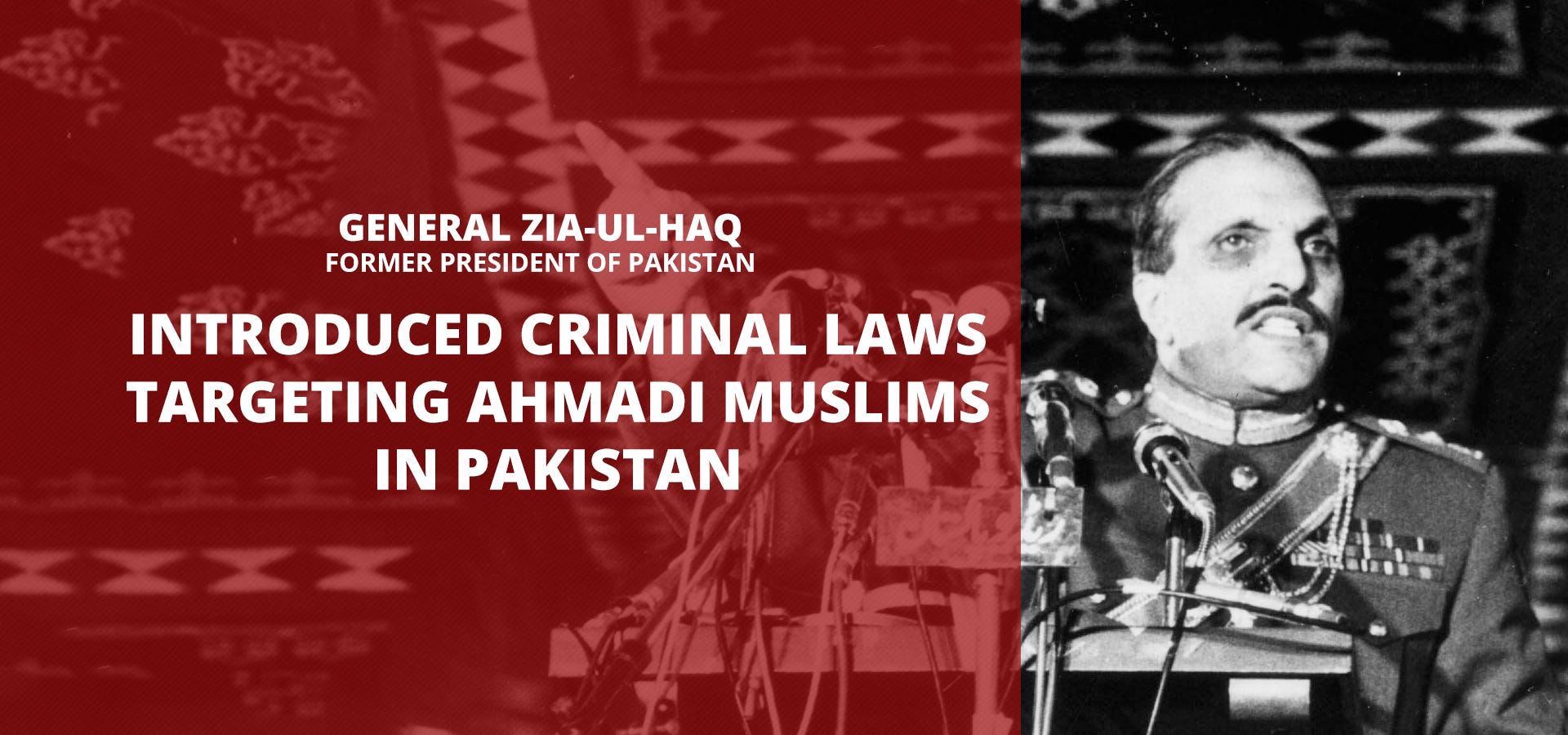
A Brief History of Ahmadi Muslims in Pakistan
The Ahmadiyya Muslim Community was founded in 1889 by a man named Mirza Ghulam Ahmad, who claimed to be the awaited Messiah to reform Muslims, peacefully revive Islam, and reject all forms of religious violence. The community has since peacefully spread globally to more than 200 nations. Members of this community include Dr. Abdus Salam, Pakistan’s first Nobel Laureate, and Sir Muhammad Zafrullah Khan, the only person in history to serve as President of the UN General Assembly and Chief Judge of the World Supreme Court. Members of the U.S. chapter also include Grammy Award winning icon Dr. Yusef Lateef, jazz great Ahmad Jamal, former NBA player Abdul Jeelani, and two time Oscar winner Mahershala Ali. In fact, the Ahmadiyya Muslim Community USA is the oldest organized Muslim community in the country, establishing America’s first mosque in 1921.
Despite suffering decades of violent religious persecution, it is well documented that Ahmadi Muslims have maintained their position against all forms of religious violence. Pakistan’s persecution of Ahmadis escalated in 1974, when, in an unprecedented vote, the General Assembly amended the country’s Constitution to formally declare the Ahmadiyya Muslim Community ‘outside the fold of Islam.’ Thus, Pakistan enacted a system of religious apartheid that has only expanded every year since.
Advancing Apartheid
Imagine, for a moment, if the United States passed a constitutional amendment declaring Catholics outside the fold of Christianity? This is what has happened in Pakistan against Ahmadi Muslims. Notwithstanding Pakistan’s absurd second amendment, in 1984 Pakistan added Ordinance XX to its penal code. Ordinance XX criminalized any Ahmadi Muslim who proclaims to be a Muslim, or even “posed” as a Muslim, with arrest and fine. By 1986, Pakistan added Section 295-C, mandating up to and including the death penalty for Ahmadi Muslims. What does “posing” as a Muslim mean? Well, it can mean anything extremist clerics and theocratic evangelicals in political office want it to mean to arrest and torture Ahmadi Muslims.
What does this apartheid look like, practically? All books, literature, events, speech, and websites belonging to the Ahmadiyya Muslim community in Pakistan are criminalized. Pakistan denies Ahmadis free and fair voting. We cannot vote, run for office, or have any say in the electoral process, specifically due to our faith. Pakistan additionally forces Ahmadi Muslims to declare our faith on our passports as a means to prevent us from performing the Hajj pilgrimage. To perform Hajj, a Pakistani citizen must have “Muslim” on their passport for religious affiliation. To obtain a passport with “Muslim” as the religious affiliation, Pakistan requires applicants to complete a form declaring Ahmadi Muslims as “non-Muslim.” Since Ahmadis refuse to declare themselves non-Muslim, they are identified as “Ahmadis,” and thus denied the ability to perform Hajj. In other words, Pakistan’s government has created special ID cards to single out Ahmadis.
One need not look too far back into history to know what happens when a government targets a community due to their faith, forcing them to hold special religious identification cards.
These apartheid conditions have additionally led to systemic violent persecution of Ahmadi Muslims, including mass murder, grave desecration, expulsion of school children for their faith, and a complete lockdown of all religious practice. This apartheid has resulted in mass casualty events as well. For example, on May 28, 2010, the Taliban attacked two mosques in Lahore belong to the Ahmadiyya Muslim Community during Friday prayer—killing more than 86 Ahmadi Muslims in broad daylight. Despite weeks of warnings and threats from the Taliban, the police and Pakistan’s government refused to act, allowing this preventable atrocity from proceeding full fledged. Pakistan has meanwhile faced repeated condemnation from Amnesty International, Human Rights Watch, and U.S. Commission on International Religious Freedom (USCIRF) for its incessant violation of religious freedom—yet the discriminatory laws remain.
The USA-Pakistan Relationship
In 2020, for the first time, the U.S. State Department labeled Pakistan a country of particular concern over its increasing persecution of religious minorities.
This label is the State Department’s strongest condemnation under the International Religious Freedom Act, and normally mandates sanctions for the designated country. Then Secretary of State Mike Pompeo intervened, however, with a presidential waiver to avoid such punishment.
The alliance between the two nations has sent more than $70 billion in economic and military aid to Pakistan since Pakistan’s founding in 1947. If not for the sake of sheer justice, then at least for the sake of protecting American interests, the United States should mandate that its ally, Pakistan, be accountable and repeal its discriminatory anti-Ahmadi legislation and actions. While the legislation particularly targets Ahmadi Muslims, it tragically also enables societal discrimination and violence against Pakistan’s Christian, Sikh, Hindu, and Shia communities.
Most recently, the Pakistan Telecommunications Authority (PTA) has intensified the government’s decades-long violent persecution of religious minorities — particularly that of the Ahmadiyya Muslim community. The PTA filed a lawsuit against two American citizens who belong to the Ahmadiyya Muslim Community, seeking to shut down a U.S. based website, trueislam.com. The PTA argues that because Ahmadis built the U.S.-based website, it violates Pakistan’s anti-Ahmadi laws. The PTA applied the same convoluted logic to order Google to remove any app built by the Ahmadiyya Muslim Community from the tech giant’s Play store.
Google has, sadly, capitulated to the draconian demands. Sam Brownback, the former U.S. Ambassador at Large for International Religious Freedom, compared Pakistan’s persecution of Ahmadi Muslims to the Chinese dictatorship, exclaiming, “[This is] Pakistan following in the China model.”
Pakistan’s government has traversed this dangerous road for now more than half a century, suffocating its own national security, and becoming “a safe haven for certain regionally focused terrorist groups,” according to the State Department. This is, quite simply, unsustainable.
Persecution Against Ahmadi Muslims Today
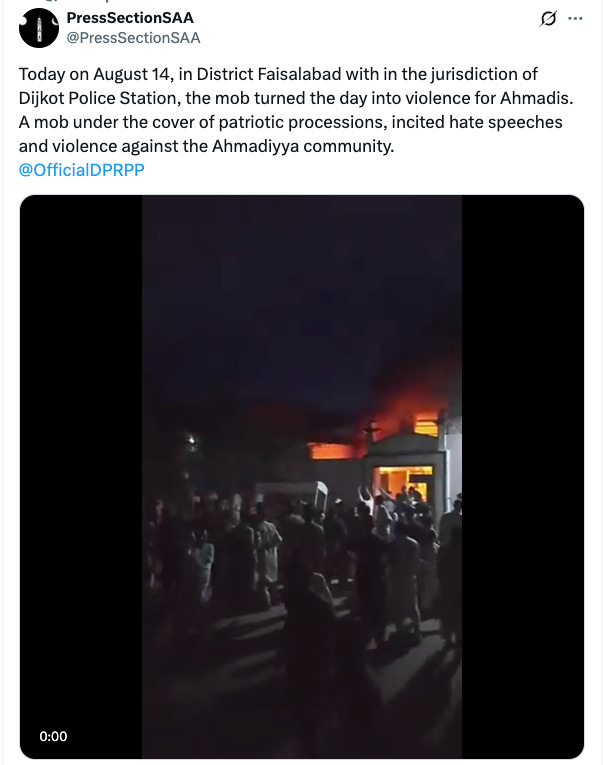
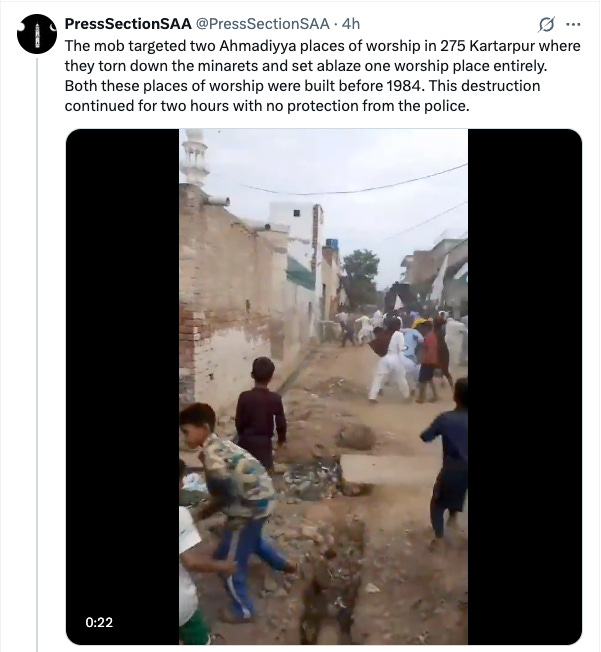
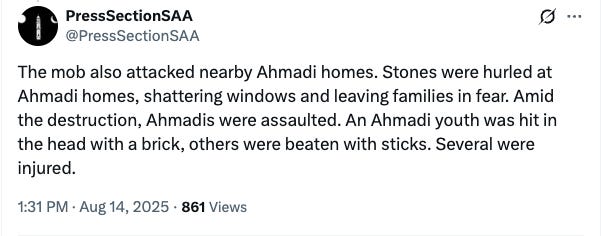
Even literally on Pakistan’s Independence Day, the persecution of Ahmadi Muslims in Pakistan increased with yet another attack on Ahmadi mosques. Corporate media largely ignores these atrocities, which is why you likely have not yet heard of these attacks. And sadly, the Pakistani government largely approves these attacks either by refusing to prosecute the instigators or by simply turning a blind eye. For example, see this important thread from Pakistan’s chapter of the Ahmadiyya Muslim Community, reporting on this latest attack, in which police took more than two hours to respond even as the violent attacks raged on.
Tweet 1 of 3:
Tweet 2 of 3:
Tweet 3 of 3:
You can read the full thread on Twitter here.
Over the years, hundreds of Ahmadi Muslims have been murdered in broad daylight, most of their cases never resolved. Thousands have faced arrest, expulsion, and discrimination only on account of their faith, many still languishing in torturous prisons on trumped up charges and without meaningful access to counsel or due process. And millions either suffer under apartheid or have been forced to immigrate to other parts of the world for their own safety and well-being. This is what modern day apartheid looks like, and it is critical we name this cancer for what it is.
My Response to Apartheid
As a child I grew up and watching this violent persecution and vile discrimination first hand. How it impact my family, my friends, and my loved ones. I also watched my late parents respond by emphasizing the need to respond to this vile and violent hatred with moral clarity. That meant expanding our empathy, increasing our compassion, and elevating our tenacity in service to all humanity, regardless of differentiating factors. It’s one driving reason I went to law school and have committed myself to a career as a human rights lawyer.
This expansion of compassion, as my parents taught me, is the true meaning of the word Jihad — a struggle against evil, injustice, and hate. Most of all, a struggle against the self that wants to give in to the hate, give up hope, and accept despair. Instead, winning that Jihad is indeed the greatest and true Jihad that each of us should constantly engage—as it is through self improvement on the tenets of justice that we can establish justice locally, nationally, and internationally.
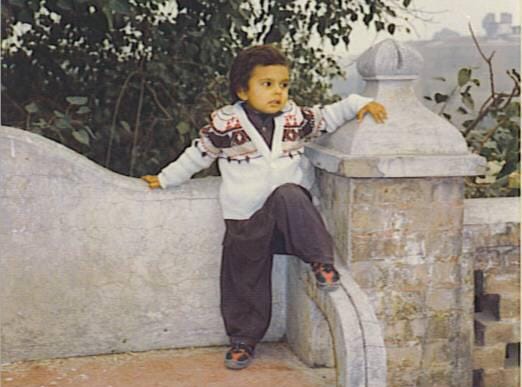
Pakistan is my birth country. It will also be so. My love for my birth country cannot change any more than can my need for oxygen to live. My criticism of Pakistan is not because of any dislike or hatred of my birth nation—God forbid. Rather, it is because I know what Pakistan is capable of, and what it was meant to be—a beacon of justice and religious freedom for all people, if it so chooses. Indeed, as Pakistan’s esteemed founder Muhammad Ali Jinnah emphatically and repeatedly declared,
We are starting in the days where there is no discrimination, no distinction between one community and another, no discrimination between one caste or creed and another. We are starting with this fundamental principle: that we are all citizens, and equal citizens, of one State.
And again,
You are free; you are free to go to your temples, you are free to go to your mosques or to any other place or worship in this State of Pakistan. You may belong to any religion or caste or creed - that has nothing to do with the business of the State.
And again,
Pakistan is not going to be a theocratic State - to be ruled by priests with a divine mission. We have many non-Muslims - Hindus, Christians, and Parsis - but they are all Pakistanis. They will enjoy the same rights and privileges as any other citizens and will play their rightful part in the affairs of Pakistan.
Jinnah was not an Ahmadi Muslim. In fact, he was hardly a practicing Muslim. But he was a visionary dedicated to universal human rights, secular governance, and justice for all people. That is the vision of Pakistan worth fighting for. Indeed, that is the vision of global peace worth fighting for.
Conclusion
I share this important article and personal experience with my readers so you know this important truth: When I speak of discrimination against marginalized communities anywhere in the world, I speak not just as a human rights lawyer trained on this important topic—but as someone on the receiving end of apartheid violence. I speak from experience. From the pain of watching family and friends murdered, tortured, and denied basic human dignity. From the horror of seeing those who I thought would speak up for my humanity, instead turn a blind calloused eye. And from knowing that I can never align myself with the oppressor of any people, any community, anywhere in the world.
My fight will always be for justice, not just for my own Ahmadiyya Muslim Community, but for every human on Earth of any faith, or of no faith. That is the truth path to absolute justice. That is what I am beholden to. And that is what I am grateful to each of you for, as your trust and support enables me to continue to elevate this fight for universal human rights. My gratitude to you for joining me in this Jihad of justice.
FOR ADDITIONAL READING:
See my article on the persecution of Ahmadi Muslims from September 2024.
I’ve also written extensive peer reviewed scholarship on Pakistan’s persecution of the Ahmadiyya Muslim Community, which if you’re so inclined, you can download for free and read here.
Thank you, Qasim for sharing your personal story with us, and also for explaining the true meaning of the word "Jihad," which most Westerners equate more with revenge, as it is reported in the news. Thank you. Your parents taught you well, to be compassionate and forgiving to all people.
I used to teach at Purdue. I designed my entire second semester freshman composition class (Research) around marginalization. On day one, as I explained the syllabus and group work, someone asked me, "What is marginalization?" I said, "Let's see what the scholars have to say, and I took them to Ithaca College's website, where there was a great definition: treatment of a person, group, or concept as insignificant or peripheral. We then spent about five minutes listing marginalized people and came up with 27 groups (and that didn't begin to explore the secondary marginalization within the marginalized group (the idea that your sect of Islam was tossed in Pakistan--among Muslims--blows my mind).
Needless to say, my studetns learned a lot in that class. They got into groups and did research on their choice for five weeks, then presented their findings to the class. For the next five weeks, they had to partake in a community outreach and work with their group (homeless, inmate, foster children, people with disabilities, elderly, etc. were some of the groups) and create the primary portion of their research. In the last third of the class, they complied all of their work into one term paper and completed it with a class presentation to educate their peers about a different marginalized community.
As things have changed over the last ten years since I lost my position (another story), I wonder if any of my students say, "Yeah, I learned all about marginalization in Deb's class, and now I'm watching it in real time!"