

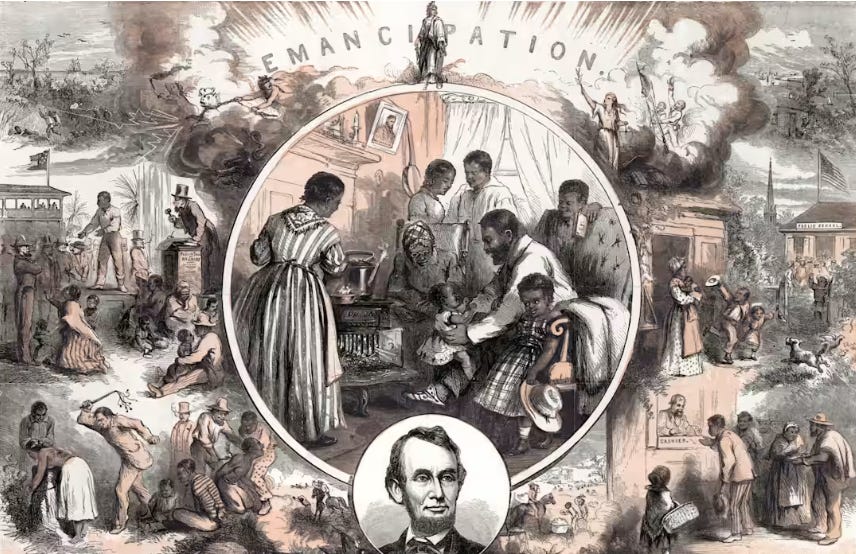
Today marks Juneteenth, a day to commemorate that moment in 1865—more than two years after the Emancipation Proclamation—when Union troops arrived in Galveston, Texas to inform enslaved Black Americans that they were finally free. It is an acknowledgement of a step towards liberation long delayed, a day that reminds us of both how far we’ve come—and how far we have yet to go.
But let us be honest about what Juneteenth truly represents: a partial liberation. Because the truth is, slavery may have been outlawed on paper, but it never fully ended in practice. So what steps can we take today to advance true liberation in the United States? Let’s Address This.
The Truth about Legality vs Morality and Justice
This Juneteenth, let us remember that human trafficking was legal. Slavery was legal. Jim Crow segregation was legal. The U.S. government paying reparations to white enslavers—compensating them for the “loss property,” (i.e. enslaved people)—was legal. And yet not one dollar of reparations has ever been paid to those who were enslaved, brutalized, and dehumanized. So let this be our collective reminder: legality is not a measure of morality nor justice, it has always been a measure of power.
If you need further proof, consider that slavery still exists in America today—within the prison system. The 13th Amendment abolished slavery except as punishment for a crime. And that exception created a pipeline from plantation slavery to prison slavery, where today, incarcerated people—disproportionately Black and brown—are forced to work for pennies on the dollar. Meanwhile, the private prison industry has become a multi-billion dollar empire, profiting from modern-day enslavement. That’s not justice. That’s not freedom. That’s human trafficking and white supremacy by another name.
Also consider that Juneteenth only became a federal holiday in 2021—five years ago. For centuries, Black Americans carried this history on their own, commemorate it in the margins, and pass it down from generation to generation because the federal government refused to acknowledge its own crimes. Recognizing Juneteenth on the national calendar is progress, yes—but it is not justice. It is not accountability.
Substance Over Symbolism
Indeed, we cannot confuse symbolism for substance.
This Juneteenth, let us not simply celebrate freedom with BBQs and hashtags—let us (particularly non-Black people) recommit ourselves to the work of building a more perfect union. That means fighting for reparations. That means abolishing prison slavery. That means ending voter suppression. That means investing in Black communities instead of over-policing them. That means funding racial justice instead of white supremacy. That means demanding HR 40 (the bill to study reparations) is passed, and the move to pay reparations is completed. This brilliant piece by Professor Ta-Nehisi Coates on The Case for Reparations is a must read for anyone unsure on the subject.
Justice isn’t just a date on the calendar—it requires action, courage, and the willingness to name hard truths. It requires taking action. It requires investing resources.
So as one small but meaningful step, join me by investing in amazing Black voices this Juneteenth. These are just seven voices I listen to, read, learn from, and subscribe to as much as I can as a paid subscriber, and I invite you to do so as well:
There is no justice without economic justice. And investing in the economic growth of Black voices as they elevate calls for racial justice and human rights is a critical step forward for our country. So, skip coffee once or twice a month and invest in at least a few, or as many as you can, of the aforementioned voices. Tag in the comments the Black voices you follow and learn from, so others can also follow and support them.
In Closing
This is a journey, and it is far from over. Today we remember the enslaved who fought for freedom. We remember the children lost to mass incarceration. We remember the redlining, the lynchings, the Black codes, the broken promises of Reconstruction, the war on drugs, the school-to-prison pipeline. And we remember those who never stopped resisting—like Harriet, like Frederick, like Coretta, like Malcolm, like Martin, like Rosa, and like Ruby, and so many more. We walk in their footsteps and carry their torch.
We affirm that justice delayed is justice denied—and that we will not wait another century for what is rightfully owed. We stand with our Black neighbors, not just in memory, but in movement.
A solemn and powerful Juneteenth to you and yours.
Qasim Rashid is a human rights attorney, author, and host of Let’s Address This—a platform dedicated to human rights, historical accountability, and the journalism that corporate media refuses to deliver. Subscribe, share, and let’s remain relentless in our mission for a more perfect Union.
Let us also remember than prejudice, racism, and slavery was not only about the Black slave trade, but so many other marginalized groups in America: slaughter of Native Americans; imprisonment of gays, women, and others who refused to "conform;" and that the largest mass lynching in America was of Italian immigrants in New Orleans in 1891, who were acquitted in a sham trial for a murder they did not commit, but then dragged from their holding cells and lynched by a White mob of hundreds of screaming dolts, not unlike what might have happened on January 6th. Juneteenth was a long time in becoming a holiday. It's a good day for reflection on how far we've come and how low we have currently sunk ... and the mystery of why. I'm now 70 and will never understand how we made this turn into the last dying breath of the Confederacy, but here we are. Thank you Qasim, for continuing the good fight and good trouble. This is why I support your blog as a paid subscriber.
And let me add: if you are ready to invest in Black rights and strength, volunteer for Black Voters Matter. Their texting program to Black voters gives information and alerts to voters all over the South to keep Black power alive: www.blackvotersmatterfund.org
I have texted with them for more than a year and think they have a terrific team. Volunteers are also white and Asian, and we all work together to keep Black voters voting!