


I co-wrote the piece below with Lauren Harper and Dr. Anthony Douglas II, on a remarkable new piece of legislation aimed at combatting gun violence. Lauren Harper is a gun violence prevention advocate and grassroots organizer dedicated to tackling the root causes of gun violence in Illinois. Dr. Anthony Douglas II, MD MPH, is a surgical resident at the University of Chicago and the founder of the nation’s first Surgical Advocacy Fellowship.
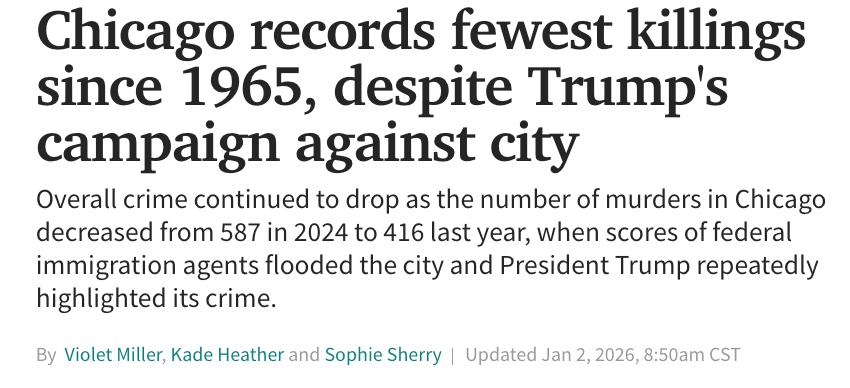
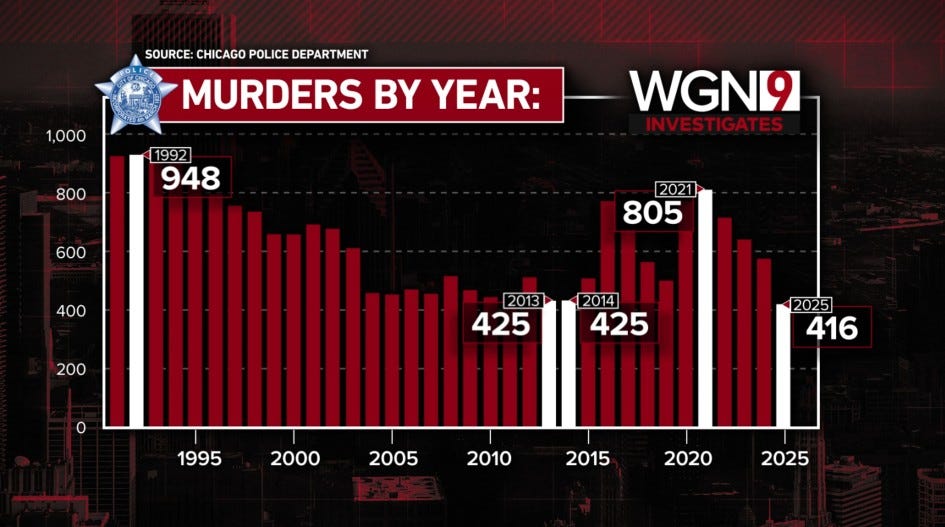
In a world of dystopia, here’s some excellent news. Chicago just recorded its lowest number of homicides since 1965, dropping from 587 in 2024 to 416 in 2025. It’s a stunning 30% drop. And it happened for at least two reasons that every state nationwide should adopt. If Chicago’s policies were extrapolated and adopted nationwide to address America’s 40,000 annual gun deaths, a 30% drop could mean an additional 12,000 lives saved every single year.
And while Trump and his administration are already attempting to take credit for Chicago’s progress, we know the downtrend began well before his ICE goons or National Guard arrived. So, let us be clear about how we got here, how we can build on this momentum nationally, and the ingenious role the RIFL Act plays in making a safer future a reality. Let’s Address This.
The Good News and The Bad News
Over the last decade, Illinois has pieced together a patchwork of common sense gun laws. We banned assault weapons, we strengthened safe gun storage laws, we required dealers to obtain state licenses.
Certainly we are safer because of these laws. But as any gun safety advocate will tell you, better legislation is only part of the equation.
In addition to these laws, the real work horse has been the quiet and painstaking work of violence intervention organizations that focus on hyper local community building, street outreach, deescalation, and healing.
Now for the bad news. Despite their major success in making our communities safer, in 2026, these critically important organizations are fighting to exist due to the Trump administration’s federal funding cuts. Without their work we will likely see shootings rise once again. But we are not hopeless or helpless. We have a viable solution to help fill this gap in the funding that was unlawfully stripped away.
Introducing: The RIFL Act
The Responsibility in Firearms Act (The RIFL Act, HB3320/SB2279) is a solution that both protects our communities, and holds firearms manufacturers more accountable for the deadly weapons they create. How? By introducing a powerful new tool to combat gun violence. The RIFL Act creates a fund that sets aside money for this critically important community violence intervention (CVI) work. A fund paid for by gun manufacturers—not by taxpayers.
Let us step back for a moment.
Did you know that the average hospital bill for a victim shot and hospitalized is $82,000? That’s more than the median American salary. Victims pay the highest price of gun violence, burdened by the trauma of gun violence, by exorbitant medical bills, the indirect expenses of lost work and quality of life costs, and the years of psychological trauma that follows. And likewise, such is the cancer of gun violence that it also harms every one of us nationwide. For example, gun violence financially harms every person in this country in at least three ways. First, taxpayers foot the bill for the majority of that $82,000 cost through Medicaid. Second, insurance premiums are unnecessarily high to cover these costs. And third, we all foot the bill for rising judicial and law enforcement costs.
In Illinois, for example, these costs amount to over $18 Billion for our yearly average of 6,700 injuries, suicides, homicides, and accidental shootings. This is unsustainable.
Currently, firearms manufacturers pay for none of this. In fact, they enjoy unprecedented immunity from lawsuits for the consequences of their products by federal law (PLCAA 2005). Therefore, they can maintain artificially low firearm prices because of this immunity, incentivizing more firearm sales, enabling even more gun violence. It is a vicious cycle. And yet even worse, firearms manufacturers see increased sales and profit in the aftermath of crime and mass shootings. Therefore, they have no incentive to facilitate gun safety, because they know gun violence makes them more money. The RIFL Act takes aim to flip this paradigm.
The Paradigm Shift of the RIFL Act
The biggest problem with the current model is that incentives are diametrically opposed. Violence creates profit, while safety discourages profit.
The RIFL Act flips this paradigm by financially incentivizing gun manufacturers to be part of the solution. So imagine for a moment, the new reality once the RIFL Act becomes law. In this new reality, if a gun manufacturer wants a license to sell their products in our state, they must pay into a fund in proportion to the costs and harm their products create in our state.
How would this work? On an annual basis, all guns recovered connected to an injury or death are reported regardless of where they were purchased. At the end of the year, if manufacturers wish to sell in our state, they pay their “share” into the fund. In turn, the state invests this money into proven CVI strategies that reduce gun injury and death. Thus, whether federal funding is denied or delivered, our state remains funded to continue proven CVI strategies to decrease gun violence.
But that’s not all. By aligning the industry’s financial incentive (keeping in mind they’ll pay nothing if their products are not recovered) with what should be a common goal of reducing harm, we motivate the gun industry to innovate safer products, work toward reducing trafficking, and engage with us in conversations around public safety.
Instead of working to pass a patchwork of reactionary “band aid” laws, the gun industry can take the lead on harm reduction. They can choose to apply biometric fingerprint triggers to their products so that only the lawful gun owner can fire the gun. They can choose to hold gun buy-back programs in high-risk neighborhoods. They can educate people on safe gun storage and suicide prevention practices. They can work to eliminate gun trafficking from neighboring states. They can recall products compatible with highly lethal additions like, “switches.”
In short, the RIFL Act proactively compels firearms manufacturers to decrease gun violence.
The industry knows these strategies that will reduce harm, they just never had the incentive to deploy them. While they’ve reaped profits, taxpayers have been left to foot the bill their harm caused. Now, all that changes.
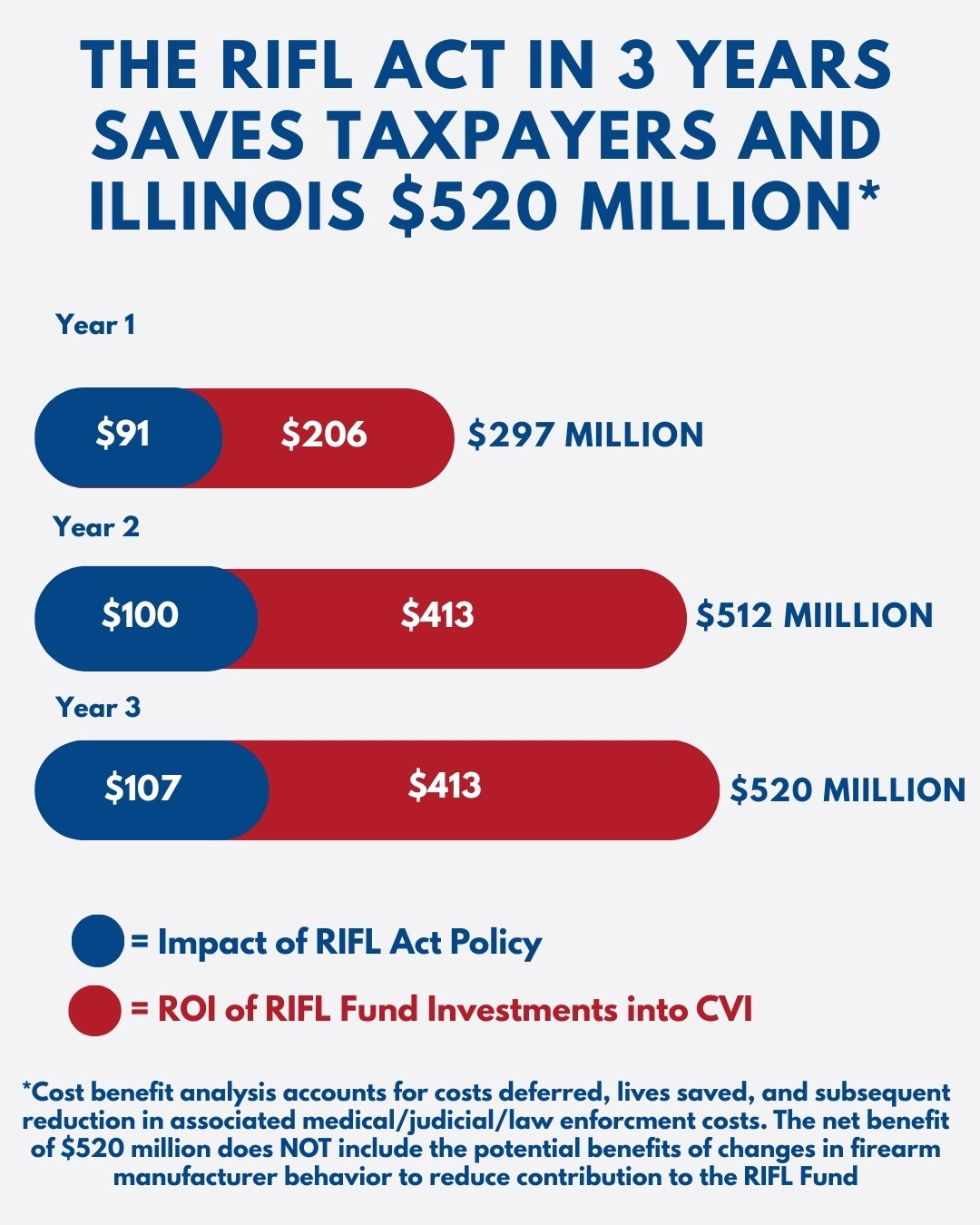
If passed, Illinois will be the first state to implement cost-sharing for the firearm manufacturing industry. This is not only a fiscally responsible solution to the gun violence and suicide epidemic, it will also saves the State of Illinois half a billion dollars in just 3 years.
Gun Safety Must Be A National Strategy
The RIFL Act is now being introduced in States across this country, including Hawaii and New York. The impact on the industry would create a new de facto standard of responsibility nationwide.
So, what can you do? If you are an Illinois resident, now is the time to call your State Representative and Senator to ask them to support House Bill 3320 or Senate Bill 2279, The Responsibility in Firearm Legislation Act. If you are not from Illinois, learn more by following the effort on Facebook at RIFL Act Coalition or Instagram at @rifl_illinois. Ask your local lawmaker to sponsor a version of this bill for your state. Ask them if they believe we as taxpayers should pay for the firearm industry’s recklessness, or whether the firearm industry should pay for their own recklessness?
Our interests are misaligned. The RIFL Act realigns them on a unified target of increased community safety and decreased gun violence. We must not simply celebrate historic lows in gun deaths in 2025, but seek to further decrease those deaths in 2026 and beyond, in Illinois and nationwide. Let’s get to work.

Lauren Harper is a gun violence prevention advocate and grassroots organizer with a passion for solving the root causes of gun violence in Illinois.
Dr. Anthony Douglas II, MD MPH, is a surgical resident at the University of Chicago and founder of the nation’s first Surgical Advocacy Fellowship.
The RIFL act sounds great but I’d like to hear more about what were the actions over the last year that worked. What useful programs are being cut and can you describe them. This is an incredible success story and I’d like to hear more
Thx for shining light on a successful policy here in Chicago. BTW this morning saw you on AlJazeera’s media segment as a human rights lawyer/expert. Super articulate! Took a couple of screenshots.