

The following is a guest piece authored by Pat Zabawa, Executive Director of Rank MI Vote. It answers several critical questions. Namely, what is ranked choice voting? How does it help strengthen our democracy? And how can you enact it in your local and state elections? Rank MI Vote is a non-profit, non-partisan advocacy organization committed to expanding access to Democracy for Americans.
As you read, I welcome your support of Let’s Address This with a subscription, so we can continue to elevate these critical voices to protect our democracy.
America has reached a boiling point, with political division threatening to tear our communities apart. Instead of fighting for our votes by standing on their values, politicians fight one another. This leaves voters feeling anger, apathy, or both. None of this is healthy for our democracy.
It doesn’t have to be this way. Here in Michigan, our grassroots volunteers are showing that everyday people can improve our democracy by working to bring Ranked Choice Voting to our state. Ranked Choice Voting empowers voters and improves the health of our democracy. Michiganders are on the ground fighting for a future that rewards candidates who focus on collaboration and gives voters more power to express their voice. Ranked Choice Voting can ease the division and you can help make this happen. Let’s address this.
What Is Ranked Choice Voting?
Ranked Choice Voting is a simple improvement to our elections that addresses some of the worst aspects of our politics: billionaire-funded attack ads and elected officials who don’t have to answer to the majority (more than 50%) of voters. Used statewide in Maine and Alaska and in cities from New York City to Salt Lake City, 14 million American voters benefit from Ranked Choice Voting in their elections.
Today, voters are forced to choose one candidate, very often the lesser of two evils. In a Ranked Choice Voting election, voters have the freedom to rank the candidates in order of preference: first, second, third, and so on. If your favorite choice can’t win, your vote counts for your next choice. The winning candidate must receive more than 50% of votes to win. Without Ranked Choice Voting, a candidate can win even if most voters wanted someone else. But with Ranked Choice Voting, the winner always needs majority support.
Ranked Choice Voting changes the incentive for our elections from divisiveness to cooperation. Today, campaigns win by spending heavily on negative ads. The result is division, anger, and ultimately apathy and lower voter turnout. In the most cynical strategy in politics, campaigns spend billions attacking their opponents, knowing they are driving voters to stay home out of frustration; they just hope their opponent is the one with more potential supporters throwing in the towel.

How Does Ranked Choice Voting Work?
But Ranked Choice Voting flips the incentive. When candidates need voters to rank them second or third to win an election, the winning strategy isn’t to put down their competitors and their supporters—it’s to appeal to values and find common ground. This lowers the temperature of our politics.
Ranked Choice Voting gives voters more power and creates an electoral environment that attracts voter participation. It’s a proven system. New York City began using Ranked Choice Voting in its primaries in 2021. In its 2025 mayoral primary, Zohran Mamdani, who wasn’t the favored candidate when he entered the race, cross-endorsed multiple competitors, and even appeared in a political ad with one. Millions of New Yorkers saw collaboration between opposing candidates, and voter turnout hit 30-year highs.
For example, assume three candidates, Jim, Jack, and Jules are running for the same seat.
Jim receives 35% of the vote
Jack receives 33% of the vote
Jules receives 32% of the vote
Under the current rules, Jim wins even though 65% of people voted for someone else.
Under the Ranked Choice Voting strategy, voters would rank each of their candidates from most to least preferred. Thus, while after the first round, Jim gets 35%, Jack gets 33%, and Jules gets 32%, the election process continues until someone exceeds 50% of the vote. Since Jules received the fewest first place votes, we go to Round 2. In Round 2, we look at who Jules’ voters ranked second or third. Let’s assume three out of four of Jules’ voters ranked Jack second, and one out of four of Jules’ voters ranks Jim second. Accordingly, of the 32 points up for grabs, 24 would be awarded to each Jack, and only 8 points to Jim.
Now the final tally is tabulated.
Jim: 35 points in Round 1 + 8 points in Round 2 = 43 points
Jack: 33 points in Round 1 + 24 points in Round 2 = 57 points
Therefore, because 57% of voters prefer Jack over Jim, Jack wins the election. Now, compare this to the current model where Jim would have been selected to represent the community with only 35% support. It does not take a political scientist to understand that a model that selects a public servant who the majority of the public opposes is bad, while a model that selects a public servant who the majority of the public supports, is good. This is how Ranked Choice Voting makes democracy stronger, more representative, and more sustainable.
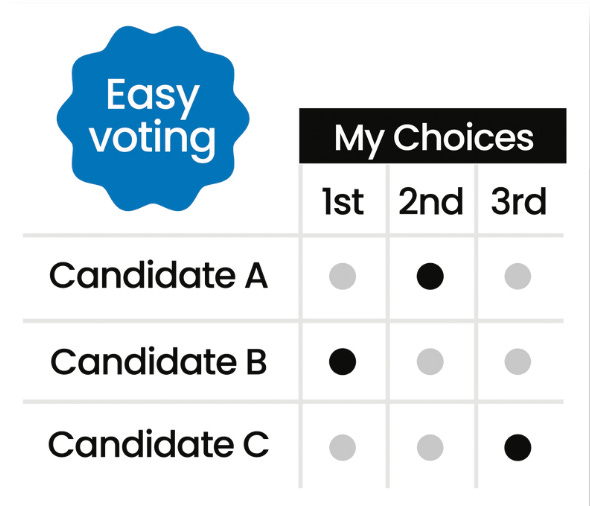
And if you’re a visual learner like I am, here’s what a Ranked Choice Ballot looks like.
(Check out this TikTok video demonstrating Ranked Choice Voting to a child from a Rank MI Vote demonstration that’s garnered over three quarter of a million views!)
The Future of Politics
Today, nearly 9 in 10 voters feel our political system is broken. Voters feel alienated from the candidates who win elections, and many potential voters, especially young people, abstain from voting. Polling and survey data show many young non-voters cite disinterest in candidates, dissatisfaction, or belief that voting “doesn’t matter” as reasons for abstaining. Information about voting during election season is ubiquitous; not voting is a very intentional choice.
This is a call to action. When voters feel frustrated, we must listen. It’s our responsibility to address these concerns and improve our electoral system. We can have elections where we are free to vote for our hopes and not our fears. That is our opportunity and responsibility now in Michigan.
Following in the footsteps of nearly a decade of grassroots electoral reform in Michigan, we at Rank MI Vote are collecting signatures to win a November 2026 statewide Ranked Choice Voting initiative. Our constitutional amendment would implement Ranked Choice Voting at the top of the ballot in Michigan’s primary and general elections and allow municipalities to use Ranked Choice Voting at the local level if they so choose.
This campaign is something we (and you!) can do to lower the temperature and make the will of the voters truly matter in our democracy. Our supporters and volunteers are making a real difference right now, and we would love for Rank MI Vote to have your support, too.
The Way Forward
With over 445,000 valid signatures needed within a 6 month window to get our proposal on the ballot, Rank MI Vote will need your help to make this happen. If you’re in Michigan, the team especially needs you to pick up a clipboard and collect signatures from your family, friends, and neighbors. We can get you connected to a local team at rankmivote.org/volunteer. You can help your contacts and Michigander acquaintances find where to sign our petition at rankmivote.org/where-do-i-sign.
Those outside of Michigan can support our campaign as well. Social media has already helped us grow our volunteer team, and you can help us uplift our presence online by following us across platforms and doing all of the well-known platform boosting interactions. Some of our supporters who can’t volunteer or donate are helping us by turning on notifications and hammering the like and share button to get the word out. If you can post on a platform, you can help us find new petition signers, volunteers, and donors.
Rank MI Vote is entirely grassroots-funded. Our volunteers are our donors, our leaders, and our entire campaign in any meaningful sense of the word. Many of these volunteers cut their teeth on past initiatives and share a commitment to build upon that legacy. You can help us continue to advance democracy by supporting us with a contribution at RankMIVote.org/Donate.
It’s not often that we have the opportunity to take part in a true, grassroots campaign of volunteers coming together to change the system. We can lower the temperature of our politics and lift up the will of the people. Together, we can make Michigan a model for the nation.
Across Michigan, our campaign is already sparking hope – but it’s only through your action that we can carry it through to next November. So I’ll ask: Can we count on you to help empower voters and spread that hope even further?
I think it’s absurd that a candidate could win when that candidate lost 65% of the vote. Ranked choice voting makes tons of sense.
Yup 👍
It’s up there with campaign finance reform and a single payer healthcare system in terms of importance.