


Happy New Year. And what a New Year’s Day it was.
I’m writing this as I leave Zohran Mamdani’s inauguration in New York City to fly home to Chicago. Rather than wait, I wanted to capture fresh what felt unmistakably historic about today—because what I witnessed was not symbolism, not branding, and not performative politics. It was a serious governing vision, articulated with confidence and moral clarity, at a moment when this country is desperate for both.
And along with that vision, I see danger lurking before us. One that I cannot overstate enough. One that will require each of us to work together to combat, and defeat. We can, if we choose to—but we must choose to. Let’s Address This.
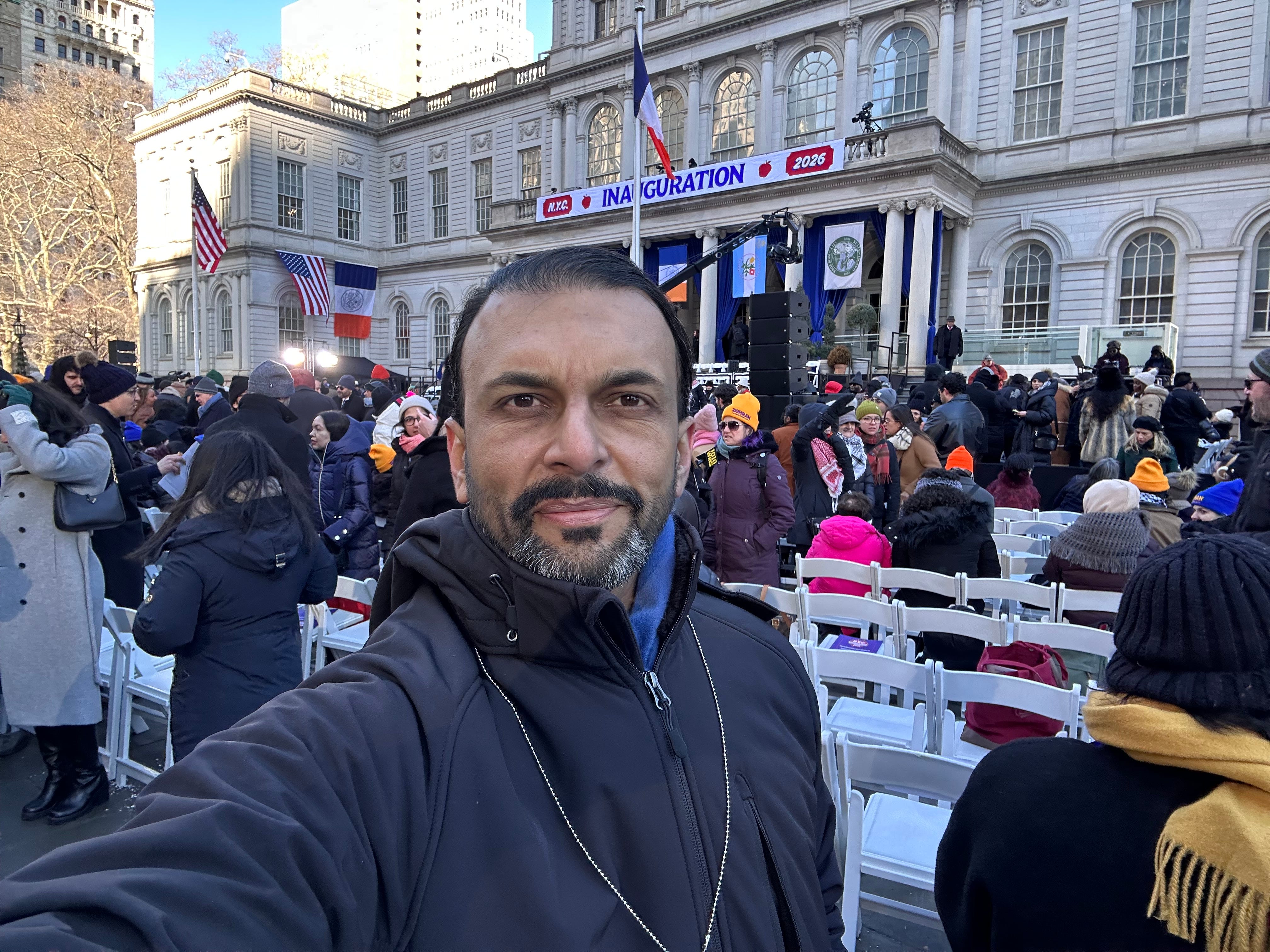
Mayor Zohran Kwame Mamdani
It was cold Inauguration Day in New York City. As I sat with thousands of people from all over the country and world, I couldn’t help but appreciate that this diverse crowd was America. It was humanity. To my left a DACA recipient from Mexico. To my right, a Black woman fired up about civil rights. Behind me, an Iranian woman. Next to her an Indian woman. In front of me a white man. A familiar face walked by—a Sikh friend—but I couldn’t catch him because there were just so many people to speak with.
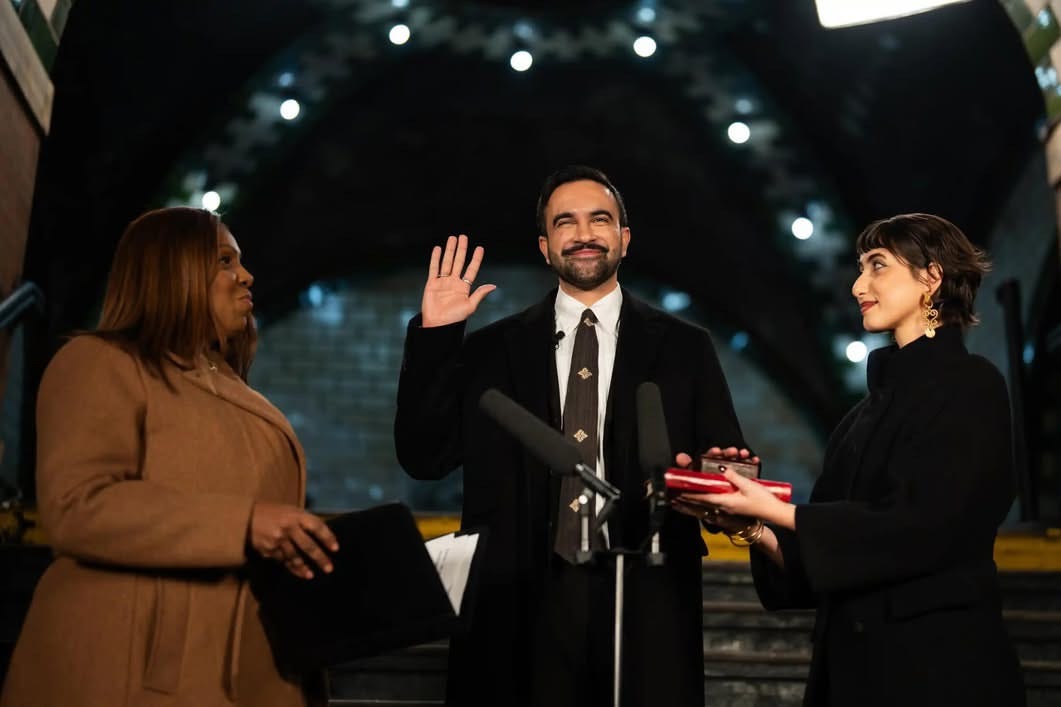
As I basked in the warmth of the historic moment, we were treated to a series of brilliant speakers from Congresswoman Alexandria Ocasio Cortez, Singer and Actor Mandy Patinkin, Poet Cornelius Eady, and Senator Bernie Sanders—among several more iconic sets of remarks. Finally, Mayor Zohran Kwame Mamdani entered the stage. As I wrote on social media—as an American Muslim, I cannot adequately enough express my joy in watching a Jewish American Senator swear in a Muslim American mayor of New York City on the Qur’an. This is what makes America great.
And adding to that elation was the substance of Mayor Mamdani’s remarks, calling on all New Yorkers to not only demand more and better, but to hold him and his administration accountable to deliver on the human rights they campaigned on. I can best articulate Mayor Mamdani’s remarks into the following three main points.
The representation was real.
There was no tokenism here. No carefully curated optics meant to check boxes and move on. The crowd, the stage, and the leadership reflected New York as it actually exists. Mamdani didn’t just speak about working people—he situated himself among them. As he put it plainly, “I stand alongside construction workers in steel-toed boots and halal cart vendors whose knees ache from working all day.” That line landed because it wasn’t rhetorical. Then Alderman Mamdani went on a weeks long hunger strike to win historic alleviations from debt for Taxi cab drivers, drivers who were dying by suicide due to the suffocating debt. Moreover, the statement matched the room’s composition, the coalition he built, and the governing team he has assembled.
This matters. Representation is not just who gets invited to the podium—it’s who government is structurally designed to serve. Mamdani’s administration looks like the city because it intends to work for the city.
There was an unmistakable shift from defensive politics to affirmative justice.
For too long, Democrats have been trapped in a posture of apology—explaining why basic human rights are “reasonable,” why dignity is “pragmatic,” why justice must be incremental so as not to offend entrenched power. What I heard today was a clean break from that cowardice.
Mamdani explicitly rejected the idea that this moment requires lowering expectations: “In writing this address, I have been told that this is the occasion to reset expectations… I will do no such thing. The only expectation I seek to reset is that of small expectations.” That is not rhetorical bravado—it is a governing philosophy. One that understands that working people do not suffer from asking for too much, but from being told to accept too little.
He followed that with a commitment we rarely hear stated so directly: “No longer will City Hall hesitate to use its power to improve New Yorkers’ lives.” That sentence alone draws a sharp line between governance that manages decline and governance that actually confronts injustice. He related how he sat one on one with hundreds of New Yorkers from all five boroughs to understand the crisis of affordability from their points of view, and build policy with their input to counter these economic injustices.
While newly minted mayors often prioritize meeting with billionaires to discuss how to make billionaires even wealthier, Mayor Mamdani is meeting with countless working people to assess how to unapologetically protect their humanity. That is powerful.
Mayor Mamdani stood firmly in who he is—and refused to dilute it.
He did not obscure his faith, his background, or his politics. He did not run from the labels others use to marginalize or discredit. Instead, he claimed them with confidence. “I was elected as a democratic socialist and I will govern as a democratic socialist,” he said, adding, “I will not abandon my principles for fear of being deemed radical.” He doubled down by proudly embracing his faith as a Muslim, swearing in on the Holy Qur’an, speaking in Urdu during his address, and referencing his South Asian ethnicity, his Ugandan birth, and the fact that New York City belongs to everyone—whether they arrived five generations ago or five minutes ago.
That clarity matters. Authoritarian movements thrive on fear and ambiguity. They succeed when leaders are ashamed of their values or afraid to articulate them. Mamdani did the opposite. He made clear that the real radicalism is a system “which gives so much to so few and denies so many people the basic necessities of life.”
That combination—authentic representation, unapologetic justice, and principled conviction—is exactly what this moment demands. And if (when) it succeeds in New York, it can succeed elsewhere. This is not just a local victory; it is a governing model. One that says we do not need to choose between courage and competence, between values and results.
Hope And Danger
As I left the inauguration and tried to find a place to thaw my frozen feet, I felt a warmth I have not felt in a long time—maybe ever. I felt a warmth ignited only by the feeling of hope and the fire of fearlessness against injustice. And as I complete this piece, I reflect and realize what I feel most strongly is this: hope here was not abstract. It was operational. It was practical. It was real. This very real hope is how movements become governments—and how governments begin to serve the people they claim to represent. This hope is how meaningful progress happens—not through empty slogans, but through consequential accountability and action.
But let me be clear—we are not in any kind of clear yet. While today is a big win to start 2026, there are also dangerous forces of disinformation working hard to divide us, to convince us to wage culture wars against one another, and to prevent a change to the status quo. It is critical we address them, and stand united against them.
Rising Anti-Muslim Hate
For those of us old enough to remember the spike in anti-Muslim hate after 9/11, or after the “anti-Shariah” legislation from 2011—we are about to witness a new high water mark of anti-Muslim and Islamophobic hate. I am doing my best to remind everyone that, far from being unAmerican, a Muslim Mayor is about as New York and about as much as American as one can imagine.
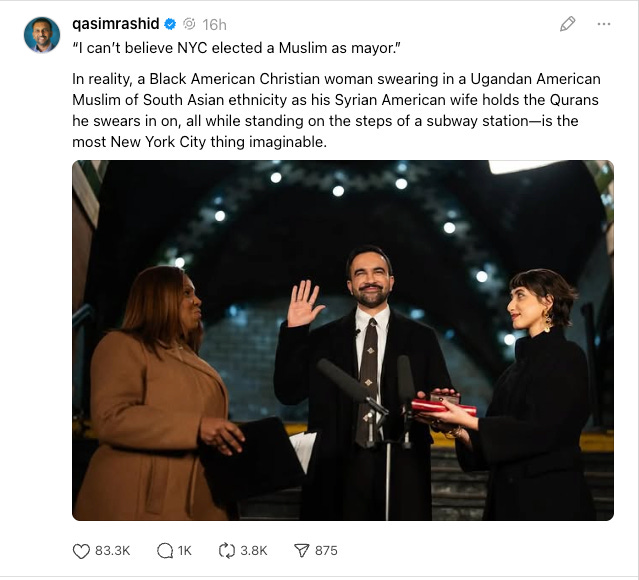
But the hate is relentless. A cursory glance at social media and you’ll see ongoing comments demonizing Mayor Mamdani as a Muslim, and demonizing him for taking his oath on a Qur’an.
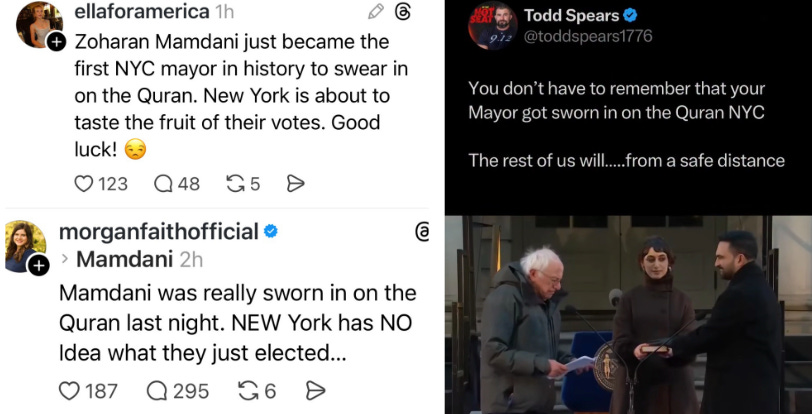
Obviously, the First Amendment to the United States Constitution bans all religious tests to hold office. A person may swear in on a Bible, a Qur’an, a stack of comic books, on the US Constitution itself, on Shakespeare, or by their oath alone. Scripture is merely a symbolic gesture to allow a person to express their personal faith—not a Constitutional requirement.
As you might expect, I am working actively to combat this hate, and launched Islam Today earlier in 2025 as a paywall-free newsletter to debunk anti-Muslim hate and replace fear with facts and hate with compassion. Feel free to subscribe if you want timely and accurate information on debunking hate. As you see rising anti-Muslim hate in the coming days, know that it is not random, but deliberate, calculated, and cruel. Stand united against it, and arm yourself with knowledge to counter it.
Rising Disinformation
Unable to attack Mayor Mamdani on what he actually believes, you will see propagandists promote grotesque disinformation. Consider the following attempts to allege unpatriotic sentiments towards Mayor Mamdani.
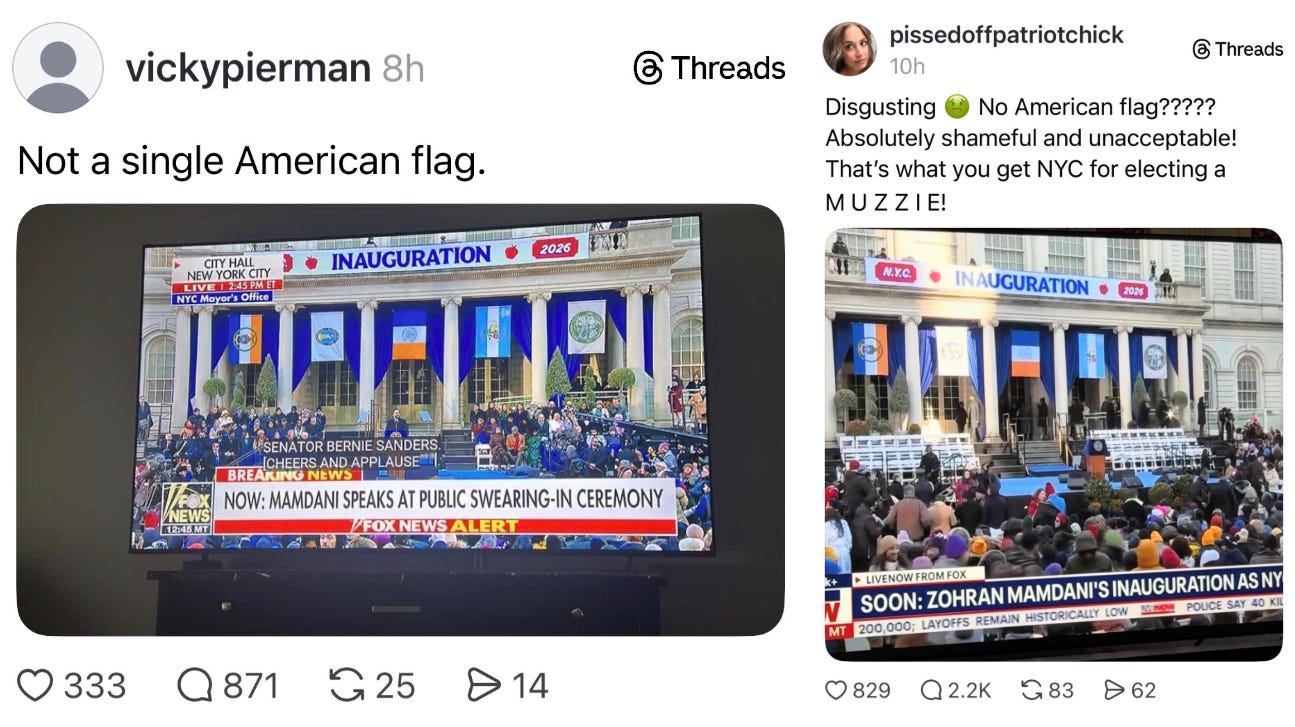
There was no rhyme or reason to this easily disprovable lie. And indeed, I was able to debunk them in seconds with the below image.
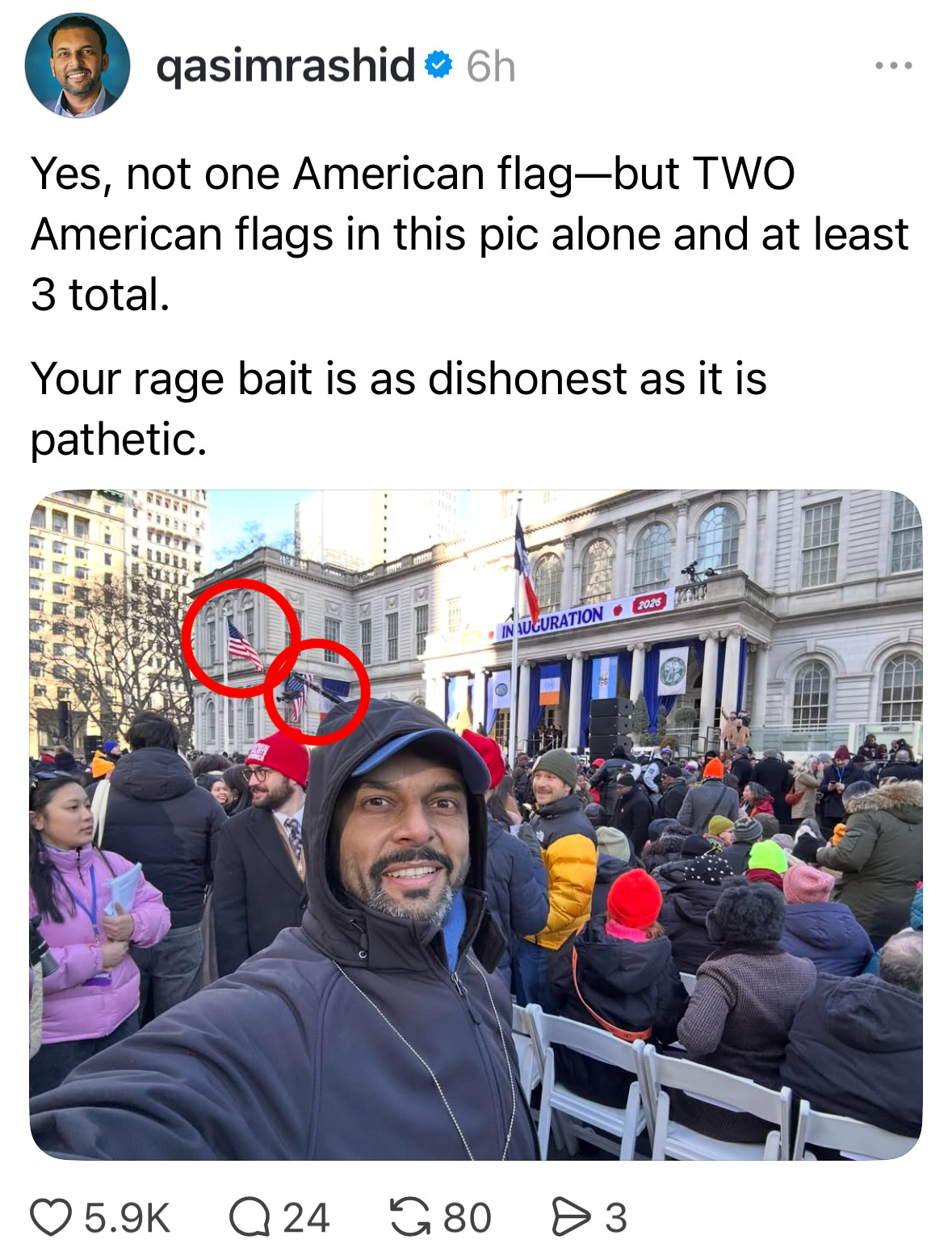
But the fact remains that this petty and arbitrary talking point of “no American flags” is going viral throughout right wing media, leading only to more hate, disinformation, and fear. They will paint Mayor Mamdani as anti-American, try to foster fear against him, and try to derail his affordability agenda. Do not let them use such petty culture wars to divide working people. Billionaires are waging an all out class war against us to maintain the status quo—a status quo that works only for them. We must resist.
This disinformation is a snapshot of what we will unfortunately see in the coming months, and why we must remain ready to push forward for justice and humanity. As James Baldwin reminds us, despair is not an option. Hopelessness is not an option. But taking action, is. Here’s what that looks like.
The Future
Let me start with four action items each of us can accomplish in January:
Get involved with your local city council, school board, and/or county board. Attend their meetings, speak at these meetings, and understand the local issues. And where you see injustice, call it out and make your voice heard.
Midterm elections are here, and primaries are in direct sight. Get behind candidates committed to justice, that reject corporate and SuperPAC money, and who have a track record of condemning horrors like genocide. Donate to their campaigns, volunteer for their election and re-election, and share their content on social media.
Run for office. If you cannot find the right candidate who is committed to justice, become the candidate committed to justice and lead by example. Young people, women, underrepresented communities — all of your voices are needed. Run.
Stay actively informed on the critical issues that impact us locally, nationally, and internationally. And on that, I hope you also invest in me to provide that insight.
Let’s Address This is my struggle to elevate marginalized voices, bring attention and insight to neglected issues, and demand accountability of those in power. Normally writers offer some discount or ‘new year sale’ to subscribe. While I don’t oppose that approach, I take a different path. I simply ensure my content is freely accessible to all readers, period. Whether you subscribe for free, or for $6/mo, $50/year, or as a Founding Member at $500—my advocacy is accessible to all because I don’t believe in paywalls for access.
So then why subscribe at all?
Well, subscribe because being informed matters, and the better informed we are on the injustices we face, the better the actions we can take to counter those injustices. Elizabeth Freeman became informed that Article 1 of the newly ratified Massachusetts State Constitution declared, “All men are born free and equal,” and used that as the foundation of her lawsuit—and in doing so both won her freedom and made history.
Subscribe because billionaires have bought media outlets to turn a clickbait profit, rather than to ensure Americans are informed on the things that matter. I’ve written about this dangerous capitulation of corporate bought media numerous times, and how it is simply unsustainable if we hope to uphold our democracy and human rights.
But finally, subscribe simply because you believe in me, in my struggle for human rights advocacy, and in the idea that we should invest in the people on the front lines of human rights issues working to uplift our society. I’m not funded by billionaires, and I’m not a billion dollar corporation. I’m a human rights lawyer doing everything in my power to uphold justice and build a better future for my children and yours.
In Closing
We have overcome insurmountable obstacles in the past—and we did so by banding together. We must do so again now. As Mayor Mamdani declared in his powerful inauguration remarks, “We will replace the frigidity of rugged individualism with the warmth of collectivism.” In other words, e pluribus unum, out of many, one.
We face major struggles in 2026. But just as our nation continues to fight to become a more perfect Union year in and year out, we too shall advance and overcome, even if it is one small but consequential step at a time. But only if we choose to.
So, in 2026, let us choose to. This year, may we successfully uphold justice in all we do, may we always protect the rights of the marginalized, and may we stand united with sincere good will towards our neighbors of every faith (or no faith), color, and nationality. Indeed, may we finally form that more perfect Union—together. Indeed, I close with the same remarks as Mayor Mamdani:
“The work continues, the work endures, the work, my friends, has only just begun.”
I am grateful for your continued love, prayers, and trust as we elevate our struggle for justice in 2026 and beyond. Thank you, and let’s act to make it a Happy New Year.
Sincerely,
Qasim Rashid, Esq.
Founder, Let’s Address This
January 1, 2026
This is such a beautiful piece, Qasim. Your hope, Mamdani's hope and determination shine through it.
Hearing both Jack Smith and Zohran Mamdani speak these past couple of days feels unbelievably refreshing, even cleansing.
Thanks for all you do for your children and ours.
May this be the beginning of a return to people who care about their constituentsWishing the new mayor all good ahead🙏🙏